01Pflichten mit have to
Have to drückt eine Pflicht aus; has to steht bei he/she/it, have to bei I/you/we/they.
He has to sign in.
Must, have to und should · A2. Have to drückt eine Pflicht aus; has to steht bei he/she/it, have to bei I/you/we/they.
Übe Must, have to und should in kurzen Situationen. Lies den Hinweis, wähle oder schreibe eine Form und prüfe die Begründung. Die Stufe dient der redaktionellen Orientierung.
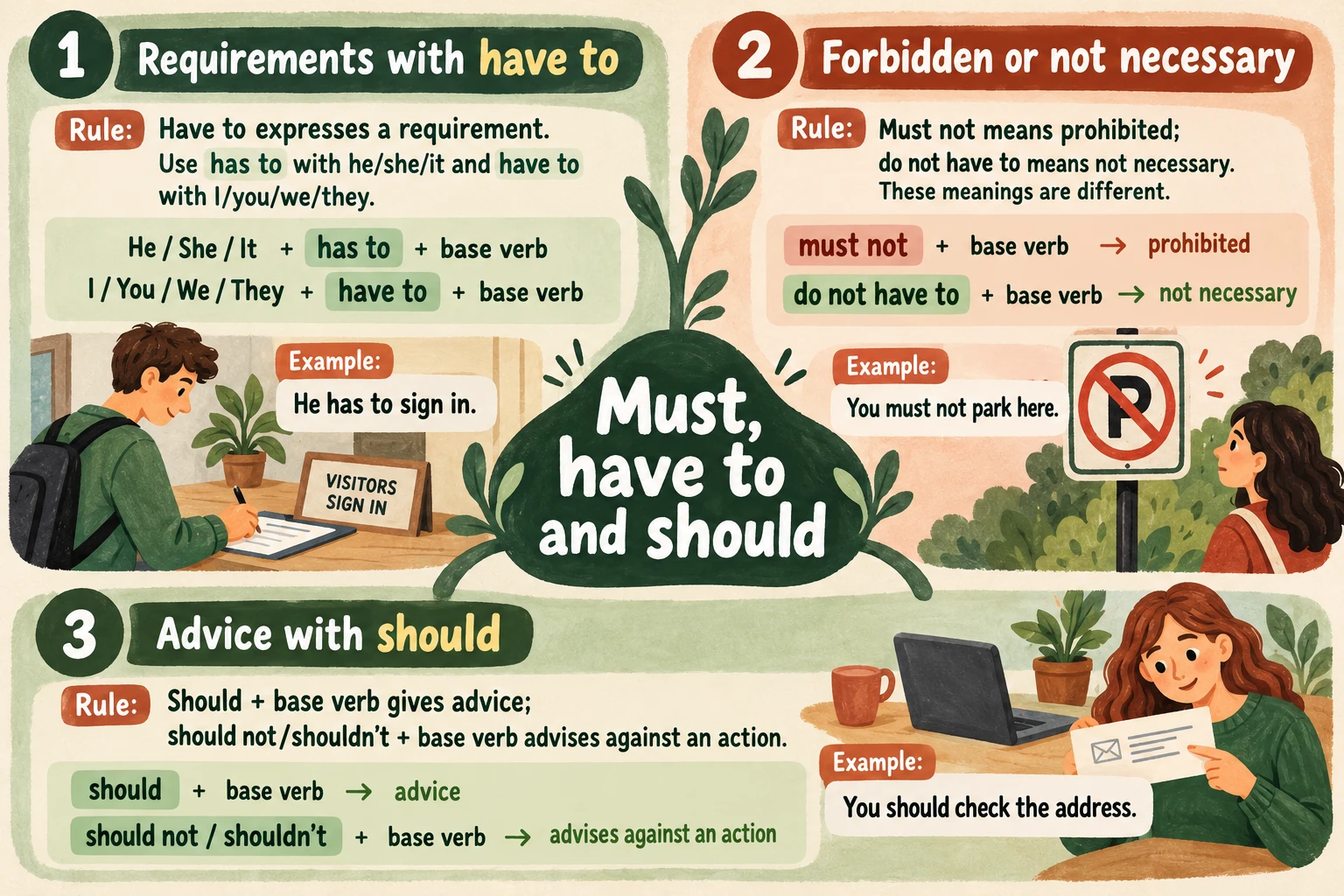
Have to drückt eine Pflicht aus; has to steht bei he/she/it, have to bei I/you/we/they.
He has to sign in.Must not bedeutet verboten; do not have to bedeutet nicht nötig. Diese Bedeutungen sind verschieden.
You must not park here.Should + Grundform gibt Rat; should not/shouldn’t + Grundform rät von einer Handlung ab.
You should check the address.
The rule says all staff have to wear badges. Nina ___ to wear one too.
Have to drückt eine Pflicht aus; has to steht bei he/she/it, have to bei I/you/we/they.
He has to sign in.Must not bedeutet verboten; do not have to bedeutet nicht nötig. Diese Bedeutungen sind verschieden.
You must not park here.Should + Grundform gibt Rat; should not/shouldn’t + Grundform rät von einer Handlung ab.
You should check the address.Bewahre den ersten Versuch. Verstehe die Änderung. Prüfe sie in einer neuen Situation.
Noch keine Lernnotizen. Starte mit einem kurzen Einstieg.
Have to drückt eine Pflicht aus; has to steht bei he/she/it, have to bei I/you/we/they.
He has to sign in.Must not bedeutet verboten; do not have to bedeutet nicht nötig. Diese Bedeutungen sind verschieden.
You must not park here.Should + Grundform gibt Rat; should not/shouldn’t + Grundform rät von einer Handlung ab.
You should check the address.Das Öffnen einer Antwort wird für diese Aufgabe als Hilfe erfasst.
The rule says all staff have to wear badges. Nina ___ to wear one too.
Achte auf „The rule says all staff have to wear badges. Nina ___ to wear one too.“. Have to drückt eine Pflicht aus; has to steht bei he/she/it, have to bei I/you/we/they. Vollständiger Satz: „The rule says all staff have to wear badges. Nina has to wear one too.“.
It is optional to bring lunch. You ___ bring it.
Achte auf „It is optional to bring lunch. You ___ bring it.“. Must not bedeutet verboten; do not have to bedeutet nicht nötig. Diese Bedeutungen sind verschieden. Vollständiger Satz: „It is optional to bring lunch. You do not have to bring it.“.
My advice is to rest. You should ___ a break. (take)
Achte auf „My advice is to rest. You should ___ a break. (take)“. Should + Grundform gibt Rat; should not/shouldn’t + Grundform rät von einer Handlung ab. Vollständiger Satz: „My advice is to rest. You should take a break. (take)“.
I ___ to show my ticket before entering. (have)
Vollständiger Beispielsatz: „I have to show my ticket before entering. (have)“. Have to drückt eine Pflicht aus; has to steht bei he/she/it, have to bei I/you/we/they.
The sign says entry is forbidden. You ___ enter.
Achte auf „The sign says entry is forbidden. You ___ enter.“. Must not bedeutet verboten; do not have to bedeutet nicht nötig. Diese Bedeutungen sind verschieden. Vollständiger Satz: „The sign says entry is forbidden. You must not enter.“.
For safety, you should not ___ while driving. (text)
Achte auf „For safety, you should not ___ while driving. (text)“. Should + Grundform gibt Rat; should not/shouldn’t + Grundform rät von einer Handlung ab. Vollständiger Satz: „For safety, you should not text while driving. (text)“.
Each player ___ to arrive by eight. (have)
Vollständiger Beispielsatz: „Each player has to arrive by eight. (have)“. Have to drückt eine Pflicht aus; has to steht bei he/she/it, have to bei I/you/we/they.
The children ___ to wait for a teacher. (have)
Achte auf „The children ___ to wait for a teacher. (have)“. Have to drückt eine Pflicht aus; has to steht bei he/she/it, have to bei I/you/we/they. Vollständiger Satz: „The children have to wait for a teacher. (have)“.
The museum is free today. You ___ pay.
Achte auf „The museum is free today. You ___ pay.“. Must not bedeutet verboten; do not have to bedeutet nicht nötig. Diese Bedeutungen sind verschieden. Vollständiger Satz: „The museum is free today. You do not have to pay.“.
If you want better sleep, you should ___ less coffee. (drink)
Vollständiger Beispielsatz: „If you want better sleep, you should drink less coffee. (drink)“. Should + Grundform gibt Rat; should not/shouldn’t + Grundform rät von einer Handlung ab.
Touching the cable is prohibited. You ___ touch it.
Achte auf „Touching the cable is prohibited. You ___ touch it.“. Must not bedeutet verboten; do not have to bedeutet nicht nötig. Diese Bedeutungen sind verschieden. Vollständiger Satz: „Touching the cable is prohibited. You must not touch it.“.
You look ill. You should ___ a doctor. (see)
Vollständiger Beispielsatz: „You look ill. You should see a doctor. (see)“. Should + Grundform gibt Rat; should not/shouldn’t + Grundform rät von einer Handlung ab.