01Have got and has got
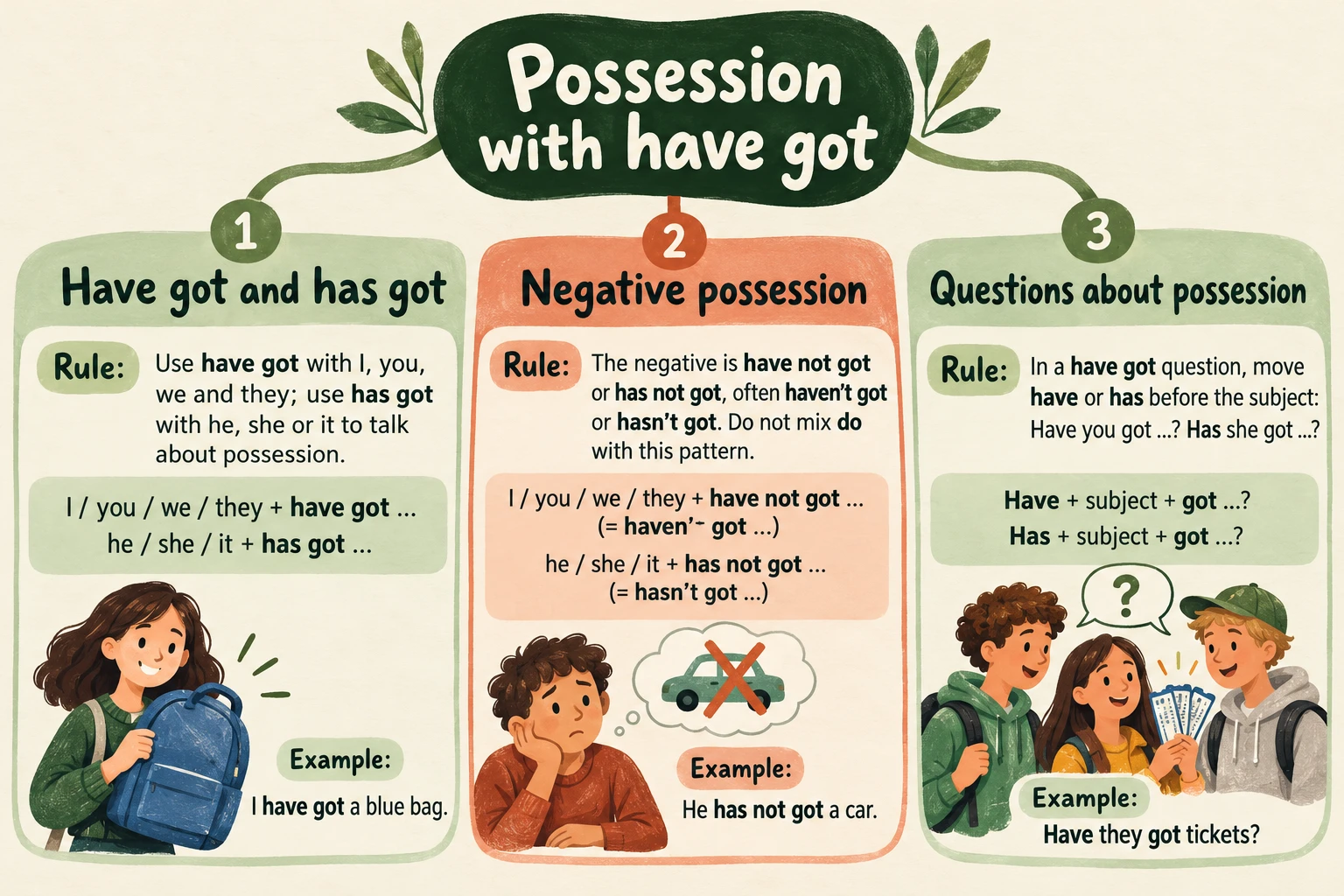
Use have got with I, you, we and they; use has got with he, she or it to talk about possession.
I have got a blue bag.
Possession with have got · A1. Use have got with I, you, we and they; use has got with he, she or it to talk about possession.
Practise Possession with have got in short situations. Read the clue, choose or write a form, then check the reason. The level is an editorial guide.
Use have got with I, you, we and they; use has got with he, she or it to talk about possession.
I have got a blue bag.The negative is have not got or has not got, often haven’t got or hasn’t got. Do not mix do with this pattern.
He has not got a car.In a have got question, move have or has before the subject: Have you got ...? Has she got ...?
Have they got tickets?
Nora ___ got a red bicycle.
Use have got with I, you, we and they; use has got with he, she or it to talk about possession.
I have got a blue bag.The negative is have not got or has not got, often haven’t got or hasn’t got. Do not mix do with this pattern.
He has not got a car.In a have got question, move have or has before the subject: Have you got ...? Has she got ...?
Have they got tickets?Keep the first try. Understand the change. Check it in a fresh situation.
No practice notes yet. Try a short warm-up.
Use have got with I, you, we and they; use has got with he, she or it to talk about possession.
I have got a blue bag.The negative is have not got or has not got, often haven’t got or hasn’t got. Do not mix do with this pattern.
He has not got a car.In a have got question, move have or has before the subject: Have you got ...? Has she got ...?
Have they got tickets?Opening an answer records help for that question.
Nora ___ got a red bicycle.
Look at “Nora ___ got a red bicycle.”. Use have got with I, you, we and they; use has got with he, she or it to talk about possession. Complete sentence: “Nora has got a red bicycle.”.
I need a pen; I ___ got one.
Look at “I need a pen; I ___ got one.”. The negative is have not got or has not got, often haven’t got or hasn’t got. Do not mix do with this pattern. Complete sentence: “I need a pen; I have not got one.”.
___ you got an appointment today?
Look at “___ you got an appointment today?”. In a have got question, move have or has before the subject: Have you got ...? Has she got ...? Complete sentence: “Have you got an appointment today?”.
We ___ got a small balcony.
Reference completion: “We have got a small balcony.”. Use have got with I, you, we and they; use has got with he, she or it to talk about possession. The missing form may also be ’ve: it attaches directly to We to make We’ve got. It is a contraction of have in this sentence, not a separate word or a form of be.
The printer is out of ink. It ___ got any ink.
Look at “The printer is out of ink. It ___ got any ink.”. The negative is have not got or has not got, often haven’t got or hasn’t got. Do not mix do with this pattern. Complete sentence: “The printer is out of ink. It has not got any ink.”.
___ your brother got a driving licence?
Look at “___ your brother got a driving licence?”. In a have got question, move have or has before the subject: Have you got ...? Has she got ...? Complete sentence: “Has your brother got a driving licence?”.
My grandparents ___ got a garden.
Reference completion: “My grandparents have got a garden.”. Use have got with I, you, we and they; use has got with he, she or it to talk about possession.
This room ___ got two windows.
Look at “This room ___ got two windows.”. Use have got with I, you, we and they; use has got with he, she or it to talk about possession. Complete sentence: “This room has got two windows.”.
Our bags are empty. We ___ got any snacks.
Look at “Our bags are empty. We ___ got any snacks.”. The negative is have not got or has not got, often haven’t got or hasn’t got. Do not mix do with this pattern. Complete sentence: “Our bags are empty. We have not got any snacks.”.
___ this phone got a camera?
Reference completion: “Has this phone got a camera?”. In a have got question, move have or has before the subject: Have you got ...? Has she got ...?
They ___ got a map, so they cannot find the path.
Look at “They ___ got a map, so they cannot find the path.”. The negative is have not got or has not got, often haven’t got or hasn’t got. Do not mix do with this pattern. Complete sentence: “They have not got a map, so they cannot find the path.”.
___ your neighbours got a dog?
Reference completion: “Have your neighbours got a dog?”. In a have got question, move have or has before the subject: Have you got ...? Has she got ...?