01Have got und has got
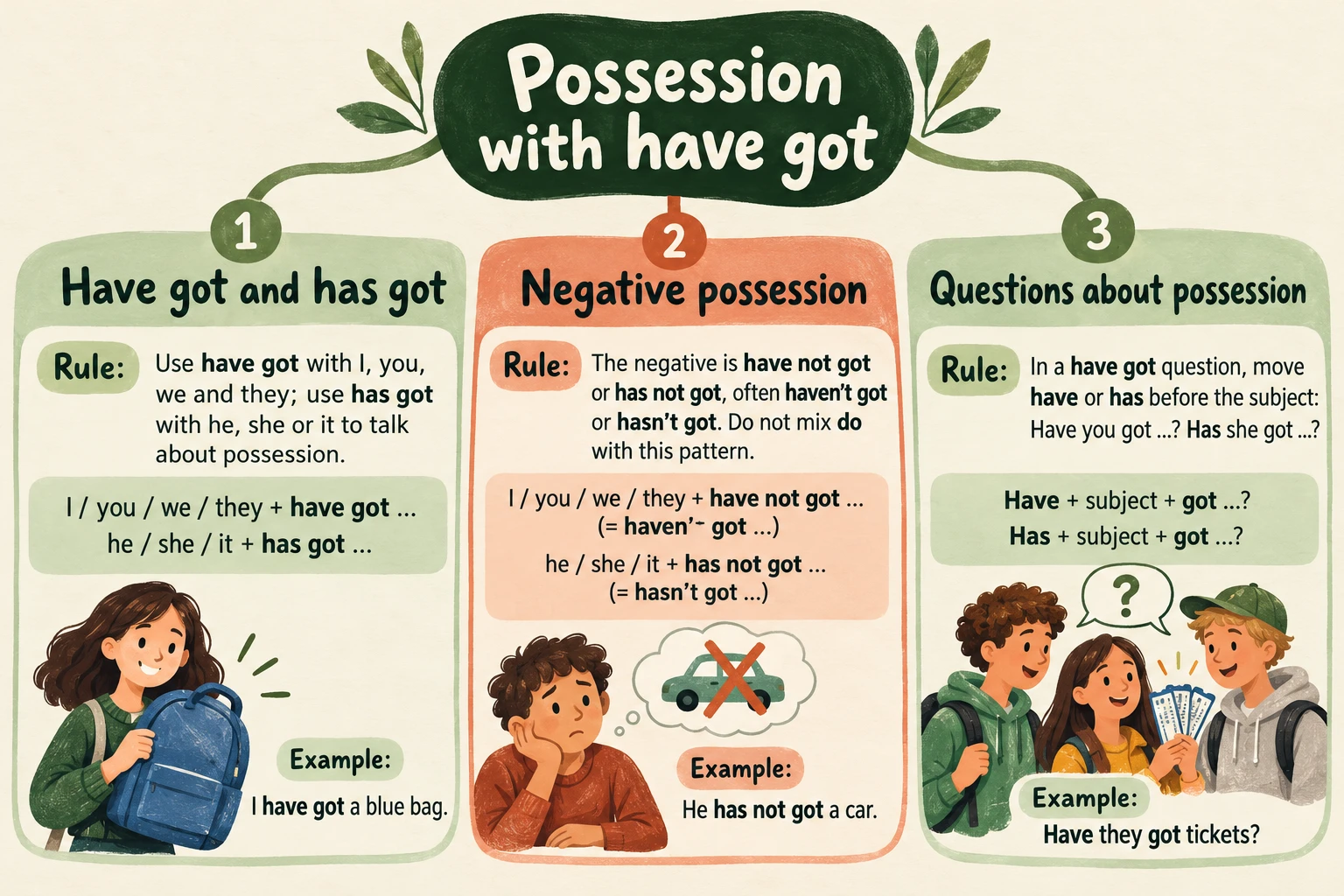
Für Besitz steht have got mit I, you, we, they und has got mit he, she, it.
I have got a blue bag.
Besitz mit have got · A1. Für Besitz steht have got mit I, you, we, they und has got mit he, she, it.
Übe Besitz mit have got in kurzen Situationen. Lies den Hinweis, wähle oder schreibe eine Form und prüfe die Begründung. Die Stufe dient der redaktionellen Orientierung.
Für Besitz steht have got mit I, you, we, they und has got mit he, she, it.
I have got a blue bag.Die Verneinung lautet have not got oder has not got, oft haven’t got oder hasn’t got. Mische kein do in dieses Muster.
He has not got a car.Bei Fragen rückt have oder has vor das Subjekt: Have you got ...? Has she got ...?
Have they got tickets?
Nora ___ got a red bicycle.
Für Besitz steht have got mit I, you, we, they und has got mit he, she, it.
I have got a blue bag.Die Verneinung lautet have not got oder has not got, oft haven’t got oder hasn’t got. Mische kein do in dieses Muster.
He has not got a car.Bei Fragen rückt have oder has vor das Subjekt: Have you got ...? Has she got ...?
Have they got tickets?Bewahre den ersten Versuch. Verstehe die Änderung. Prüfe sie in einer neuen Situation.
Noch keine Lernnotizen. Starte mit einem kurzen Einstieg.
Für Besitz steht have got mit I, you, we, they und has got mit he, she, it.
I have got a blue bag.Die Verneinung lautet have not got oder has not got, oft haven’t got oder hasn’t got. Mische kein do in dieses Muster.
He has not got a car.Bei Fragen rückt have oder has vor das Subjekt: Have you got ...? Has she got ...?
Have they got tickets?Das Öffnen einer Antwort wird für diese Aufgabe als Hilfe erfasst.
Nora ___ got a red bicycle.
Achte auf „Nora ___ got a red bicycle.“. Für Besitz steht have got mit I, you, we, they und has got mit he, she, it. Vollständiger Satz: „Nora has got a red bicycle.“.
I need a pen; I ___ got one.
Achte auf „I need a pen; I ___ got one.“. Die Verneinung lautet have not got oder has not got, oft haven’t got oder hasn’t got. Mische kein do in dieses Muster. Vollständiger Satz: „I need a pen; I have not got one.“.
___ you got an appointment today?
Achte auf „___ you got an appointment today?“. Bei Fragen rückt have oder has vor das Subjekt: Have you got ...? Has she got ...? Vollständiger Satz: „Have you got an appointment today?“.
We ___ got a small balcony.
Vollständiger Beispielsatz: „We have got a small balcony.“. Für Besitz steht have got mit I, you, we, they und has got mit he, she, it. Die Lücke kann auch ’ve enthalten: direkt an We angefügt ergibt das We’ve got. Hier ist es die Kurzform von have, kein eigenes Wort und keine Form von be.
The printer is out of ink. It ___ got any ink.
Achte auf „The printer is out of ink. It ___ got any ink.“. Die Verneinung lautet have not got oder has not got, oft haven’t got oder hasn’t got. Mische kein do in dieses Muster. Vollständiger Satz: „The printer is out of ink. It has not got any ink.“.
___ your brother got a driving licence?
Achte auf „___ your brother got a driving licence?“. Bei Fragen rückt have oder has vor das Subjekt: Have you got ...? Has she got ...? Vollständiger Satz: „Has your brother got a driving licence?“.
My grandparents ___ got a garden.
Vollständiger Beispielsatz: „My grandparents have got a garden.“. Für Besitz steht have got mit I, you, we, they und has got mit he, she, it.
This room ___ got two windows.
Achte auf „This room ___ got two windows.“. Für Besitz steht have got mit I, you, we, they und has got mit he, she, it. Vollständiger Satz: „This room has got two windows.“.
Our bags are empty. We ___ got any snacks.
Achte auf „Our bags are empty. We ___ got any snacks.“. Die Verneinung lautet have not got oder has not got, oft haven’t got oder hasn’t got. Mische kein do in dieses Muster. Vollständiger Satz: „Our bags are empty. We have not got any snacks.“.
___ this phone got a camera?
Vollständiger Beispielsatz: „Has this phone got a camera?“. Bei Fragen rückt have oder has vor das Subjekt: Have you got ...? Has she got ...?
They ___ got a map, so they cannot find the path.
Achte auf „They ___ got a map, so they cannot find the path.“. Die Verneinung lautet have not got oder has not got, oft haven’t got oder hasn’t got. Mische kein do in dieses Muster. Vollständiger Satz: „They have not got a map, so they cannot find the path.“.
___ your neighbours got a dog?
Vollständiger Beispielsatz: „Have your neighbours got a dog?“. Bei Fragen rückt have oder has vor das Subjekt: Have you got ...? Has she got ...?