01Have got et has got
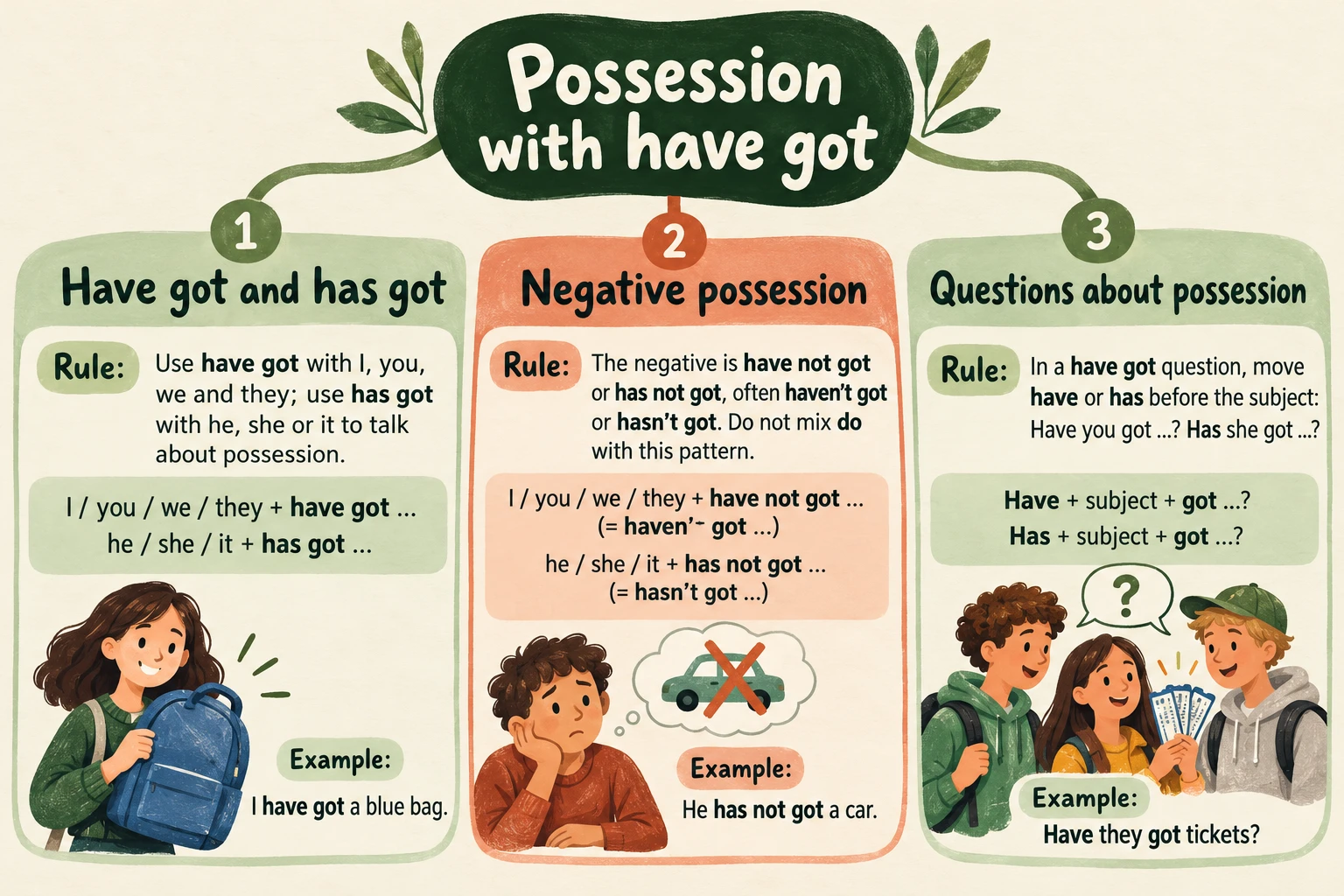
Pour exprimer la possession, utilise have got avec I, you, we, they et has got avec he, she, it.
I have got a blue bag.
Possession avec have got · A1. Pour exprimer la possession, utilise have got avec I, you, we, they et has got avec he, she, it.
Travaille Possession avec have got dans de courtes situations. Lis l’indice, choisis ou écris une forme, puis vérifie l’explication. Le niveau est une indication éditoriale.
Pour exprimer la possession, utilise have got avec I, you, we, they et has got avec he, she, it.
I have got a blue bag.La négation est have not got ou has not got, souvent haven’t got ou hasn’t got. N’ajoute pas do à cette structure.
He has not got a car.Dans une question, place have ou has avant le sujet : Have you got ...? Has she got ...?
Have they got tickets?
Nora ___ got a red bicycle.
Pour exprimer la possession, utilise have got avec I, you, we, they et has got avec he, she, it.
I have got a blue bag.La négation est have not got ou has not got, souvent haven’t got ou hasn’t got. N’ajoute pas do à cette structure.
He has not got a car.Dans une question, place have ou has avant le sujet : Have you got ...? Has she got ...?
Have they got tickets?Gardez la première tentative, comprenez le changement et essayez dans une nouvelle situation.
Pas encore de notes. Essayez un court échauffement.
Pour exprimer la possession, utilise have got avec I, you, we, they et has got avec he, she, it.
I have got a blue bag.La négation est have not got ou has not got, souvent haven’t got ou hasn’t got. N’ajoute pas do à cette structure.
He has not got a car.Dans une question, place have ou has avant le sujet : Have you got ...? Has she got ...?
Have they got tickets?Ouvrir une réponse enregistre une aide pour cette question.
Nora ___ got a red bicycle.
Observe « Nora ___ got a red bicycle. ». Pour exprimer la possession, utilise have got avec I, you, we, they et has got avec he, she, it. Phrase complète : « Nora has got a red bicycle. ».
I need a pen; I ___ got one.
Observe « I need a pen; I ___ got one. ». La négation est have not got ou has not got, souvent haven’t got ou hasn’t got. N’ajoute pas do à cette structure. Phrase complète : « I need a pen; I have not got one. ».
___ you got an appointment today?
Observe « ___ you got an appointment today? ». Dans une question, place have ou has avant le sujet : Have you got ...? Has she got ...? Phrase complète : « Have you got an appointment today? ».
We ___ got a small balcony.
Phrase de référence : « We have got a small balcony. ». Pour exprimer la possession, utilise have got avec I, you, we, they et has got avec he, she, it. La forme ’ve convient aussi : elle s’attache directement à We pour former We’ve got. Elle abrège have ici ; ce n’est ni un mot séparé ni une forme de be.
The printer is out of ink. It ___ got any ink.
Observe « The printer is out of ink. It ___ got any ink. ». La négation est have not got ou has not got, souvent haven’t got ou hasn’t got. N’ajoute pas do à cette structure. Phrase complète : « The printer is out of ink. It has not got any ink. ».
___ your brother got a driving licence?
Observe « ___ your brother got a driving licence? ». Dans une question, place have ou has avant le sujet : Have you got ...? Has she got ...? Phrase complète : « Has your brother got a driving licence? ».
My grandparents ___ got a garden.
Phrase de référence : « My grandparents have got a garden. ». Pour exprimer la possession, utilise have got avec I, you, we, they et has got avec he, she, it.
This room ___ got two windows.
Observe « This room ___ got two windows. ». Pour exprimer la possession, utilise have got avec I, you, we, they et has got avec he, she, it. Phrase complète : « This room has got two windows. ».
Our bags are empty. We ___ got any snacks.
Observe « Our bags are empty. We ___ got any snacks. ». La négation est have not got ou has not got, souvent haven’t got ou hasn’t got. N’ajoute pas do à cette structure. Phrase complète : « Our bags are empty. We have not got any snacks. ».
___ this phone got a camera?
Phrase de référence : « Has this phone got a camera? ». Dans une question, place have ou has avant le sujet : Have you got ...? Has she got ...?
They ___ got a map, so they cannot find the path.
Observe « They ___ got a map, so they cannot find the path. ». La négation est have not got ou has not got, souvent haven’t got ou hasn’t got. N’ajoute pas do à cette structure. Phrase complète : « They have not got a map, so they cannot find the path. ».
___ your neighbours got a dog?
Phrase de référence : « Have your neighbours got a dog? ». Dans une question, place have ou has avant le sujet : Have you got ...? Has she got ...?