01Have got y has got
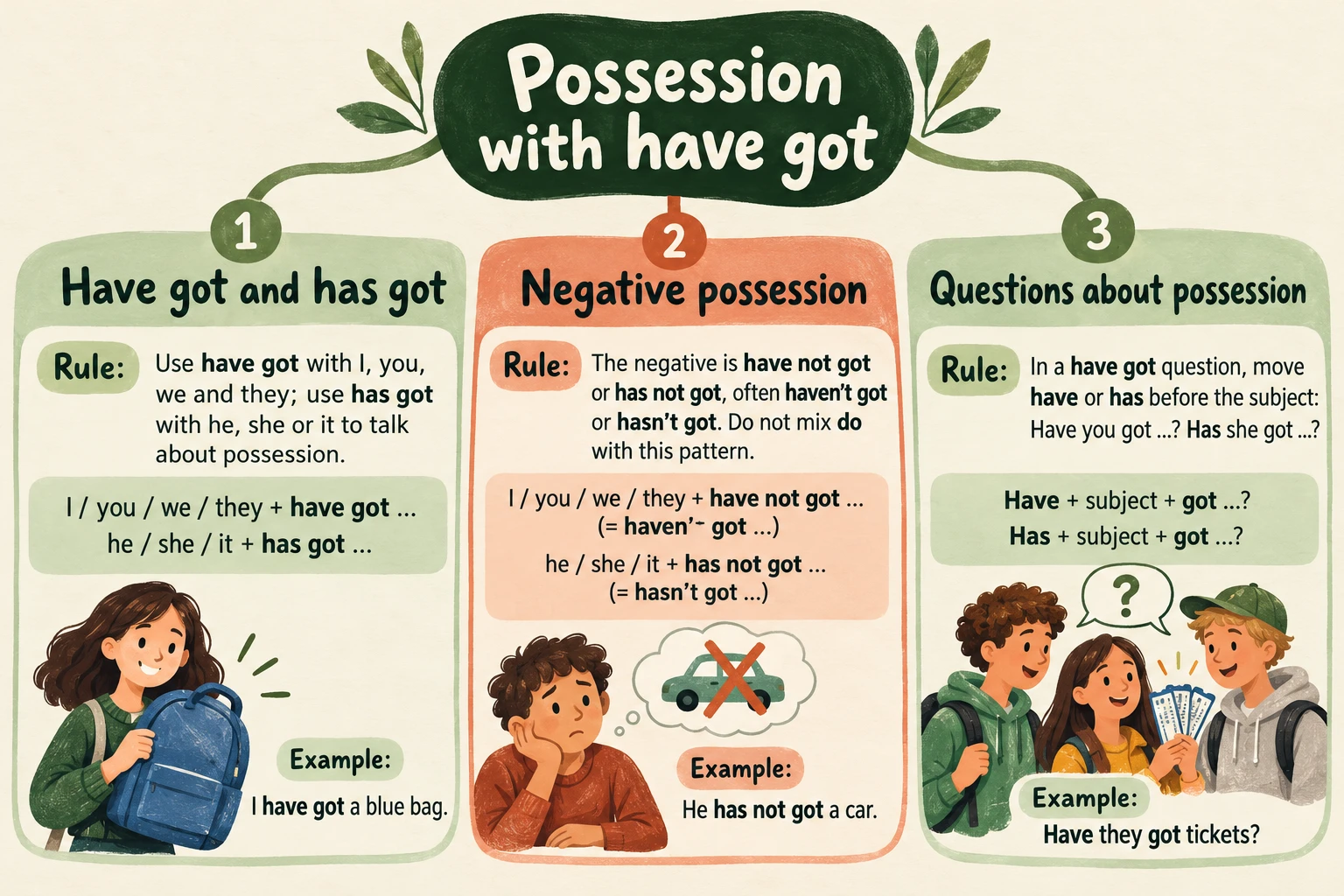
Para expresar posesión usa have got con I, you, we y they; has got con he, she e it.
I have got a blue bag.
Posesión con have got · A1. Para expresar posesión usa have got con I, you, we y they; has got con he, she e it.
Practica Posesión con have got en situaciones breves. Lee la pista, elige o escribe una forma y revisa la explicación. El nivel es una orientación editorial.
Para expresar posesión usa have got con I, you, we y they; has got con he, she e it.
I have got a blue bag.La negativa es have not got o has not got, a menudo haven’t got o hasn’t got. No mezcles do con esta estructura.
He has not got a car.En preguntas, have o has va antes del sujeto: Have you got ...? Has she got ...?
Have they got tickets?
Nora ___ got a red bicycle.
Para expresar posesión usa have got con I, you, we y they; has got con he, she e it.
I have got a blue bag.La negativa es have not got o has not got, a menudo haven’t got o hasn’t got. No mezcles do con esta estructura.
He has not got a car.En preguntas, have o has va antes del sujeto: Have you got ...? Has she got ...?
Have they got tickets?Conserva el primer intento, entiende el cambio y compruébalo en otra situación.
Aún no hay repasos. Prueba un calentamiento corto.
Para expresar posesión usa have got con I, you, we y they; has got con he, she e it.
I have got a blue bag.La negativa es have not got o has not got, a menudo haven’t got o hasn’t got. No mezcles do con esta estructura.
He has not got a car.En preguntas, have o has va antes del sujeto: Have you got ...? Has she got ...?
Have they got tickets?Abrir una respuesta registra ayuda para esa pregunta.
Nora ___ got a red bicycle.
Mira «Nora ___ got a red bicycle.». Para expresar posesión usa have got con I, you, we y they; has got con he, she e it. Oración completa: «Nora has got a red bicycle.».
I need a pen; I ___ got one.
Mira «I need a pen; I ___ got one.». La negativa es have not got o has not got, a menudo haven’t got o hasn’t got. No mezcles do con esta estructura. Oración completa: «I need a pen; I have not got one.».
___ you got an appointment today?
Mira «___ you got an appointment today?». En preguntas, have o has va antes del sujeto: Have you got ...? Has she got ...? Oración completa: «Have you got an appointment today?».
We ___ got a small balcony.
Oración de referencia: «We have got a small balcony.». Para expresar posesión usa have got con I, you, we y they; has got con he, she e it. También se admite ’ve en el hueco: se une directamente a We para formar We’ve got. Aquí contrae have; no es una palabra independiente ni una forma de be.
The printer is out of ink. It ___ got any ink.
Mira «The printer is out of ink. It ___ got any ink.». La negativa es have not got o has not got, a menudo haven’t got o hasn’t got. No mezcles do con esta estructura. Oración completa: «The printer is out of ink. It has not got any ink.».
___ your brother got a driving licence?
Mira «___ your brother got a driving licence?». En preguntas, have o has va antes del sujeto: Have you got ...? Has she got ...? Oración completa: «Has your brother got a driving licence?».
My grandparents ___ got a garden.
Oración de referencia: «My grandparents have got a garden.». Para expresar posesión usa have got con I, you, we y they; has got con he, she e it.
This room ___ got two windows.
Mira «This room ___ got two windows.». Para expresar posesión usa have got con I, you, we y they; has got con he, she e it. Oración completa: «This room has got two windows.».
Our bags are empty. We ___ got any snacks.
Mira «Our bags are empty. We ___ got any snacks.». La negativa es have not got o has not got, a menudo haven’t got o hasn’t got. No mezcles do con esta estructura. Oración completa: «Our bags are empty. We have not got any snacks.».
___ this phone got a camera?
Oración de referencia: «Has this phone got a camera?». En preguntas, have o has va antes del sujeto: Have you got ...? Has she got ...?
They ___ got a map, so they cannot find the path.
Mira «They ___ got a map, so they cannot find the path.». La negativa es have not got o has not got, a menudo haven’t got o hasn’t got. No mezcles do con esta estructura. Oración completa: «They have not got a map, so they cannot find the path.».
___ your neighbours got a dog?
Oración de referencia: «Have your neighbours got a dog?». En preguntas, have o has va antes del sujeto: Have you got ...? Has she got ...?