01Have got e has got
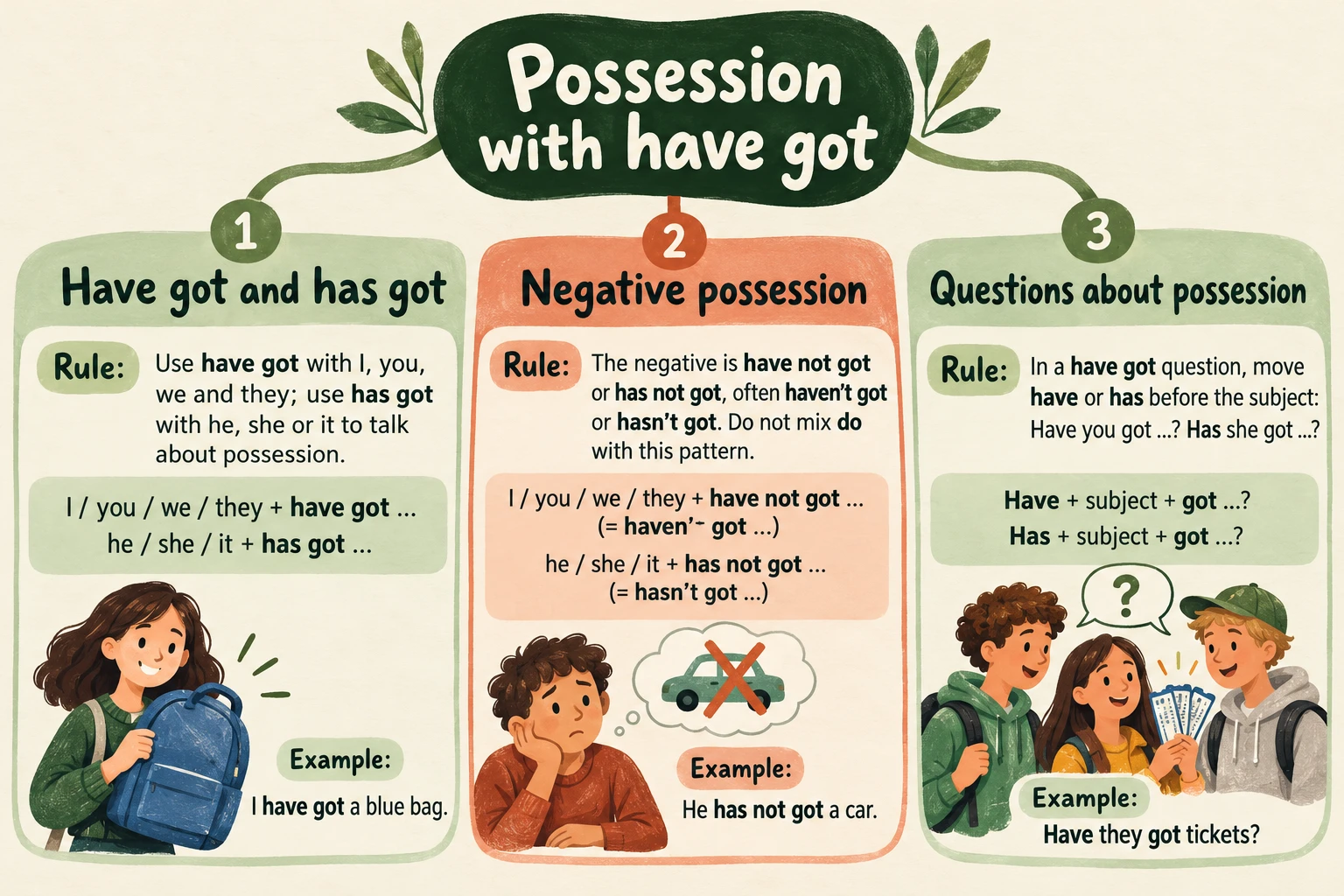
Para posse, use have got com I, you, we e they; has got com he, she e it.
I have got a blue bag.
Posse com have got · A1. Para posse, use have got com I, you, we e they; has got com he, she e it.
Pratique Posse com have got em situações curtas. Leia a pista, escolha ou escreva uma forma e confira a explicação. O nível é uma orientação editorial.
Para posse, use have got com I, you, we e they; has got com he, she e it.
I have got a blue bag.A negativa é have not got ou has not got, geralmente haven’t got ou hasn’t got. Não misture do nessa estrutura.
He has not got a car.Nas perguntas, have ou has vem antes do sujeito: Have you got ...? Has she got ...?
Have they got tickets?
Nora ___ got a red bicycle.
Para posse, use have got com I, you, we e they; has got com he, she e it.
I have got a blue bag.A negativa é have not got ou has not got, geralmente haven’t got ou hasn’t got. Não misture do nessa estrutura.
He has not got a car.Nas perguntas, have ou has vem antes do sujeito: Have you got ...? Has she got ...?
Have they got tickets?Guarde a primeira tentativa, entenda a mudança e confira em outra situação.
Ainda não há revisões. Faça um aquecimento curto.
Para posse, use have got com I, you, we e they; has got com he, she e it.
I have got a blue bag.A negativa é have not got ou has not got, geralmente haven’t got ou hasn’t got. Não misture do nessa estrutura.
He has not got a car.Nas perguntas, have ou has vem antes do sujeito: Have you got ...? Has she got ...?
Have they got tickets?Abrir uma resposta registra ajuda para essa questão.
Nora ___ got a red bicycle.
Observe “Nora ___ got a red bicycle.”. Para posse, use have got com I, you, we e they; has got com he, she e it. Frase completa: “Nora has got a red bicycle.”.
I need a pen; I ___ got one.
Observe “I need a pen; I ___ got one.”. A negativa é have not got ou has not got, geralmente haven’t got ou hasn’t got. Não misture do nessa estrutura. Frase completa: “I need a pen; I have not got one.”.
___ you got an appointment today?
Observe “___ you got an appointment today?”. Nas perguntas, have ou has vem antes do sujeito: Have you got ...? Has she got ...? Frase completa: “Have you got an appointment today?”.
We ___ got a small balcony.
Frase de referência: “We have got a small balcony.”. Para posse, use have got com I, you, we e they; has got com he, she e it. A lacuna também aceita ’ve: a forma se liga diretamente a We em We’ve got. Aqui é contração de have, não uma palavra separada nem uma forma de be.
The printer is out of ink. It ___ got any ink.
Observe “The printer is out of ink. It ___ got any ink.”. A negativa é have not got ou has not got, geralmente haven’t got ou hasn’t got. Não misture do nessa estrutura. Frase completa: “The printer is out of ink. It has not got any ink.”.
___ your brother got a driving licence?
Observe “___ your brother got a driving licence?”. Nas perguntas, have ou has vem antes do sujeito: Have you got ...? Has she got ...? Frase completa: “Has your brother got a driving licence?”.
My grandparents ___ got a garden.
Frase de referência: “My grandparents have got a garden.”. Para posse, use have got com I, you, we e they; has got com he, she e it.
This room ___ got two windows.
Observe “This room ___ got two windows.”. Para posse, use have got com I, you, we e they; has got com he, she e it. Frase completa: “This room has got two windows.”.
Our bags are empty. We ___ got any snacks.
Observe “Our bags are empty. We ___ got any snacks.”. A negativa é have not got ou has not got, geralmente haven’t got ou hasn’t got. Não misture do nessa estrutura. Frase completa: “Our bags are empty. We have not got any snacks.”.
___ this phone got a camera?
Frase de referência: “Has this phone got a camera?”. Nas perguntas, have ou has vem antes do sujeito: Have you got ...? Has she got ...?
They ___ got a map, so they cannot find the path.
Observe “They ___ got a map, so they cannot find the path.”. A negativa é have not got ou has not got, geralmente haven’t got ou hasn’t got. Não misture do nessa estrutura. Frase completa: “They have not got a map, so they cannot find the path.”.
___ your neighbours got a dog?
Frase de referência: “Have your neighbours got a dog?”. Nas perguntas, have ou has vem antes do sujeito: Have you got ...? Has she got ...?