
A2-B1

First Conditional Exercises

About this lesson

First conditional · A2. For an ordinary possible future condition, use if + present simple; a predicted result often uses will + base verb. Keep subject agreement and negative forms. This introductory pattern does not ban will from every if-clause: willingness and other meanings need separate treatment.

Explore possible future situations with if and unless, then choose the result that fits.

12 items
Save it to find it in My collection.
Knowledge map

First conditional

Start practising
First conditional — Knowledge map

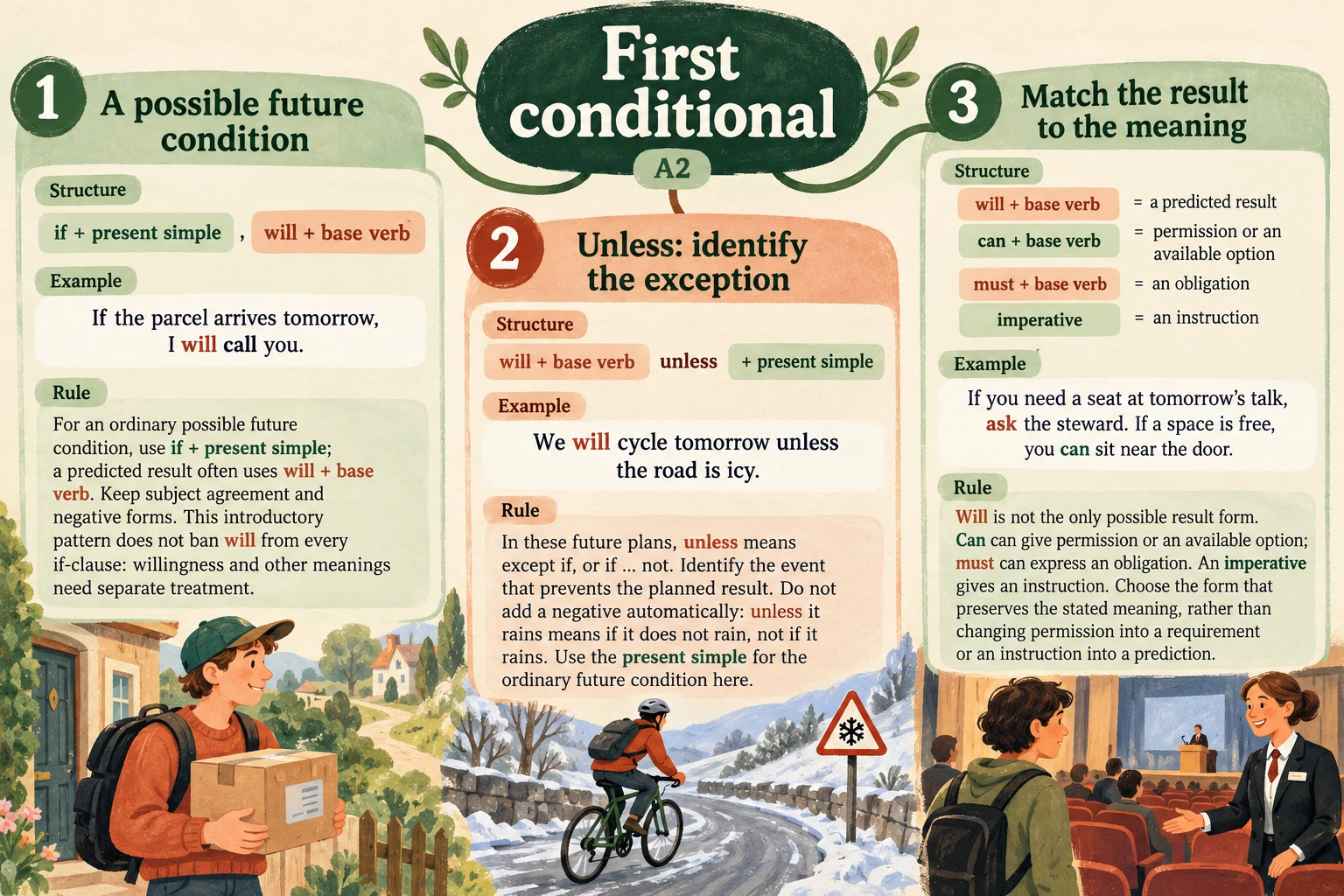
01A possible future condition

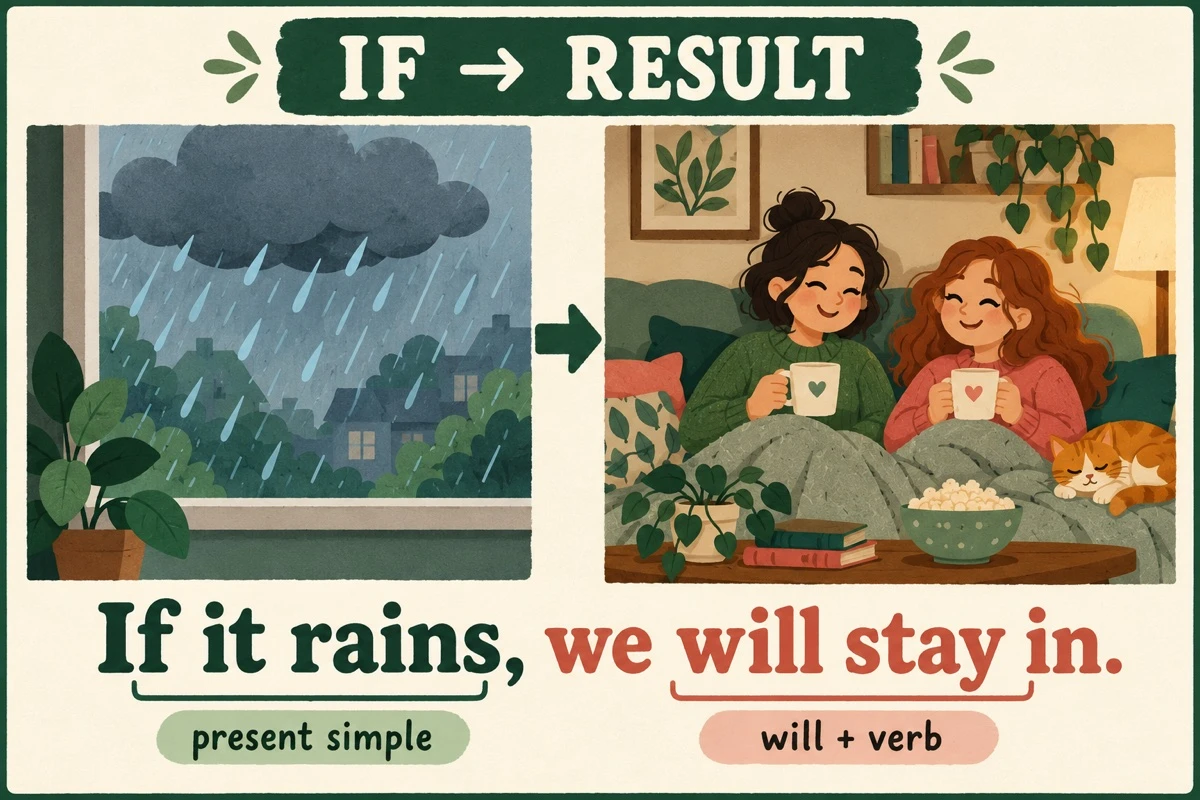
For an ordinary possible future condition, use if + present simple; a predicted result often uses will + base verb. Keep subject agreement and negative forms. This introductory pattern does not ban will from every if-clause: willingness and other meanings need separate treatment.

If + present simple, will + base verb
02Unless: identify the exception

In these future plans, unless means except if, or if ... not. Identify the event that prevents the planned result. Do not add a negative automatically: unless it rains means if it does not rain, not if it rains. Use the present simple for the ordinary future condition here.

unless = except if

03Match the result to the meaning

Will is not the only possible result form. Can can give permission or an available option; must can express an obligation. An imperative gives an instruction. Choose the form that preserves the stated meaning, rather than changing permission into a requirement or an instruction into a prediction.

If you need help, ask. · If it is free, you can sit here.

Illustrated guide

0/12
Questions
01 / 12D01Save it to find it in My collection.

Mina may finish her work early tomorrow. If that happens, she plans to join us. Choose an ordinary possible-future prediction.

Choose the sentence that matches the plan.

Your answer
1 / 12

Your learning route

01
Step 1 · Warm-up

Warm-up

0/3
02
Step 2 · Build the skill

A possible future condition

0/2

For an ordinary possible future condition, use if + present simple; a predicted result often uses will + base verb. Keep subject agreement and negative forms. This introductory pattern does not ban will from every if-clause: willingness and other meanings need separate treatment.

If the parcel arrives tomorrow, I will call you.
03
Step 3 · Build the skill

Unless: identify the exception

0/1

In these future plans, unless means except if, or if ... not. Identify the event that prevents the planned result. Do not add a negative automatically: unless it rains means if it does not rain, not if it rains. Use the present simple for the ordinary future condition here.

We will cycle tomorrow unless the road is icy.
04
Step 4 · Build the skill

Match the result to the meaning

0/1

Will is not the only possible result form. Can can give permission or an available option; must can express an obligation. An imperative gives an instruction. Choose the form that preserves the stated meaning, rather than changing permission into a requirement or an instruction into a prediction.

If you need a seat at tomorrow’s talk, ask the steward. If a space is free, you can sit near the door.
05
Step 5 · New contexts

New contexts

0/3
06
Step 6 · A fresh challenge

A fresh challenge

0/2
Practice notes in this unit

Make mistakes useful.

Keep the first try. Understand the change. Check it in a fresh situation.

0

No practice notes yet. Try a short warm-up.

Lesson map

First conditional

A2
First conditional

Lesson points

01

A possible future condition

For an ordinary possible future condition, use if + present simple; a predicted result often uses will + base verb. Keep subject agreement and negative forms. This introductory pattern does not ban will from every if-clause: willingness and other meanings need separate treatment.

If the parcel arrives tomorrow, I will call you.
02

Unless: identify the exception

In these future plans, unless means except if, or if ... not. Identify the event that prevents the planned result. Do not add a negative automatically: unless it rains means if it does not rain, not if it rains. Use the present simple for the ordinary future condition here.

We will cycle tomorrow unless the road is icy.
03

Match the result to the meaning

Will is not the only possible result form. Can can give permission or an available option; must can express an obligation. An imperative gives an instruction. Choose the form that preserves the stated meaning, rather than changing permission into a requirement or an instruction into a prediction.

If you need a seat at tomorrow’s talk, ask the steward. If a space is free, you can sit near the door.

Questions & answers

Opening an answer records help for that question.

D01 · Warm-up

Mina may finish her work early tomorrow. If that happens, she plans to join us. Choose an ordinary possible-future prediction.

Choose the sentence that matches the plan.

  1. If Mina finishes early tomorrow, she will join us.
  2. If Mina finishes early tomorrow, she will joins us.
  3. If Mina finish early tomorrow, she will join us.
Answer & explanation
If Mina finishes early tomorrow, she will join us.

Look at “Mina may finish her work early tomorrow. If that happens, she plans to join us. Choose an ordinary possible-future prediction.”. For an ordinary possible future condition, use if + present simple; a predicted result often uses will + base verb. Keep subject agreement and negative forms. This introductory pattern does not ban will from every if-clause: willingness and other meanings need separate treatment. Complete sentence: “If Mina finishes early tomorrow, she will join us.”.

D02 · Warm-up

We plan to walk beside the river tomorrow. Flooding is the one event that would cancel the walk.

Choose the sentence that preserves this plan.

  1. We will walk beside the river tomorrow unless the path does not flood.
  2. We will walk beside the river tomorrow if the path floods.
  3. We will walk beside the river tomorrow unless the path floods.
Answer & explanation
We will walk beside the river tomorrow unless the path floods.

Look at “We plan to walk beside the river tomorrow. Flooding is the one event that would cancel the walk.”. In these future plans, unless means except if, or if ... not. Identify the event that prevents the planned result. Do not add a negative automatically: unless it rains means if it does not rain, not if it rains. Use the present simple for the ordinary future condition here. Complete sentence: “We will walk beside the river tomorrow unless the path floods.”.

D03 · Warm-up

For tomorrow’s video call, the manager gives you permission to use a spare tablet if your laptop stops working. Using it is optional.

Choose the sentence that gives permission.

  1. If your laptop stops working tomorrow, you can uses the spare tablet.
  2. If your laptop stops working tomorrow, you must use the spare tablet.
  3. If your laptop stops working tomorrow, you can use the spare tablet.
Answer & explanation
If your laptop stops working tomorrow, you can use the spare tablet.

Look at “For tomorrow’s video call, the manager gives you permission to use a spare tablet if your laptop stops working. Using it is optional.”. Will is not the only possible result form. Can can give permission or an available option; must can express an obligation. An imperative gives an instruction. Choose the form that preserves the stated meaning, rather than changing permission into a requirement or an instruction into a prediction. Complete sentence: “If your laptop stops working tomorrow, you can use the spare tablet.”.

P01 · Build the skill

The courier may arrive before noon tomorrow. If that happens, we predict that we will pack the parcel immediately. Use the ordinary possible-future pattern.

Choose the sentence.

  1. If the courier arrives before noon tomorrow, we will pack the parcel immediately.
  2. If the courier will arrives before noon tomorrow, we will pack the parcel immediately.
  3. If the courier arrives before noon tomorrow, we will packed the parcel immediately.
Answer & explanation
If the courier arrives before noon tomorrow, we will pack the parcel immediately.

Look at “The courier may arrive before noon tomorrow. If that happens, we predict that we will pack the parcel immediately. Use the ordinary possible-future pattern.”. For an ordinary possible future condition, use if + present simple; a predicted result often uses will + base verb. Keep subject agreement and negative forms. This introductory pattern does not ban will from every if-clause: willingness and other meanings need separate treatment. Complete sentence: “If the courier arrives before noon tomorrow, we will pack the parcel immediately.”.

P02 · Build the skill

Leo may not need the car tomorrow. In that case, I plan to drive to the clinic.

Write one full sentence beginning If Leo. Use need and will drive to the clinic.

Answer & explanation
If Leo doesn't need the car tomorrow, I will drive to the clinic.

The condition is negative: Leo does not need the car. After does not, need stays in its base form. The planned result uses I will drive; I’ll is an equivalent contraction.

Other accepted versions
  • If Leo does not need the car tomorrow, I will drive to the clinic.
  • If Leo doesn't need the car tomorrow, I'll drive to the clinic.
  • If Leo does not need the car tomorrow, I'll drive to the clinic.
P03 · Build the skill

We plan to show a film outside tomorrow evening. Rain would stop that outdoor showing.

Choose the sentence that keeps this meaning.

  1. We will show the film outside tomorrow unless if it rains.
  2. We will show the film outside tomorrow unless it rains.
  3. We will show the film outside tomorrow unless it does not rain.
Answer & explanation
We will show the film outside tomorrow unless it rains.

Look at “We plan to show a film outside tomorrow evening. Rain would stop that outdoor showing.”. In these future plans, unless means except if, or if ... not. Identify the event that prevents the planned result. Do not add a negative automatically: unless it rains means if it does not rain, not if it rains. Use the present simple for the ordinary future condition here. Complete sentence: “We will show the film outside tomorrow unless it rains.”.

P04 · Build the skill

For tomorrow’s boat trip, wearing a life jacket is compulsory if you take the boat out. Express this requirement.

Choose the sentence.

  1. If you take the boat out tomorrow, you can wear a life jacket.
  2. If you take the boat out tomorrow, you must wearing a life jacket.
  3. If you take the boat out tomorrow, you must wear a life jacket.
Answer & explanation
If you take the boat out tomorrow, you must wear a life jacket.

Look at “For tomorrow’s boat trip, wearing a life jacket is compulsory if you take the boat out. Express this requirement.”. Will is not the only possible result form. Can can give permission or an available option; must can express an obligation. An imperative gives an instruction. Choose the form that preserves the stated meaning, rather than changing permission into a requirement or an instruction into a prediction. Complete sentence: “If you take the boat out tomorrow, you must wear a life jacket.”.

R01 · New contexts

The library may close early tomorrow. We will meet at my flat if that happens. A learner wrote: If the library close early tomorrow, we will meet at my flat.

Correct the full sentence. Keep the same words except for the verb form that needs repair.

Answer & explanation
If the library closes early tomorrow, we will meet at my flat.

The singular subject the library needs closes in this present-simple condition. Will meet already has the correct base form and stays unchanged.

R02 · New contexts

We will go for a run this evening if no thunderstorm starts. A learner wrote: Unless a thunderstorm does not start this evening, we will go for a run. This reverses the intended condition.

Write the corrected full sentence using unless and starts.

Answer & explanation
Unless a thunderstorm starts this evening, we will go for a run.

The thunderstorm is the exception that cancels the run. Unless a thunderstorm starts means if no thunderstorm starts. The extra does not in the learner’s sentence reverses that meaning. Either clause order can preserve the plan. Also accepted in this task: We will go for a run this evening unless a thunderstorm starts. / We'll go for a run this evening unless a thunderstorm starts.. These are reviewed alternatives, not an exhaustive list of all possible English.

Other accepted versions
  • Unless a thunderstorm starts this evening, we'll go for a run.
  • We will go for a run unless a thunderstorm starts this evening.
  • We'll go for a run unless a thunderstorm starts this evening.
  • We will go for a run this evening unless a thunderstorm starts.
  • We'll go for a run this evening unless a thunderstorm starts.
R03 · New contexts

During tomorrow’s rehearsal, the safety instruction is to leave the room if you smell smoke. A learner wrote: If you smell smoke during tomorrow’s rehearsal, to leave the room.

Correct the full sentence as a direct instruction. Remove one word.

Answer & explanation
If you smell smoke during tomorrow’s rehearsal, leave the room.

The result is an instruction, so use the imperative leave the room without to. The possible future condition remains if you smell smoke. No will is needed to give this instruction.

Other accepted versions
  • If you smell smoke during tomorrow's rehearsal, leave the room.
X01 · A fresh challenge

Tonight’s workshop may sell out. If it does, we promise to add another workshop tomorrow. This is a real possibility.

Write one full sentence beginning If tonight’s workshop. Use sell out and will add another workshop tomorrow.

Answer & explanation
If tonight’s workshop sells out, we will add another workshop tomorrow.

The possible future condition uses sells out because the subject is the singular workshop. Will add expresses the promised result. A contraction of we will preserves that promise.

Other accepted versions
  • If tonight's workshop sells out, we will add another workshop tomorrow.
  • If tonight’s workshop sells out, we’ll add another workshop tomorrow.
  • If tonight's workshop sells out, we'll add another workshop tomorrow.
X02 · A fresh challenge

You have permission to borrow the camera tomorrow. The one exception is if Priya needs it.

Write one full sentence using unless, can borrow the camera tomorrow and Priya needs it. Either clause order is allowed.

Answer & explanation
You can borrow the camera tomorrow unless Priya needs it.

Unless Priya needs it marks the exception to permission. Can borrow keeps the optional permission; must borrow would create an obligation. Needs agrees with Priya in the ordinary future condition.

Other accepted versions
  • Unless Priya needs it, you can borrow the camera tomorrow.