
A2-B1

Primer condicional: ejercicios

Sobre esta lección

Primer condicional · A2. Para una condición futura posible corriente, usa if + presente simple; un resultado previsto suele llevar will + verbo base. Cuida la concordancia y las formas negativas. Este patrón introductorio no prohíbe will en toda cláusula con if: la disposición y otros significados se estudian aparte.

Explora situaciones futuras posibles con if y unless y elige el resultado que encaja.

12 preguntas
Guárdalo para encontrarlo en Mi colección.
Mapa de conceptos

First conditional

Empezar a practicar
First conditional — Mapa de conceptos

01Una condición futura posible

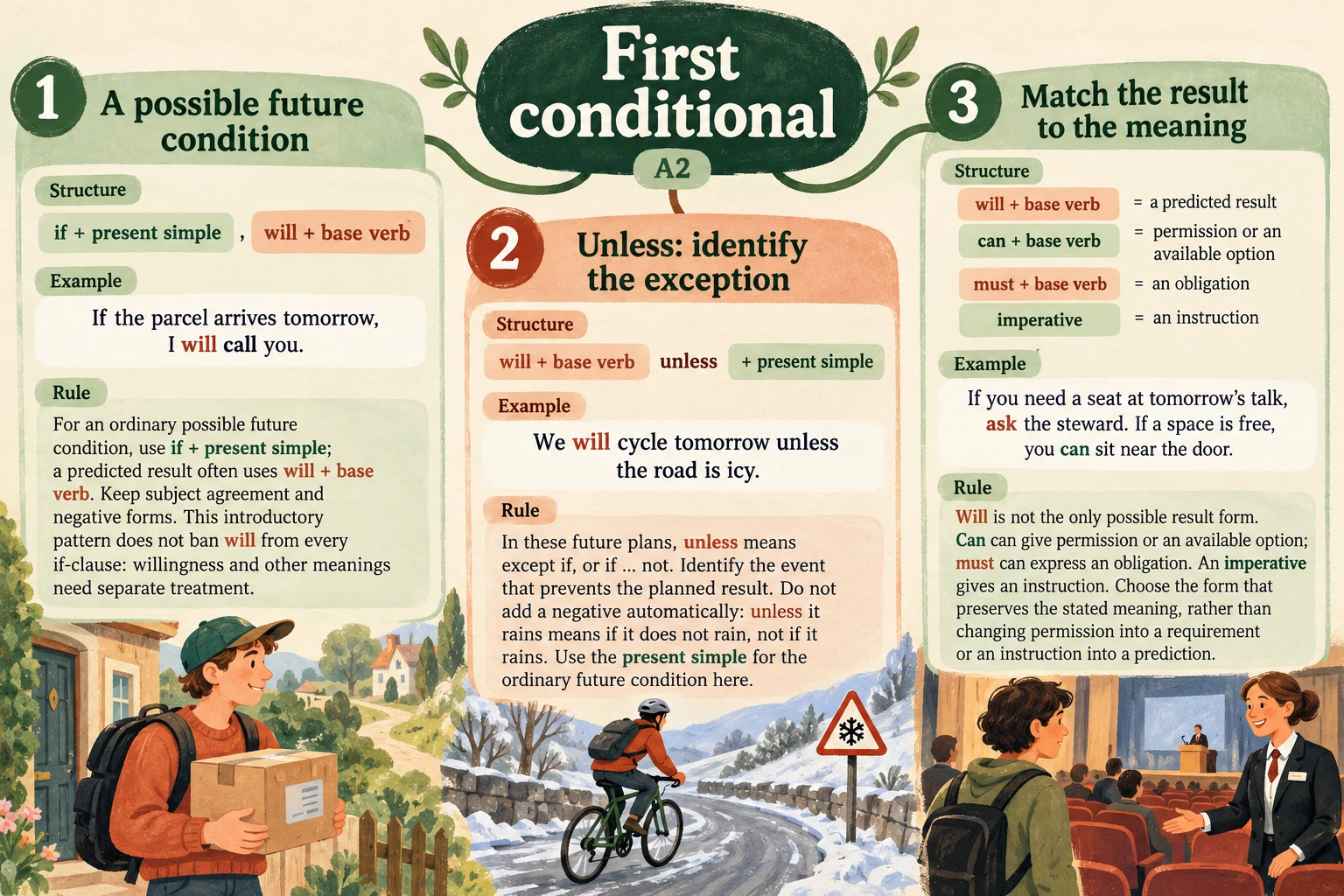
Para una condición futura posible corriente, usa if + presente simple; un resultado previsto suele llevar will + verbo base. Cuida la concordancia y las formas negativas. Este patrón introductorio no prohíbe will en toda cláusula con if: la disposición y otros significados se estudian aparte.

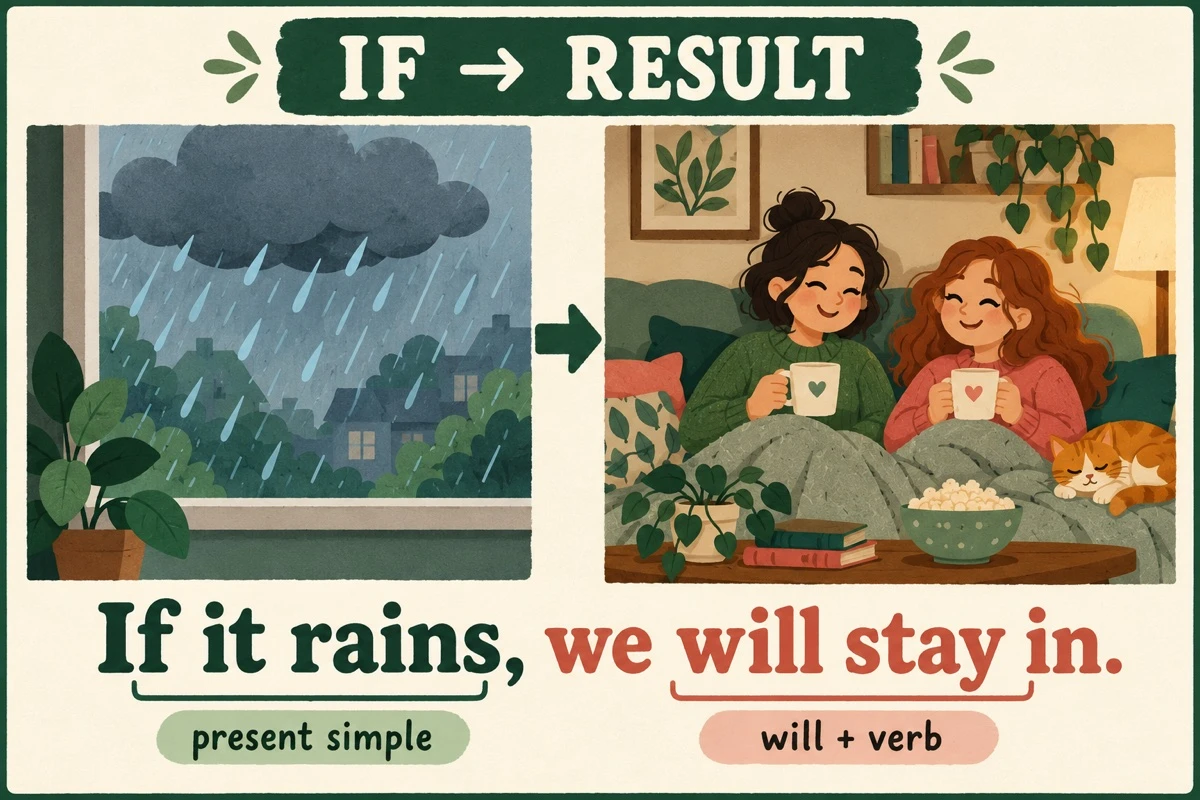
If + present simple, will + base verb
02Unless: identifica la excepción

En estos planes futuros, unless significa «excepto si» o «si no». Identifica el hecho que impide el resultado previsto. No añadas una negación automáticamente: unless it rains significa if it does not rain, no if it rains. Aquí la condición futura corriente usa presente simple.

unless = except if

03Elige el resultado según el significado

Will no es la única forma posible del resultado. Can puede expresar permiso o una opción disponible; must, una obligación. El imperativo da una instrucción. Elige la forma que conserva el sentido indicado, sin convertir un permiso en obligación ni una instrucción en predicción.

If you need help, ask. · If it is free, you can sit here.

Guía ilustrada

0/12
Preguntas
01 / 12D01Guárdalo para encontrarlo en Mi colección.

Mina may finish her work early tomorrow. If that happens, she plans to join us. Choose an ordinary possible-future prediction.

Choose the sentence that matches the plan.

Tu respuesta
1 / 12

Tu ruta de aprendizaje

01
Paso 1 · Calentamiento

Calentamiento

0/3
02
Paso 2 · Practicar la habilidad

Una condición futura posible

0/2

Para una condición futura posible corriente, usa if + presente simple; un resultado previsto suele llevar will + verbo base. Cuida la concordancia y las formas negativas. Este patrón introductorio no prohíbe will en toda cláusula con if: la disposición y otros significados se estudian aparte.

If the parcel arrives tomorrow, I will call you.
03
Paso 3 · Practicar la habilidad

Unless: identifica la excepción

0/1

En estos planes futuros, unless significa «excepto si» o «si no». Identifica el hecho que impide el resultado previsto. No añadas una negación automáticamente: unless it rains significa if it does not rain, no if it rains. Aquí la condición futura corriente usa presente simple.

We will cycle tomorrow unless the road is icy.
04
Paso 4 · Practicar la habilidad

Elige el resultado según el significado

0/1

Will no es la única forma posible del resultado. Can puede expresar permiso o una opción disponible; must, una obligación. El imperativo da una instrucción. Elige la forma que conserva el sentido indicado, sin convertir un permiso en obligación ni una instrucción en predicción.

If you need a seat at tomorrow’s talk, ask the steward. If a space is free, you can sit near the door.
05
Paso 5 · Nuevos contextos

Nuevos contextos

0/3
06
Paso 6 · Un nuevo reto

Un nuevo reto

0/2
Repasos de esta unidad

Haz que los errores sirvan.

Conserva el primer intento, entiende el cambio y compruébalo en otra situación.

0

Aún no hay repasos. Prueba un calentamiento corto.

Mapa de la lección

Primer condicional

A2
First conditional

Puntos de la lección

01

Una condición futura posible

Para una condición futura posible corriente, usa if + presente simple; un resultado previsto suele llevar will + verbo base. Cuida la concordancia y las formas negativas. Este patrón introductorio no prohíbe will en toda cláusula con if: la disposición y otros significados se estudian aparte.

If the parcel arrives tomorrow, I will call you.
02

Unless: identifica la excepción

En estos planes futuros, unless significa «excepto si» o «si no». Identifica el hecho que impide el resultado previsto. No añadas una negación automáticamente: unless it rains significa if it does not rain, no if it rains. Aquí la condición futura corriente usa presente simple.

We will cycle tomorrow unless the road is icy.
03

Elige el resultado según el significado

Will no es la única forma posible del resultado. Can puede expresar permiso o una opción disponible; must, una obligación. El imperativo da una instrucción. Elige la forma que conserva el sentido indicado, sin convertir un permiso en obligación ni una instrucción en predicción.

If you need a seat at tomorrow’s talk, ask the steward. If a space is free, you can sit near the door.

Preguntas y respuestas

Abrir una respuesta registra ayuda para esa pregunta.

D01 · Calentamiento

Mina may finish her work early tomorrow. If that happens, she plans to join us. Choose an ordinary possible-future prediction.

Choose the sentence that matches the plan.

  1. If Mina finishes early tomorrow, she will join us.
  2. If Mina finishes early tomorrow, she will joins us.
  3. If Mina finish early tomorrow, she will join us.
Respuesta y explicación
If Mina finishes early tomorrow, she will join us.

Mira «Mina may finish her work early tomorrow. If that happens, she plans to join us. Choose an ordinary possible-future prediction.». Para una condición futura posible corriente, usa if + presente simple; un resultado previsto suele llevar will + verbo base. Cuida la concordancia y las formas negativas. Este patrón introductorio no prohíbe will en toda cláusula con if: la disposición y otros significados se estudian aparte. Oración completa: «If Mina finishes early tomorrow, she will join us.».

D02 · Calentamiento

We plan to walk beside the river tomorrow. Flooding is the one event that would cancel the walk.

Choose the sentence that preserves this plan.

  1. We will walk beside the river tomorrow unless the path does not flood.
  2. We will walk beside the river tomorrow if the path floods.
  3. We will walk beside the river tomorrow unless the path floods.
Respuesta y explicación
We will walk beside the river tomorrow unless the path floods.

Mira «We plan to walk beside the river tomorrow. Flooding is the one event that would cancel the walk.». En estos planes futuros, unless significa «excepto si» o «si no». Identifica el hecho que impide el resultado previsto. No añadas una negación automáticamente: unless it rains significa if it does not rain, no if it rains. Aquí la condición futura corriente usa presente simple. Oración completa: «We will walk beside the river tomorrow unless the path floods.».

D03 · Calentamiento

For tomorrow’s video call, the manager gives you permission to use a spare tablet if your laptop stops working. Using it is optional.

Choose the sentence that gives permission.

  1. If your laptop stops working tomorrow, you can uses the spare tablet.
  2. If your laptop stops working tomorrow, you must use the spare tablet.
  3. If your laptop stops working tomorrow, you can use the spare tablet.
Respuesta y explicación
If your laptop stops working tomorrow, you can use the spare tablet.

Mira «For tomorrow’s video call, the manager gives you permission to use a spare tablet if your laptop stops working. Using it is optional.». Will no es la única forma posible del resultado. Can puede expresar permiso o una opción disponible; must, una obligación. El imperativo da una instrucción. Elige la forma que conserva el sentido indicado, sin convertir un permiso en obligación ni una instrucción en predicción. Oración completa: «If your laptop stops working tomorrow, you can use the spare tablet.».

P01 · Practicar la habilidad

The courier may arrive before noon tomorrow. If that happens, we predict that we will pack the parcel immediately. Use the ordinary possible-future pattern.

Choose the sentence.

  1. If the courier arrives before noon tomorrow, we will pack the parcel immediately.
  2. If the courier will arrives before noon tomorrow, we will pack the parcel immediately.
  3. If the courier arrives before noon tomorrow, we will packed the parcel immediately.
Respuesta y explicación
If the courier arrives before noon tomorrow, we will pack the parcel immediately.

Mira «The courier may arrive before noon tomorrow. If that happens, we predict that we will pack the parcel immediately. Use the ordinary possible-future pattern.». Para una condición futura posible corriente, usa if + presente simple; un resultado previsto suele llevar will + verbo base. Cuida la concordancia y las formas negativas. Este patrón introductorio no prohíbe will en toda cláusula con if: la disposición y otros significados se estudian aparte. Oración completa: «If the courier arrives before noon tomorrow, we will pack the parcel immediately.».

P02 · Practicar la habilidad

Leo may not need the car tomorrow. In that case, I plan to drive to the clinic.

Write one full sentence beginning If Leo. Use need and will drive to the clinic.

Respuesta y explicación
If Leo doesn't need the car tomorrow, I will drive to the clinic.

La condición es negativa: Leo does not need the car. Tras does not, need queda en forma base. El resultado previsto usa I will drive; I’ll es una contracción equivalente.

Otras respuestas aceptadas
  • If Leo does not need the car tomorrow, I will drive to the clinic.
  • If Leo doesn't need the car tomorrow, I'll drive to the clinic.
  • If Leo does not need the car tomorrow, I'll drive to the clinic.
P03 · Practicar la habilidad

We plan to show a film outside tomorrow evening. Rain would stop that outdoor showing.

Choose the sentence that keeps this meaning.

  1. We will show the film outside tomorrow unless if it rains.
  2. We will show the film outside tomorrow unless it rains.
  3. We will show the film outside tomorrow unless it does not rain.
Respuesta y explicación
We will show the film outside tomorrow unless it rains.

Mira «We plan to show a film outside tomorrow evening. Rain would stop that outdoor showing.». En estos planes futuros, unless significa «excepto si» o «si no». Identifica el hecho que impide el resultado previsto. No añadas una negación automáticamente: unless it rains significa if it does not rain, no if it rains. Aquí la condición futura corriente usa presente simple. Oración completa: «We will show the film outside tomorrow unless it rains.».

P04 · Practicar la habilidad

For tomorrow’s boat trip, wearing a life jacket is compulsory if you take the boat out. Express this requirement.

Choose the sentence.

  1. If you take the boat out tomorrow, you can wear a life jacket.
  2. If you take the boat out tomorrow, you must wearing a life jacket.
  3. If you take the boat out tomorrow, you must wear a life jacket.
Respuesta y explicación
If you take the boat out tomorrow, you must wear a life jacket.

Mira «For tomorrow’s boat trip, wearing a life jacket is compulsory if you take the boat out. Express this requirement.». Will no es la única forma posible del resultado. Can puede expresar permiso o una opción disponible; must, una obligación. El imperativo da una instrucción. Elige la forma que conserva el sentido indicado, sin convertir un permiso en obligación ni una instrucción en predicción. Oración completa: «If you take the boat out tomorrow, you must wear a life jacket.».

R01 · Nuevos contextos

The library may close early tomorrow. We will meet at my flat if that happens. A learner wrote: If the library close early tomorrow, we will meet at my flat.

Correct the full sentence. Keep the same words except for the verb form that needs repair.

Respuesta y explicación
If the library closes early tomorrow, we will meet at my flat.

El sujeto singular the library necesita closes en esta condición en presente simple. Will meet ya tiene la forma base correcta y no cambia.

R02 · Nuevos contextos

We will go for a run this evening if no thunderstorm starts. A learner wrote: Unless a thunderstorm does not start this evening, we will go for a run. This reverses the intended condition.

Write the corrected full sentence using unless and starts.

Respuesta y explicación
Unless a thunderstorm starts this evening, we will go for a run.

La tormenta es la excepción que cancela la salida. Unless a thunderstorm starts significa «si no empieza una tormenta». El does not adicional invierte ese sentido. Ambos órdenes de las cláusulas pueden conservar el plan. También se admiten estas variantes revisadas: We will go for a run this evening unless a thunderstorm starts. / We'll go for a run this evening unless a thunderstorm starts.. No es una lista de todas las expresiones posibles.

Otras respuestas aceptadas
  • Unless a thunderstorm starts this evening, we'll go for a run.
  • We will go for a run unless a thunderstorm starts this evening.
  • We'll go for a run unless a thunderstorm starts this evening.
  • We will go for a run this evening unless a thunderstorm starts.
  • We'll go for a run this evening unless a thunderstorm starts.
R03 · Nuevos contextos

During tomorrow’s rehearsal, the safety instruction is to leave the room if you smell smoke. A learner wrote: If you smell smoke during tomorrow’s rehearsal, to leave the room.

Correct the full sentence as a direct instruction. Remove one word.

Respuesta y explicación
If you smell smoke during tomorrow’s rehearsal, leave the room.

El resultado es una instrucción: usa el imperativo leave the room sin to. La condición futura posible sigue siendo if you smell smoke. Esta instrucción no necesita will.

Otras respuestas aceptadas
  • If you smell smoke during tomorrow's rehearsal, leave the room.
X01 · Un nuevo reto

Tonight’s workshop may sell out. If it does, we promise to add another workshop tomorrow. This is a real possibility.

Write one full sentence beginning If tonight’s workshop. Use sell out and will add another workshop tomorrow.

Respuesta y explicación
If tonight’s workshop sells out, we will add another workshop tomorrow.

La condición futura posible usa sells out porque workshop es singular. Will add expresa el resultado prometido. La contracción de we will conserva la promesa.

Otras respuestas aceptadas
  • If tonight's workshop sells out, we will add another workshop tomorrow.
  • If tonight’s workshop sells out, we’ll add another workshop tomorrow.
  • If tonight's workshop sells out, we'll add another workshop tomorrow.
X02 · Un nuevo reto

You have permission to borrow the camera tomorrow. The one exception is if Priya needs it.

Write one full sentence using unless, can borrow the camera tomorrow and Priya needs it. Either clause order is allowed.

Respuesta y explicación
You can borrow the camera tomorrow unless Priya needs it.

Unless Priya needs it marca la excepción al permiso. Can borrow conserva el permiso opcional; must borrow impondría una obligación. Needs concuerda con Priya en la condición futura corriente.

Otras respuestas aceptadas
  • Unless Priya needs it, you can borrow the camera tomorrow.