
A2-B1

First Conditional: reale Bedingungen Übungen

Über diese Lektion

First Conditional: reale Bedingungen · A2. Bei einer gewöhnlichen möglichen zukünftigen Bedingung steht nach if das Simple Present; eine vorhergesagte Folge hat oft will + Grundform. Achte auf Subjekt und Verb sowie Verneinungen. Dieses Einstiegsmuster verbietet will nicht in jedem if-Satz: Bereitschaft und andere Bedeutungen werden gesondert behandelt.

Erkunde mögliche zukünftige Situationen mit if und unless und wähle die passende Folge.

12 Aufgaben
Speichere es für deine Sammlung.
Wissensübersicht

First conditional

Jetzt üben
First conditional — Wissensübersicht

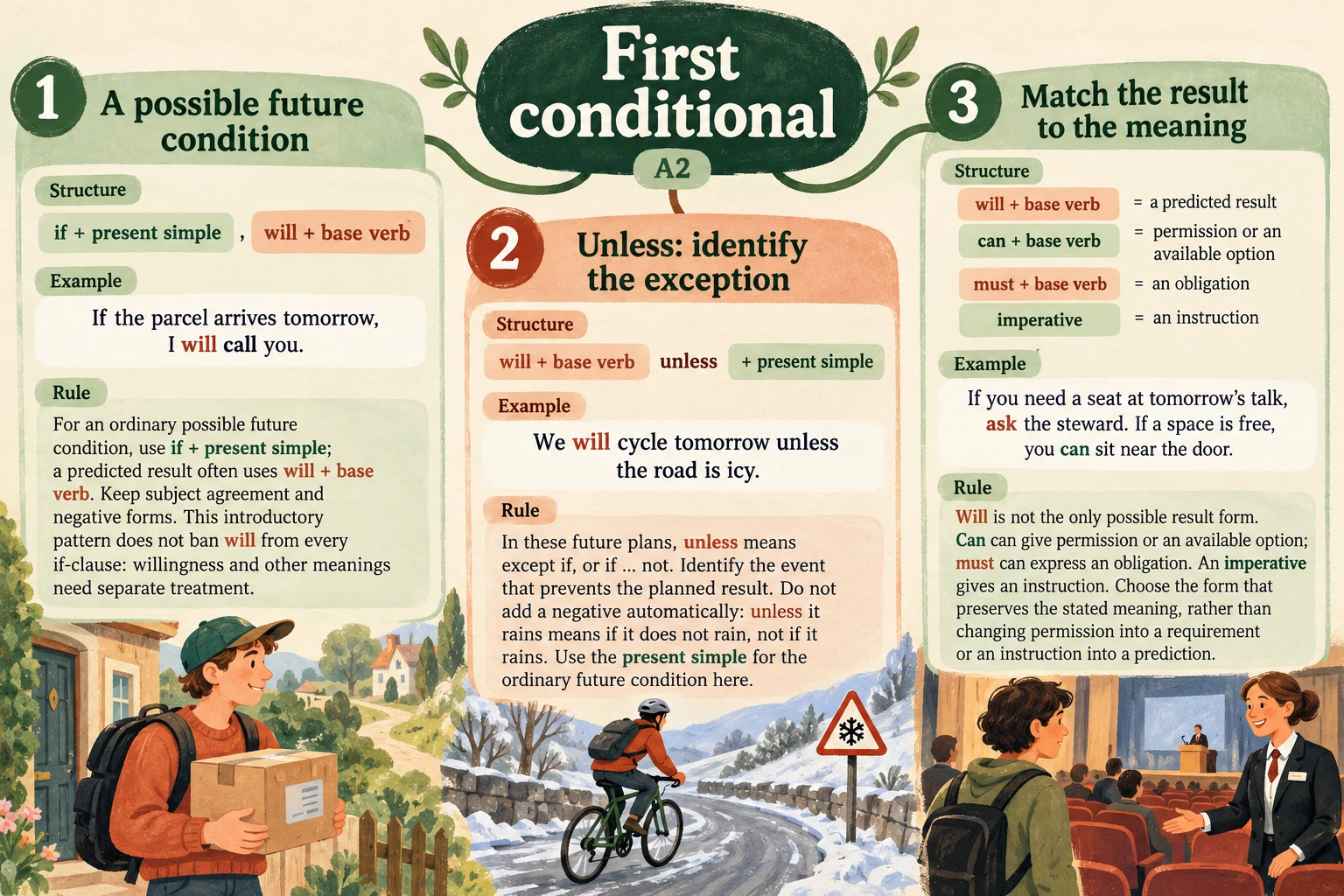
01Eine mögliche zukünftige Bedingung

Bei einer gewöhnlichen möglichen zukünftigen Bedingung steht nach if das Simple Present; eine vorhergesagte Folge hat oft will + Grundform. Achte auf Subjekt und Verb sowie Verneinungen. Dieses Einstiegsmuster verbietet will nicht in jedem if-Satz: Bereitschaft und andere Bedeutungen werden gesondert behandelt.

If + present simple, will + base verb
02Unless: die Ausnahme erkennen

In diesen Zukunftsplänen bedeutet unless „außer wenn“ oder „wenn nicht“. Bestimme, welches Ereignis die geplante Folge verhindert. Ergänze nicht automatisch eine Verneinung: unless it rains bedeutet if it does not rain, nicht if it rains. Für die gewöhnliche zukünftige Bedingung steht hier das Simple Present.

unless = except if

03Die Folge passend zur Bedeutung wählen

Will ist nicht die einzige mögliche Form der Folge. Can kann eine Erlaubnis oder eine verfügbare Möglichkeit ausdrücken; must eine Verpflichtung. Der Imperativ gibt eine Anweisung. Erhalte die genannte Bedeutung: Mache aus einer Erlaubnis keine Pflicht und aus einer Anweisung keine Vorhersage.

If you need help, ask. · If it is free, you can sit here.

Illustrierte Übersicht

0/12
Aufgaben
01 / 12D01Speichere es für deine Sammlung.

Mina may finish her work early tomorrow. If that happens, she plans to join us. Choose an ordinary possible-future prediction.

Choose the sentence that matches the plan.

Deine Antwort
1 / 12

Dein Lernweg

01
Schritt 1 · Einstieg

Einstieg

0/3
02
Schritt 2 · Gezielt üben

Eine mögliche zukünftige Bedingung

0/2

Bei einer gewöhnlichen möglichen zukünftigen Bedingung steht nach if das Simple Present; eine vorhergesagte Folge hat oft will + Grundform. Achte auf Subjekt und Verb sowie Verneinungen. Dieses Einstiegsmuster verbietet will nicht in jedem if-Satz: Bereitschaft und andere Bedeutungen werden gesondert behandelt.

If the parcel arrives tomorrow, I will call you.
03
Schritt 3 · Gezielt üben

Unless: die Ausnahme erkennen

0/1

In diesen Zukunftsplänen bedeutet unless „außer wenn“ oder „wenn nicht“. Bestimme, welches Ereignis die geplante Folge verhindert. Ergänze nicht automatisch eine Verneinung: unless it rains bedeutet if it does not rain, nicht if it rains. Für die gewöhnliche zukünftige Bedingung steht hier das Simple Present.

We will cycle tomorrow unless the road is icy.
04
Schritt 4 · Gezielt üben

Die Folge passend zur Bedeutung wählen

0/1

Will ist nicht die einzige mögliche Form der Folge. Can kann eine Erlaubnis oder eine verfügbare Möglichkeit ausdrücken; must eine Verpflichtung. Der Imperativ gibt eine Anweisung. Erhalte die genannte Bedeutung: Mache aus einer Erlaubnis keine Pflicht und aus einer Anweisung keine Vorhersage.

If you need a seat at tomorrow’s talk, ask the steward. If a space is free, you can sit near the door.
05
Schritt 5 · Neue Situationen

Neue Situationen

0/3
06
Schritt 6 · Neue Herausforderung

Neue Herausforderung

0/2
Lernnotizen dieser Einheit

Aus Fehlern lernen.

Bewahre den ersten Versuch. Verstehe die Änderung. Prüfe sie in einer neuen Situation.

0

Noch keine Lernnotizen. Starte mit einem kurzen Einstieg.

Lernübersicht

First Conditional: reale Bedingungen

A2
First conditional

Lektionspunkte

01

Eine mögliche zukünftige Bedingung

Bei einer gewöhnlichen möglichen zukünftigen Bedingung steht nach if das Simple Present; eine vorhergesagte Folge hat oft will + Grundform. Achte auf Subjekt und Verb sowie Verneinungen. Dieses Einstiegsmuster verbietet will nicht in jedem if-Satz: Bereitschaft und andere Bedeutungen werden gesondert behandelt.

If the parcel arrives tomorrow, I will call you.
02

Unless: die Ausnahme erkennen

In diesen Zukunftsplänen bedeutet unless „außer wenn“ oder „wenn nicht“. Bestimme, welches Ereignis die geplante Folge verhindert. Ergänze nicht automatisch eine Verneinung: unless it rains bedeutet if it does not rain, nicht if it rains. Für die gewöhnliche zukünftige Bedingung steht hier das Simple Present.

We will cycle tomorrow unless the road is icy.
03

Die Folge passend zur Bedeutung wählen

Will ist nicht die einzige mögliche Form der Folge. Can kann eine Erlaubnis oder eine verfügbare Möglichkeit ausdrücken; must eine Verpflichtung. Der Imperativ gibt eine Anweisung. Erhalte die genannte Bedeutung: Mache aus einer Erlaubnis keine Pflicht und aus einer Anweisung keine Vorhersage.

If you need a seat at tomorrow’s talk, ask the steward. If a space is free, you can sit near the door.

Fragen & Antworten

Das Öffnen einer Antwort wird für diese Aufgabe als Hilfe erfasst.

D01 · Einstieg

Mina may finish her work early tomorrow. If that happens, she plans to join us. Choose an ordinary possible-future prediction.

Choose the sentence that matches the plan.

  1. If Mina finishes early tomorrow, she will join us.
  2. If Mina finishes early tomorrow, she will joins us.
  3. If Mina finish early tomorrow, she will join us.
Antwort und Erklärung
If Mina finishes early tomorrow, she will join us.

Achte auf „Mina may finish her work early tomorrow. If that happens, she plans to join us. Choose an ordinary possible-future prediction.“. Bei einer gewöhnlichen möglichen zukünftigen Bedingung steht nach if das Simple Present; eine vorhergesagte Folge hat oft will + Grundform. Achte auf Subjekt und Verb sowie Verneinungen. Dieses Einstiegsmuster verbietet will nicht in jedem if-Satz: Bereitschaft und andere Bedeutungen werden gesondert behandelt. Vollständiger Satz: „If Mina finishes early tomorrow, she will join us.“.

D02 · Einstieg

We plan to walk beside the river tomorrow. Flooding is the one event that would cancel the walk.

Choose the sentence that preserves this plan.

  1. We will walk beside the river tomorrow unless the path does not flood.
  2. We will walk beside the river tomorrow if the path floods.
  3. We will walk beside the river tomorrow unless the path floods.
Antwort und Erklärung
We will walk beside the river tomorrow unless the path floods.

Achte auf „We plan to walk beside the river tomorrow. Flooding is the one event that would cancel the walk.“. In diesen Zukunftsplänen bedeutet unless „außer wenn“ oder „wenn nicht“. Bestimme, welches Ereignis die geplante Folge verhindert. Ergänze nicht automatisch eine Verneinung: unless it rains bedeutet if it does not rain, nicht if it rains. Für die gewöhnliche zukünftige Bedingung steht hier das Simple Present. Vollständiger Satz: „We will walk beside the river tomorrow unless the path floods.“.

D03 · Einstieg

For tomorrow’s video call, the manager gives you permission to use a spare tablet if your laptop stops working. Using it is optional.

Choose the sentence that gives permission.

  1. If your laptop stops working tomorrow, you can uses the spare tablet.
  2. If your laptop stops working tomorrow, you must use the spare tablet.
  3. If your laptop stops working tomorrow, you can use the spare tablet.
Antwort und Erklärung
If your laptop stops working tomorrow, you can use the spare tablet.

Achte auf „For tomorrow’s video call, the manager gives you permission to use a spare tablet if your laptop stops working. Using it is optional.“. Will ist nicht die einzige mögliche Form der Folge. Can kann eine Erlaubnis oder eine verfügbare Möglichkeit ausdrücken; must eine Verpflichtung. Der Imperativ gibt eine Anweisung. Erhalte die genannte Bedeutung: Mache aus einer Erlaubnis keine Pflicht und aus einer Anweisung keine Vorhersage. Vollständiger Satz: „If your laptop stops working tomorrow, you can use the spare tablet.“.

P01 · Gezielt üben

The courier may arrive before noon tomorrow. If that happens, we predict that we will pack the parcel immediately. Use the ordinary possible-future pattern.

Choose the sentence.

  1. If the courier arrives before noon tomorrow, we will pack the parcel immediately.
  2. If the courier will arrives before noon tomorrow, we will pack the parcel immediately.
  3. If the courier arrives before noon tomorrow, we will packed the parcel immediately.
Antwort und Erklärung
If the courier arrives before noon tomorrow, we will pack the parcel immediately.

Achte auf „The courier may arrive before noon tomorrow. If that happens, we predict that we will pack the parcel immediately. Use the ordinary possible-future pattern.“. Bei einer gewöhnlichen möglichen zukünftigen Bedingung steht nach if das Simple Present; eine vorhergesagte Folge hat oft will + Grundform. Achte auf Subjekt und Verb sowie Verneinungen. Dieses Einstiegsmuster verbietet will nicht in jedem if-Satz: Bereitschaft und andere Bedeutungen werden gesondert behandelt. Vollständiger Satz: „If the courier arrives before noon tomorrow, we will pack the parcel immediately.“.

P02 · Gezielt üben

Leo may not need the car tomorrow. In that case, I plan to drive to the clinic.

Write one full sentence beginning If Leo. Use need and will drive to the clinic.

Antwort und Erklärung
If Leo doesn't need the car tomorrow, I will drive to the clinic.

Die Bedingung ist verneint: Leo does not need the car. Nach does not bleibt need in der Grundform. Die geplante Folge lautet I will drive; I’ll ist die entsprechende Kurzform.

Weitere gültige Antworten
  • If Leo does not need the car tomorrow, I will drive to the clinic.
  • If Leo doesn't need the car tomorrow, I'll drive to the clinic.
  • If Leo does not need the car tomorrow, I'll drive to the clinic.
P03 · Gezielt üben

We plan to show a film outside tomorrow evening. Rain would stop that outdoor showing.

Choose the sentence that keeps this meaning.

  1. We will show the film outside tomorrow unless if it rains.
  2. We will show the film outside tomorrow unless it rains.
  3. We will show the film outside tomorrow unless it does not rain.
Antwort und Erklärung
We will show the film outside tomorrow unless it rains.

Achte auf „We plan to show a film outside tomorrow evening. Rain would stop that outdoor showing.“. In diesen Zukunftsplänen bedeutet unless „außer wenn“ oder „wenn nicht“. Bestimme, welches Ereignis die geplante Folge verhindert. Ergänze nicht automatisch eine Verneinung: unless it rains bedeutet if it does not rain, nicht if it rains. Für die gewöhnliche zukünftige Bedingung steht hier das Simple Present. Vollständiger Satz: „We will show the film outside tomorrow unless it rains.“.

P04 · Gezielt üben

For tomorrow’s boat trip, wearing a life jacket is compulsory if you take the boat out. Express this requirement.

Choose the sentence.

  1. If you take the boat out tomorrow, you can wear a life jacket.
  2. If you take the boat out tomorrow, you must wearing a life jacket.
  3. If you take the boat out tomorrow, you must wear a life jacket.
Antwort und Erklärung
If you take the boat out tomorrow, you must wear a life jacket.

Achte auf „For tomorrow’s boat trip, wearing a life jacket is compulsory if you take the boat out. Express this requirement.“. Will ist nicht die einzige mögliche Form der Folge. Can kann eine Erlaubnis oder eine verfügbare Möglichkeit ausdrücken; must eine Verpflichtung. Der Imperativ gibt eine Anweisung. Erhalte die genannte Bedeutung: Mache aus einer Erlaubnis keine Pflicht und aus einer Anweisung keine Vorhersage. Vollständiger Satz: „If you take the boat out tomorrow, you must wear a life jacket.“.

R01 · Neue Situationen

The library may close early tomorrow. We will meet at my flat if that happens. A learner wrote: If the library close early tomorrow, we will meet at my flat.

Correct the full sentence. Keep the same words except for the verb form that needs repair.

Antwort und Erklärung
If the library closes early tomorrow, we will meet at my flat.

Das Subjekt the library steht im Singular und braucht in dieser Bedingung closes. Will meet hat bereits die richtige Grundform und bleibt unverändert.

R02 · Neue Situationen

We will go for a run this evening if no thunderstorm starts. A learner wrote: Unless a thunderstorm does not start this evening, we will go for a run. This reverses the intended condition.

Write the corrected full sentence using unless and starts.

Antwort und Erklärung
Unless a thunderstorm starts this evening, we will go for a run.

Das Gewitter ist die Ausnahme, die den Lauf verhindert. Unless a thunderstorm starts bedeutet „wenn kein Gewitter beginnt“. Das zusätzliche does not kehrt diese Bedeutung um. Beide Satzteilfolgen können den Plan erhalten. In dieser Aufgabe sind auch diese Formen geprüft: We will go for a run this evening unless a thunderstorm starts. / We'll go for a run this evening unless a thunderstorm starts.. Die Liste ist nicht vollständig.

Weitere gültige Antworten
  • Unless a thunderstorm starts this evening, we'll go for a run.
  • We will go for a run unless a thunderstorm starts this evening.
  • We'll go for a run unless a thunderstorm starts this evening.
  • We will go for a run this evening unless a thunderstorm starts.
  • We'll go for a run this evening unless a thunderstorm starts.
R03 · Neue Situationen

During tomorrow’s rehearsal, the safety instruction is to leave the room if you smell smoke. A learner wrote: If you smell smoke during tomorrow’s rehearsal, to leave the room.

Correct the full sentence as a direct instruction. Remove one word.

Antwort und Erklärung
If you smell smoke during tomorrow’s rehearsal, leave the room.

Die Folge ist eine Anweisung, also steht der Imperativ leave the room ohne to. Die mögliche zukünftige Bedingung bleibt if you smell smoke. Für diese Anweisung ist kein will nötig.

Weitere gültige Antworten
  • If you smell smoke during tomorrow's rehearsal, leave the room.
X01 · Neue Herausforderung

Tonight’s workshop may sell out. If it does, we promise to add another workshop tomorrow. This is a real possibility.

Write one full sentence beginning If tonight’s workshop. Use sell out and will add another workshop tomorrow.

Antwort und Erklärung
If tonight’s workshop sells out, we will add another workshop tomorrow.

Die mögliche zukünftige Bedingung hat sells out, weil workshop Singular ist. Will add drückt die versprochene Folge aus. Die Kurzform von we will erhält dieses Versprechen.

Weitere gültige Antworten
  • If tonight's workshop sells out, we will add another workshop tomorrow.
  • If tonight’s workshop sells out, we’ll add another workshop tomorrow.
  • If tonight's workshop sells out, we'll add another workshop tomorrow.
X02 · Neue Herausforderung

You have permission to borrow the camera tomorrow. The one exception is if Priya needs it.

Write one full sentence using unless, can borrow the camera tomorrow and Priya needs it. Either clause order is allowed.

Antwort und Erklärung
You can borrow the camera tomorrow unless Priya needs it.

Unless Priya needs it nennt die Ausnahme von der Erlaubnis. Can borrow erhält die freiwillige Erlaubnis; must borrow würde eine Pflicht schaffen. Needs stimmt in der gewöhnlichen zukünftigen Bedingung mit Priya überein.

Weitere gültige Antworten
  • Unless Priya needs it, you can borrow the camera tomorrow.