
A2-B1

First conditional: condições possíveis: exercícios

Sobre esta lição

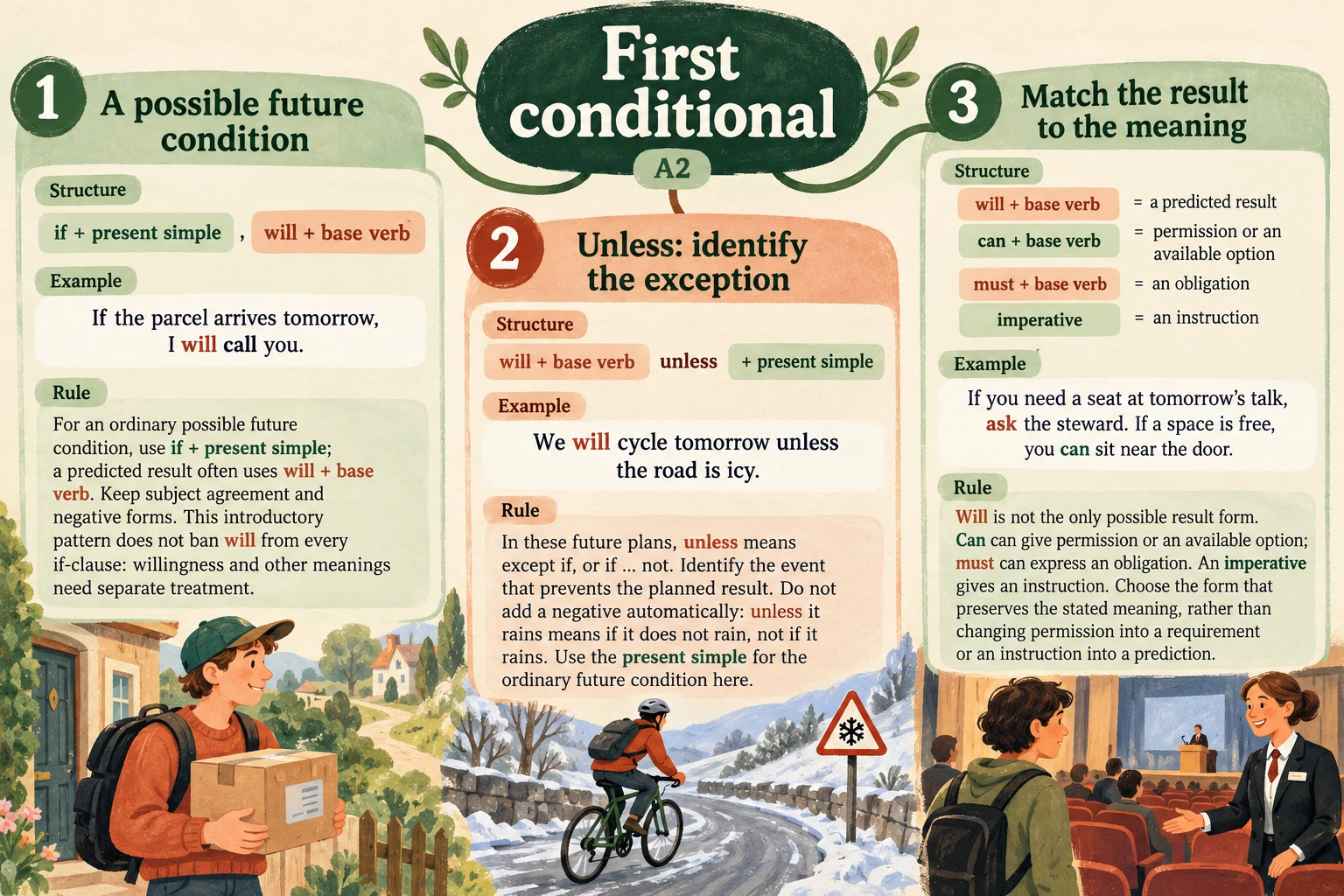
First conditional: condições possíveis · A2. Para uma condição futura possível comum, use if + presente simples; um resultado previsto costuma usar will + verbo na forma base. Observe a concordância e as formas negativas. Esse padrão introdutório não proíbe will em toda oração com if: disposição e outros sentidos precisam de estudo separado.

Explore situações futuras possíveis com if e unless e escolha o resultado adequado.

12 questões
Salve para encontrar em Minha coleção.
Mapa de conceitos

First conditional

Começar a praticar
First conditional — Mapa de conceitos

01Uma condição futura possível

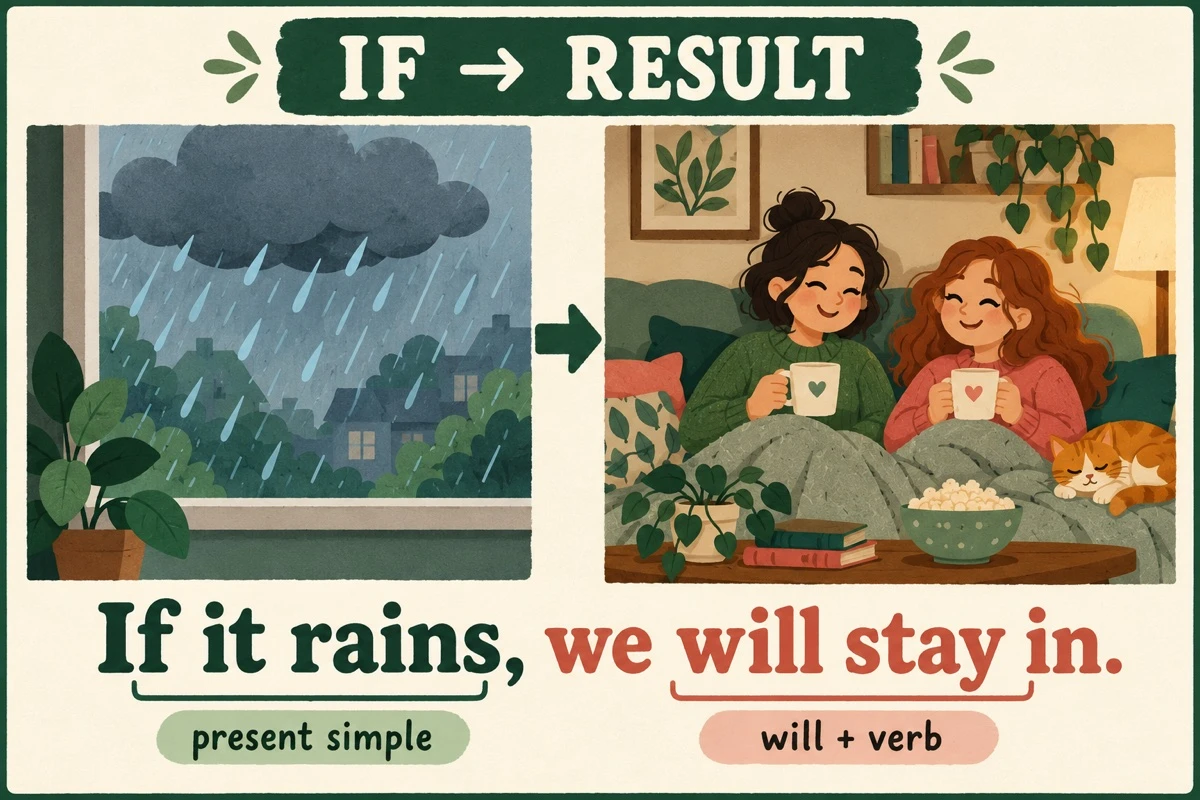
Para uma condição futura possível comum, use if + presente simples; um resultado previsto costuma usar will + verbo na forma base. Observe a concordância e as formas negativas. Esse padrão introdutório não proíbe will em toda oração com if: disposição e outros sentidos precisam de estudo separado.

If + present simple, will + base verb
02Unless: identifique a exceção

Nestes planos futuros, unless significa «a menos que» ou «se não». Identifique o evento que impede o resultado planejado. Não acrescente uma negação automaticamente: unless it rains significa if it does not rain, e não if it rains. Aqui a condição futura comum usa o presente simples.

unless = except if

03Escolha o resultado pelo sentido

Will não é a única forma possível do resultado. Can pode indicar permissão ou uma opção disponível; must pode expressar obrigação. O imperativo dá uma instrução. Escolha a forma que mantém o sentido indicado, sem transformar permissão em obrigação nem instrução em previsão.

If you need help, ask. · If it is free, you can sit here.

Guia ilustrado

0/12
Questões
01 / 12D01Salve para encontrar em Minha coleção.

Mina may finish her work early tomorrow. If that happens, she plans to join us. Choose an ordinary possible-future prediction.

Choose the sentence that matches the plan.

Sua resposta
1 / 12

Seu caminho de aprendizagem

01
Etapa 1 · Aquecimento

Aquecimento

0/3
02
Etapa 2 · Praticar a habilidade

Uma condição futura possível

0/2

Para uma condição futura possível comum, use if + presente simples; um resultado previsto costuma usar will + verbo na forma base. Observe a concordância e as formas negativas. Esse padrão introdutório não proíbe will em toda oração com if: disposição e outros sentidos precisam de estudo separado.

If the parcel arrives tomorrow, I will call you.
03
Etapa 3 · Praticar a habilidade

Unless: identifique a exceção

0/1

Nestes planos futuros, unless significa «a menos que» ou «se não». Identifique o evento que impede o resultado planejado. Não acrescente uma negação automaticamente: unless it rains significa if it does not rain, e não if it rains. Aqui a condição futura comum usa o presente simples.

We will cycle tomorrow unless the road is icy.
04
Etapa 4 · Praticar a habilidade

Escolha o resultado pelo sentido

0/1

Will não é a única forma possível do resultado. Can pode indicar permissão ou uma opção disponível; must pode expressar obrigação. O imperativo dá uma instrução. Escolha a forma que mantém o sentido indicado, sem transformar permissão em obrigação nem instrução em previsão.

If you need a seat at tomorrow’s talk, ask the steward. If a space is free, you can sit near the door.
05
Etapa 5 · Novos contextos

Novos contextos

0/3
06
Etapa 6 · Um novo desafio

Um novo desafio

0/2
Revisões desta unidade

Transforme erros em aprendizado.

Guarde a primeira tentativa, entenda a mudança e confira em outra situação.

0

Ainda não há revisões. Faça um aquecimento curto.

Mapa da aula

First conditional: condições possíveis

A2
First conditional

Pontos da aula

01

Uma condição futura possível

Para uma condição futura possível comum, use if + presente simples; um resultado previsto costuma usar will + verbo na forma base. Observe a concordância e as formas negativas. Esse padrão introdutório não proíbe will em toda oração com if: disposição e outros sentidos precisam de estudo separado.

If the parcel arrives tomorrow, I will call you.
02

Unless: identifique a exceção

Nestes planos futuros, unless significa «a menos que» ou «se não». Identifique o evento que impede o resultado planejado. Não acrescente uma negação automaticamente: unless it rains significa if it does not rain, e não if it rains. Aqui a condição futura comum usa o presente simples.

We will cycle tomorrow unless the road is icy.
03

Escolha o resultado pelo sentido

Will não é a única forma possível do resultado. Can pode indicar permissão ou uma opção disponível; must pode expressar obrigação. O imperativo dá uma instrução. Escolha a forma que mantém o sentido indicado, sem transformar permissão em obrigação nem instrução em previsão.

If you need a seat at tomorrow’s talk, ask the steward. If a space is free, you can sit near the door.

Perguntas e respostas

Abrir uma resposta registra ajuda para essa questão.

D01 · Aquecimento

Mina may finish her work early tomorrow. If that happens, she plans to join us. Choose an ordinary possible-future prediction.

Choose the sentence that matches the plan.

  1. If Mina finishes early tomorrow, she will join us.
  2. If Mina finishes early tomorrow, she will joins us.
  3. If Mina finish early tomorrow, she will join us.
Resposta e explicação
If Mina finishes early tomorrow, she will join us.

Observe “Mina may finish her work early tomorrow. If that happens, she plans to join us. Choose an ordinary possible-future prediction.”. Para uma condição futura possível comum, use if + presente simples; um resultado previsto costuma usar will + verbo na forma base. Observe a concordância e as formas negativas. Esse padrão introdutório não proíbe will em toda oração com if: disposição e outros sentidos precisam de estudo separado. Frase completa: “If Mina finishes early tomorrow, she will join us.”.

D02 · Aquecimento

We plan to walk beside the river tomorrow. Flooding is the one event that would cancel the walk.

Choose the sentence that preserves this plan.

  1. We will walk beside the river tomorrow unless the path does not flood.
  2. We will walk beside the river tomorrow if the path floods.
  3. We will walk beside the river tomorrow unless the path floods.
Resposta e explicação
We will walk beside the river tomorrow unless the path floods.

Observe “We plan to walk beside the river tomorrow. Flooding is the one event that would cancel the walk.”. Nestes planos futuros, unless significa «a menos que» ou «se não». Identifique o evento que impede o resultado planejado. Não acrescente uma negação automaticamente: unless it rains significa if it does not rain, e não if it rains. Aqui a condição futura comum usa o presente simples. Frase completa: “We will walk beside the river tomorrow unless the path floods.”.

D03 · Aquecimento

For tomorrow’s video call, the manager gives you permission to use a spare tablet if your laptop stops working. Using it is optional.

Choose the sentence that gives permission.

  1. If your laptop stops working tomorrow, you can uses the spare tablet.
  2. If your laptop stops working tomorrow, you must use the spare tablet.
  3. If your laptop stops working tomorrow, you can use the spare tablet.
Resposta e explicação
If your laptop stops working tomorrow, you can use the spare tablet.

Observe “For tomorrow’s video call, the manager gives you permission to use a spare tablet if your laptop stops working. Using it is optional.”. Will não é a única forma possível do resultado. Can pode indicar permissão ou uma opção disponível; must pode expressar obrigação. O imperativo dá uma instrução. Escolha a forma que mantém o sentido indicado, sem transformar permissão em obrigação nem instrução em previsão. Frase completa: “If your laptop stops working tomorrow, you can use the spare tablet.”.

P01 · Praticar a habilidade

The courier may arrive before noon tomorrow. If that happens, we predict that we will pack the parcel immediately. Use the ordinary possible-future pattern.

Choose the sentence.

  1. If the courier arrives before noon tomorrow, we will pack the parcel immediately.
  2. If the courier will arrives before noon tomorrow, we will pack the parcel immediately.
  3. If the courier arrives before noon tomorrow, we will packed the parcel immediately.
Resposta e explicação
If the courier arrives before noon tomorrow, we will pack the parcel immediately.

Observe “The courier may arrive before noon tomorrow. If that happens, we predict that we will pack the parcel immediately. Use the ordinary possible-future pattern.”. Para uma condição futura possível comum, use if + presente simples; um resultado previsto costuma usar will + verbo na forma base. Observe a concordância e as formas negativas. Esse padrão introdutório não proíbe will em toda oração com if: disposição e outros sentidos precisam de estudo separado. Frase completa: “If the courier arrives before noon tomorrow, we will pack the parcel immediately.”.

P02 · Praticar a habilidade

Leo may not need the car tomorrow. In that case, I plan to drive to the clinic.

Write one full sentence beginning If Leo. Use need and will drive to the clinic.

Resposta e explicação
If Leo doesn't need the car tomorrow, I will drive to the clinic.

A condição é negativa: Leo does not need the car. Depois de does not, need fica na forma base. O resultado planejado usa I will drive; I’ll é uma contração equivalente.

Outras respostas aceitas
  • If Leo does not need the car tomorrow, I will drive to the clinic.
  • If Leo doesn't need the car tomorrow, I'll drive to the clinic.
  • If Leo does not need the car tomorrow, I'll drive to the clinic.
P03 · Praticar a habilidade

We plan to show a film outside tomorrow evening. Rain would stop that outdoor showing.

Choose the sentence that keeps this meaning.

  1. We will show the film outside tomorrow unless if it rains.
  2. We will show the film outside tomorrow unless it rains.
  3. We will show the film outside tomorrow unless it does not rain.
Resposta e explicação
We will show the film outside tomorrow unless it rains.

Observe “We plan to show a film outside tomorrow evening. Rain would stop that outdoor showing.”. Nestes planos futuros, unless significa «a menos que» ou «se não». Identifique o evento que impede o resultado planejado. Não acrescente uma negação automaticamente: unless it rains significa if it does not rain, e não if it rains. Aqui a condição futura comum usa o presente simples. Frase completa: “We will show the film outside tomorrow unless it rains.”.

P04 · Praticar a habilidade

For tomorrow’s boat trip, wearing a life jacket is compulsory if you take the boat out. Express this requirement.

Choose the sentence.

  1. If you take the boat out tomorrow, you can wear a life jacket.
  2. If you take the boat out tomorrow, you must wearing a life jacket.
  3. If you take the boat out tomorrow, you must wear a life jacket.
Resposta e explicação
If you take the boat out tomorrow, you must wear a life jacket.

Observe “For tomorrow’s boat trip, wearing a life jacket is compulsory if you take the boat out. Express this requirement.”. Will não é a única forma possível do resultado. Can pode indicar permissão ou uma opção disponível; must pode expressar obrigação. O imperativo dá uma instrução. Escolha a forma que mantém o sentido indicado, sem transformar permissão em obrigação nem instrução em previsão. Frase completa: “If you take the boat out tomorrow, you must wear a life jacket.”.

R01 · Novos contextos

The library may close early tomorrow. We will meet at my flat if that happens. A learner wrote: If the library close early tomorrow, we will meet at my flat.

Correct the full sentence. Keep the same words except for the verb form that needs repair.

Resposta e explicação
If the library closes early tomorrow, we will meet at my flat.

O sujeito singular the library exige closes nesta condição no presente simples. Will meet já tem a forma base correta e não muda.

R02 · Novos contextos

We will go for a run this evening if no thunderstorm starts. A learner wrote: Unless a thunderstorm does not start this evening, we will go for a run. This reverses the intended condition.

Write the corrected full sentence using unless and starts.

Resposta e explicação
Unless a thunderstorm starts this evening, we will go for a run.

A tempestade é a exceção que cancela a corrida. Unless a thunderstorm starts significa «se nenhuma tempestade começar». O does not extra inverte esse sentido. As duas ordens das orações podem manter o plano. Também são aceitas estas variantes revisadas: We will go for a run this evening unless a thunderstorm starts. / We'll go for a run this evening unless a thunderstorm starts.. A lista não cobre todas as expressões possíveis.

Outras respostas aceitas
  • Unless a thunderstorm starts this evening, we'll go for a run.
  • We will go for a run unless a thunderstorm starts this evening.
  • We'll go for a run unless a thunderstorm starts this evening.
  • We will go for a run this evening unless a thunderstorm starts.
  • We'll go for a run this evening unless a thunderstorm starts.
R03 · Novos contextos

During tomorrow’s rehearsal, the safety instruction is to leave the room if you smell smoke. A learner wrote: If you smell smoke during tomorrow’s rehearsal, to leave the room.

Correct the full sentence as a direct instruction. Remove one word.

Resposta e explicação
If you smell smoke during tomorrow’s rehearsal, leave the room.

O resultado é uma instrução: use o imperativo leave the room sem to. A condição futura possível continua sendo if you smell smoke. Essa instrução não precisa de will.

Outras respostas aceitas
  • If you smell smoke during tomorrow's rehearsal, leave the room.
X01 · Um novo desafio

Tonight’s workshop may sell out. If it does, we promise to add another workshop tomorrow. This is a real possibility.

Write one full sentence beginning If tonight’s workshop. Use sell out and will add another workshop tomorrow.

Resposta e explicação
If tonight’s workshop sells out, we will add another workshop tomorrow.

A condição futura possível usa sells out porque workshop é singular. Will add expressa o resultado prometido. A contração de we will mantém a promessa.

Outras respostas aceitas
  • If tonight's workshop sells out, we will add another workshop tomorrow.
  • If tonight’s workshop sells out, we’ll add another workshop tomorrow.
  • If tonight's workshop sells out, we'll add another workshop tomorrow.
X02 · Um novo desafio

You have permission to borrow the camera tomorrow. The one exception is if Priya needs it.

Write one full sentence using unless, can borrow the camera tomorrow and Priya needs it. Either clause order is allowed.

Resposta e explicação
You can borrow the camera tomorrow unless Priya needs it.

Unless Priya needs it marca a exceção à permissão. Can borrow mantém a opção permitida; must borrow criaria uma obrigação. Needs concorda com Priya nesta condição futura comum.

Outras respostas aceitas
  • Unless Priya needs it, you can borrow the camera tomorrow.