
A2-B1

Le premier conditionnel anglais : exercices

À propos de cette leçon

Le premier conditionnel anglais · A2. Pour une condition future possible ordinaire, utilisez if + présent simple ; une conséquence prévue emploie souvent will + base verbale. Respectez les accords et les formes négatives. Ce modèle introductif ne bannit pas will de toute proposition avec if : la volonté et les autres sens demandent une étude distincte.

Explorez des situations futures possibles avec if et unless, puis choisissez la conséquence adaptée.

12 questions
Retrouvez-le dans Ma collection après enregistrement.
Carte des notions

First conditional

Commencer
First conditional — Carte des notions

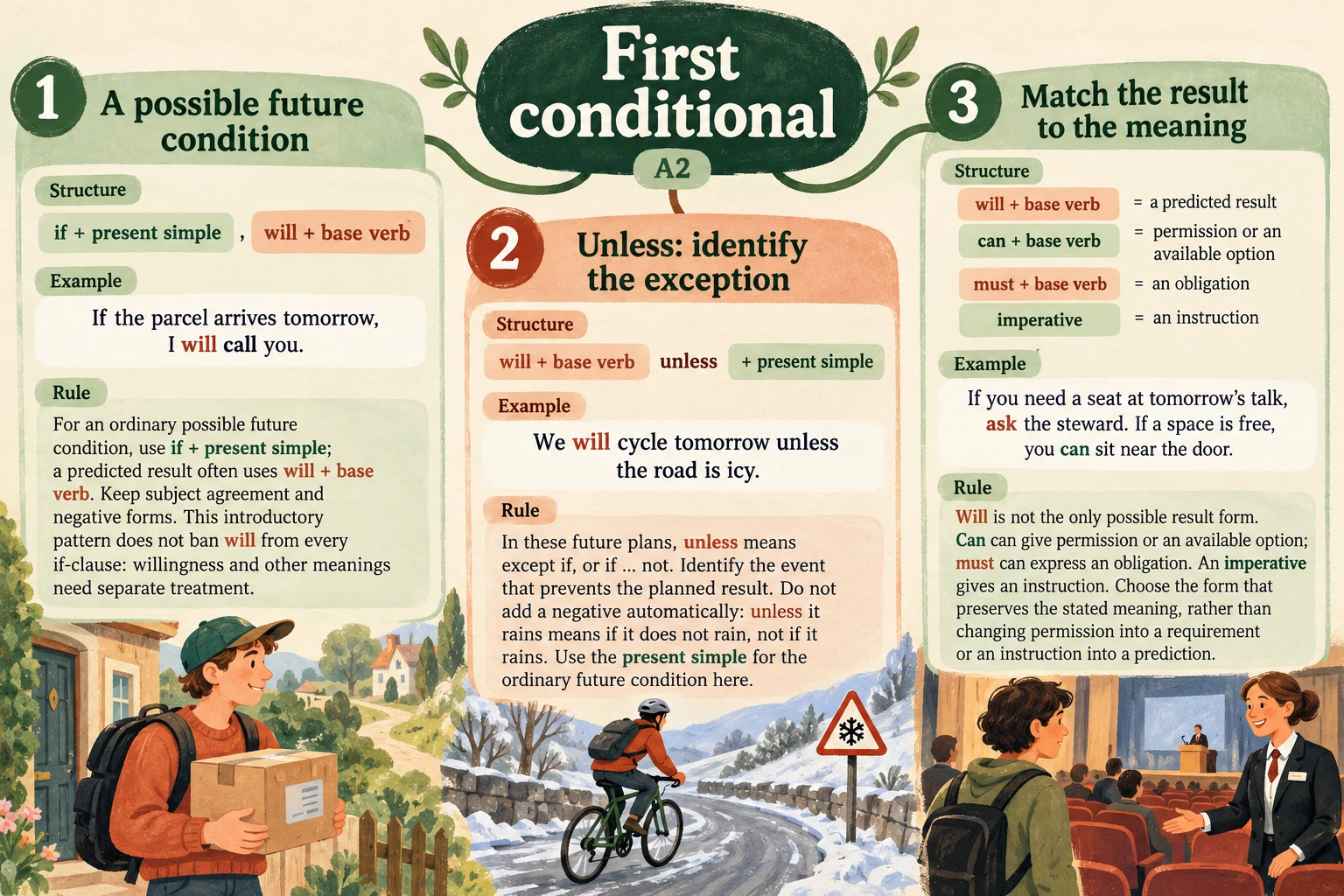
01Une condition future possible

Pour une condition future possible ordinaire, utilisez if + présent simple ; une conséquence prévue emploie souvent will + base verbale. Respectez les accords et les formes négatives. Ce modèle introductif ne bannit pas will de toute proposition avec if : la volonté et les autres sens demandent une étude distincte.

If + present simple, will + base verb
02Unless : repérer l’exception

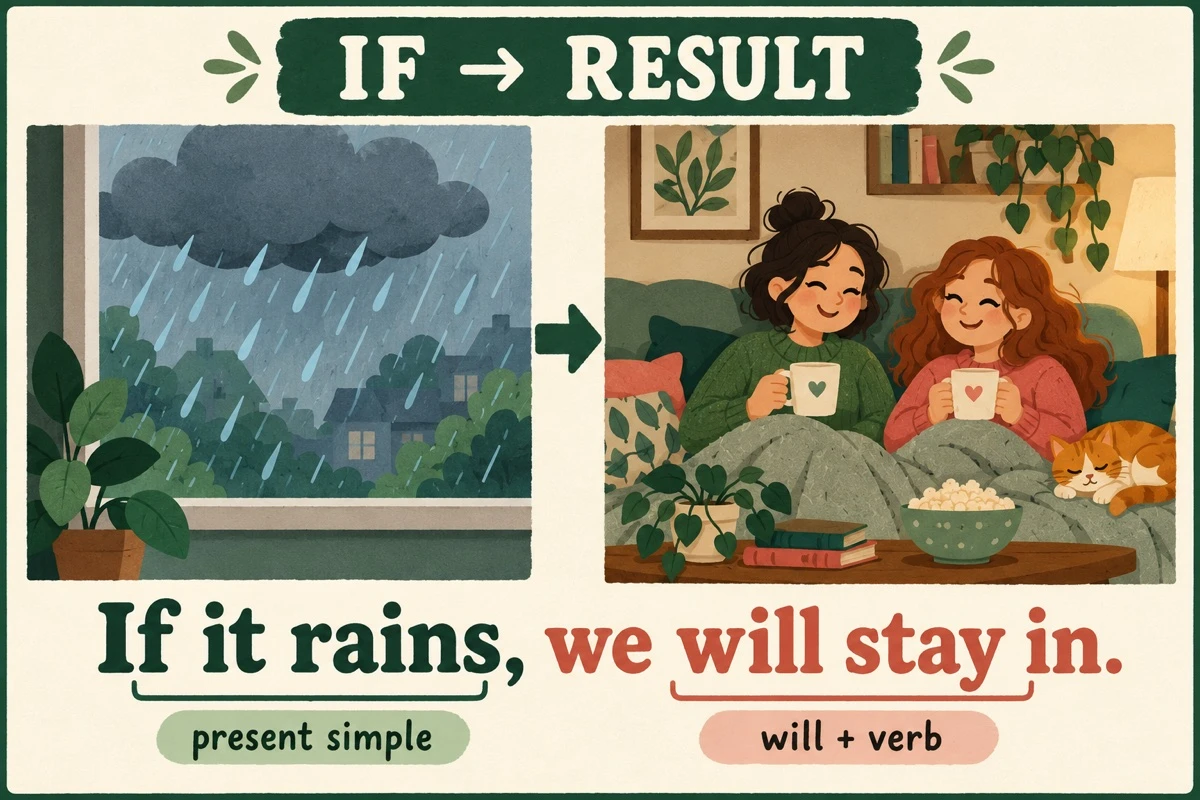
Dans ces projets futurs, unless signifie « sauf si » ou « si… ne… pas ». Repérez l’événement qui empêche le résultat prévu. N’ajoutez pas automatiquement une négation : unless it rains signifie if it does not rain, et non if it rains. La condition future ordinaire utilise ici le présent simple.

unless = except if

03Adapter la conséquence au sens

Will n’est pas la seule forme possible pour la conséquence. Can peut exprimer une permission ou une possibilité disponible ; must, une obligation. L’impératif donne une consigne. Choisissez la forme qui conserve le sens indiqué, sans transformer une permission en obligation ni une consigne en prévision.

If you need help, ask. · If it is free, you can sit here.

Guide illustré

0/12
Questions
01 / 12D01Retrouvez-le dans Ma collection après enregistrement.

Mina may finish her work early tomorrow. If that happens, she plans to join us. Choose an ordinary possible-future prediction.

Choose the sentence that matches the plan.

Votre réponse
1 / 12

Votre parcours

01
Étape 1 · Échauffement

Échauffement

0/3
02
Étape 2 · Développer la compétence

Une condition future possible

0/2

Pour une condition future possible ordinaire, utilisez if + présent simple ; une conséquence prévue emploie souvent will + base verbale. Respectez les accords et les formes négatives. Ce modèle introductif ne bannit pas will de toute proposition avec if : la volonté et les autres sens demandent une étude distincte.

If the parcel arrives tomorrow, I will call you.
03
Étape 3 · Développer la compétence

Unless : repérer l’exception

0/1

Dans ces projets futurs, unless signifie « sauf si » ou « si… ne… pas ». Repérez l’événement qui empêche le résultat prévu. N’ajoutez pas automatiquement une négation : unless it rains signifie if it does not rain, et non if it rains. La condition future ordinaire utilise ici le présent simple.

We will cycle tomorrow unless the road is icy.
04
Étape 4 · Développer la compétence

Adapter la conséquence au sens

0/1

Will n’est pas la seule forme possible pour la conséquence. Can peut exprimer une permission ou une possibilité disponible ; must, une obligation. L’impératif donne une consigne. Choisissez la forme qui conserve le sens indiqué, sans transformer une permission en obligation ni une consigne en prévision.

If you need a seat at tomorrow’s talk, ask the steward. If a space is free, you can sit near the door.
05
Étape 5 · Nouveaux contextes

Nouveaux contextes

0/3
06
Étape 6 · Un nouveau défi

Un nouveau défi

0/2
Révisions de cette unité

Apprenez de vos erreurs.

Gardez la première tentative, comprenez le changement et essayez dans une nouvelle situation.

0

Pas encore de notes. Essayez un court échauffement.

Carte de la leçon

Le premier conditionnel anglais

A2
First conditional

Points de la leçon

01

Une condition future possible

Pour une condition future possible ordinaire, utilisez if + présent simple ; une conséquence prévue emploie souvent will + base verbale. Respectez les accords et les formes négatives. Ce modèle introductif ne bannit pas will de toute proposition avec if : la volonté et les autres sens demandent une étude distincte.

If the parcel arrives tomorrow, I will call you.
02

Unless : repérer l’exception

Dans ces projets futurs, unless signifie « sauf si » ou « si… ne… pas ». Repérez l’événement qui empêche le résultat prévu. N’ajoutez pas automatiquement une négation : unless it rains signifie if it does not rain, et non if it rains. La condition future ordinaire utilise ici le présent simple.

We will cycle tomorrow unless the road is icy.
03

Adapter la conséquence au sens

Will n’est pas la seule forme possible pour la conséquence. Can peut exprimer une permission ou une possibilité disponible ; must, une obligation. L’impératif donne une consigne. Choisissez la forme qui conserve le sens indiqué, sans transformer une permission en obligation ni une consigne en prévision.

If you need a seat at tomorrow’s talk, ask the steward. If a space is free, you can sit near the door.

Questions et réponses

Ouvrir une réponse enregistre une aide pour cette question.

D01 · Échauffement

Mina may finish her work early tomorrow. If that happens, she plans to join us. Choose an ordinary possible-future prediction.

Choose the sentence that matches the plan.

  1. If Mina finishes early tomorrow, she will join us.
  2. If Mina finishes early tomorrow, she will joins us.
  3. If Mina finish early tomorrow, she will join us.
Réponse et explication
If Mina finishes early tomorrow, she will join us.

Observe « Mina may finish her work early tomorrow. If that happens, she plans to join us. Choose an ordinary possible-future prediction. ». Pour une condition future possible ordinaire, utilisez if + présent simple ; une conséquence prévue emploie souvent will + base verbale. Respectez les accords et les formes négatives. Ce modèle introductif ne bannit pas will de toute proposition avec if : la volonté et les autres sens demandent une étude distincte. Phrase complète : « If Mina finishes early tomorrow, she will join us. ».

D02 · Échauffement

We plan to walk beside the river tomorrow. Flooding is the one event that would cancel the walk.

Choose the sentence that preserves this plan.

  1. We will walk beside the river tomorrow unless the path does not flood.
  2. We will walk beside the river tomorrow if the path floods.
  3. We will walk beside the river tomorrow unless the path floods.
Réponse et explication
We will walk beside the river tomorrow unless the path floods.

Observe « We plan to walk beside the river tomorrow. Flooding is the one event that would cancel the walk. ». Dans ces projets futurs, unless signifie « sauf si » ou « si… ne… pas ». Repérez l’événement qui empêche le résultat prévu. N’ajoutez pas automatiquement une négation : unless it rains signifie if it does not rain, et non if it rains. La condition future ordinaire utilise ici le présent simple. Phrase complète : « We will walk beside the river tomorrow unless the path floods. ».

D03 · Échauffement

For tomorrow’s video call, the manager gives you permission to use a spare tablet if your laptop stops working. Using it is optional.

Choose the sentence that gives permission.

  1. If your laptop stops working tomorrow, you can uses the spare tablet.
  2. If your laptop stops working tomorrow, you must use the spare tablet.
  3. If your laptop stops working tomorrow, you can use the spare tablet.
Réponse et explication
If your laptop stops working tomorrow, you can use the spare tablet.

Observe « For tomorrow’s video call, the manager gives you permission to use a spare tablet if your laptop stops working. Using it is optional. ». Will n’est pas la seule forme possible pour la conséquence. Can peut exprimer une permission ou une possibilité disponible ; must, une obligation. L’impératif donne une consigne. Choisissez la forme qui conserve le sens indiqué, sans transformer une permission en obligation ni une consigne en prévision. Phrase complète : « If your laptop stops working tomorrow, you can use the spare tablet. ».

P01 · Développer la compétence

The courier may arrive before noon tomorrow. If that happens, we predict that we will pack the parcel immediately. Use the ordinary possible-future pattern.

Choose the sentence.

  1. If the courier arrives before noon tomorrow, we will pack the parcel immediately.
  2. If the courier will arrives before noon tomorrow, we will pack the parcel immediately.
  3. If the courier arrives before noon tomorrow, we will packed the parcel immediately.
Réponse et explication
If the courier arrives before noon tomorrow, we will pack the parcel immediately.

Observe « The courier may arrive before noon tomorrow. If that happens, we predict that we will pack the parcel immediately. Use the ordinary possible-future pattern. ». Pour une condition future possible ordinaire, utilisez if + présent simple ; une conséquence prévue emploie souvent will + base verbale. Respectez les accords et les formes négatives. Ce modèle introductif ne bannit pas will de toute proposition avec if : la volonté et les autres sens demandent une étude distincte. Phrase complète : « If the courier arrives before noon tomorrow, we will pack the parcel immediately. ».

P02 · Développer la compétence

Leo may not need the car tomorrow. In that case, I plan to drive to the clinic.

Write one full sentence beginning If Leo. Use need and will drive to the clinic.

Réponse et explication
If Leo doesn't need the car tomorrow, I will drive to the clinic.

La condition est négative : Leo does not need the car. Après does not, need reste à la base verbale. La conséquence prévue utilise I will drive ; I’ll est la contraction équivalente.

Autres réponses acceptées
  • If Leo does not need the car tomorrow, I will drive to the clinic.
  • If Leo doesn't need the car tomorrow, I'll drive to the clinic.
  • If Leo does not need the car tomorrow, I'll drive to the clinic.
P03 · Développer la compétence

We plan to show a film outside tomorrow evening. Rain would stop that outdoor showing.

Choose the sentence that keeps this meaning.

  1. We will show the film outside tomorrow unless if it rains.
  2. We will show the film outside tomorrow unless it rains.
  3. We will show the film outside tomorrow unless it does not rain.
Réponse et explication
We will show the film outside tomorrow unless it rains.

Observe « We plan to show a film outside tomorrow evening. Rain would stop that outdoor showing. ». Dans ces projets futurs, unless signifie « sauf si » ou « si… ne… pas ». Repérez l’événement qui empêche le résultat prévu. N’ajoutez pas automatiquement une négation : unless it rains signifie if it does not rain, et non if it rains. La condition future ordinaire utilise ici le présent simple. Phrase complète : « We will show the film outside tomorrow unless it rains. ».

P04 · Développer la compétence

For tomorrow’s boat trip, wearing a life jacket is compulsory if you take the boat out. Express this requirement.

Choose the sentence.

  1. If you take the boat out tomorrow, you can wear a life jacket.
  2. If you take the boat out tomorrow, you must wearing a life jacket.
  3. If you take the boat out tomorrow, you must wear a life jacket.
Réponse et explication
If you take the boat out tomorrow, you must wear a life jacket.

Observe « For tomorrow’s boat trip, wearing a life jacket is compulsory if you take the boat out. Express this requirement. ». Will n’est pas la seule forme possible pour la conséquence. Can peut exprimer une permission ou une possibilité disponible ; must, une obligation. L’impératif donne une consigne. Choisissez la forme qui conserve le sens indiqué, sans transformer une permission en obligation ni une consigne en prévision. Phrase complète : « If you take the boat out tomorrow, you must wear a life jacket. ».

R01 · Nouveaux contextes

The library may close early tomorrow. We will meet at my flat if that happens. A learner wrote: If the library close early tomorrow, we will meet at my flat.

Correct the full sentence. Keep the same words except for the verb form that needs repair.

Réponse et explication
If the library closes early tomorrow, we will meet at my flat.

Le sujet singulier the library demande closes dans cette condition au présent simple. Will meet comporte déjà la bonne base verbale et ne change pas.

R02 · Nouveaux contextes

We will go for a run this evening if no thunderstorm starts. A learner wrote: Unless a thunderstorm does not start this evening, we will go for a run. This reverses the intended condition.

Write the corrected full sentence using unless and starts.

Réponse et explication
Unless a thunderstorm starts this evening, we will go for a run.

L’orage est l’exception qui annule la course. Unless a thunderstorm starts signifie « si aucun orage ne commence ». Le does not ajouté inverse ce sens. Les deux ordres des propositions peuvent conserver le projet. Autres variantes vérifiées pour cette tâche : We will go for a run this evening unless a thunderstorm starts. / We'll go for a run this evening unless a thunderstorm starts.. La liste ne couvre pas toutes les formulations possibles.

Autres réponses acceptées
  • Unless a thunderstorm starts this evening, we'll go for a run.
  • We will go for a run unless a thunderstorm starts this evening.
  • We'll go for a run unless a thunderstorm starts this evening.
  • We will go for a run this evening unless a thunderstorm starts.
  • We'll go for a run this evening unless a thunderstorm starts.
R03 · Nouveaux contextes

During tomorrow’s rehearsal, the safety instruction is to leave the room if you smell smoke. A learner wrote: If you smell smoke during tomorrow’s rehearsal, to leave the room.

Correct the full sentence as a direct instruction. Remove one word.

Réponse et explication
If you smell smoke during tomorrow’s rehearsal, leave the room.

La conséquence est une consigne : employez l’impératif leave the room sans to. La condition future possible reste if you smell smoke. Cette consigne ne demande pas will.

Autres réponses acceptées
  • If you smell smoke during tomorrow's rehearsal, leave the room.
X01 · Un nouveau défi

Tonight’s workshop may sell out. If it does, we promise to add another workshop tomorrow. This is a real possibility.

Write one full sentence beginning If tonight’s workshop. Use sell out and will add another workshop tomorrow.

Réponse et explication
If tonight’s workshop sells out, we will add another workshop tomorrow.

La condition future possible utilise sells out car workshop est singulier. Will add exprime la conséquence promise. La contraction de we will conserve cette promesse.

Autres réponses acceptées
  • If tonight's workshop sells out, we will add another workshop tomorrow.
  • If tonight’s workshop sells out, we’ll add another workshop tomorrow.
  • If tonight's workshop sells out, we'll add another workshop tomorrow.
X02 · Un nouveau défi

You have permission to borrow the camera tomorrow. The one exception is if Priya needs it.

Write one full sentence using unless, can borrow the camera tomorrow and Priya needs it. Either clause order is allowed.

Réponse et explication
You can borrow the camera tomorrow unless Priya needs it.

Unless Priya needs it marque l’exception à la permission. Can borrow conserve le caractère facultatif ; must borrow créerait une obligation. Needs s’accorde avec Priya dans cette condition future ordinaire.

Autres réponses acceptées
  • Unless Priya needs it, you can borrow the camera tomorrow.