01Can with a base verb
Use can + base verb for ability. Can does not gain -s after he/she/it.
He can juggle.
Can and cannot for ability · A1. Use can + base verb for ability. Can does not gain -s after he/she/it.
Practise Can and cannot for ability in short situations. Read the clue, choose or write a form, then check the reason. The level is an editorial guide.
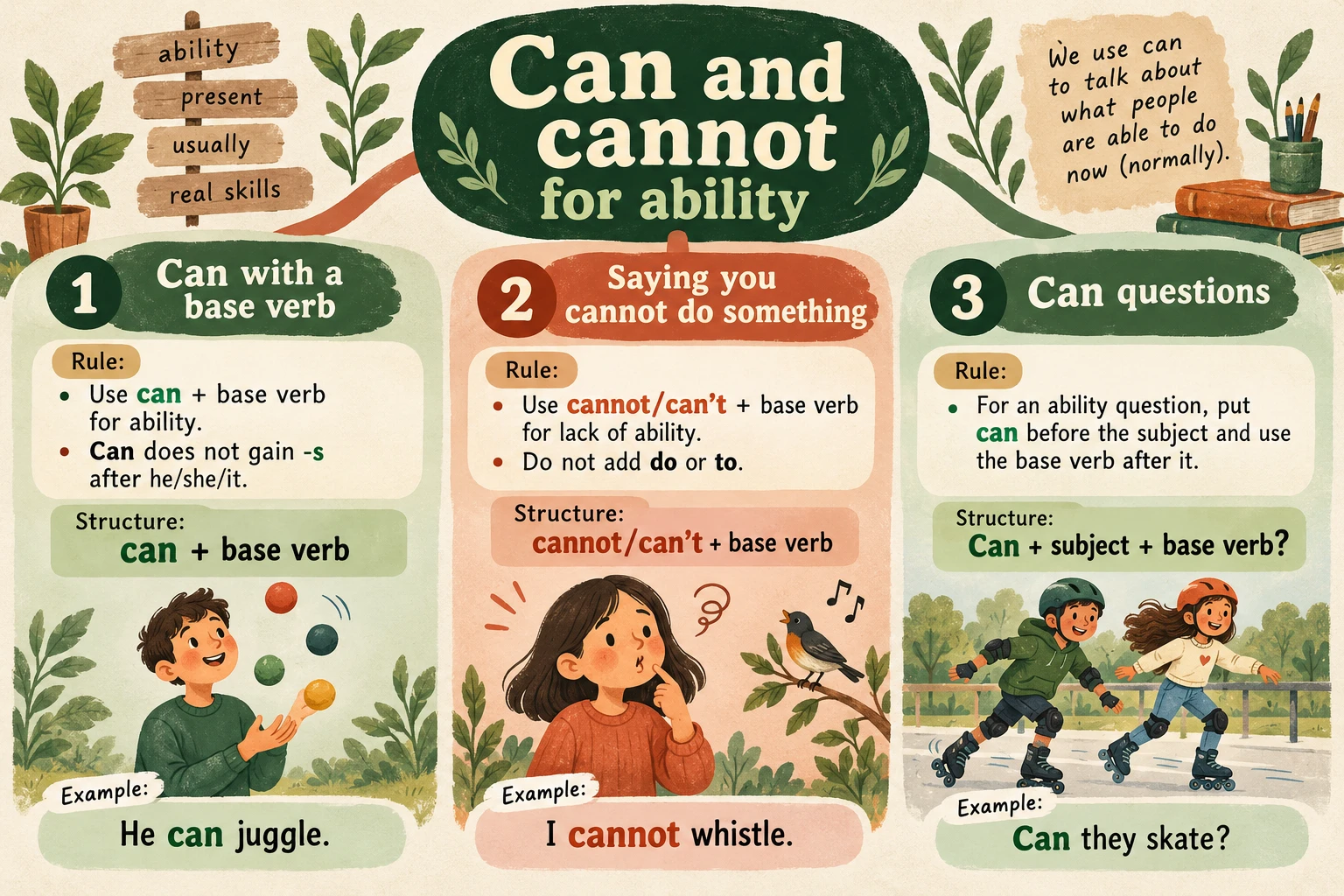
Use can + base verb for ability. Can does not gain -s after he/she/it.
He can juggle.Use cannot/can’t + base verb for lack of ability; do not add do or to.
I cannot whistle.For an ability question, put can before the subject and use the base verb after it.
Can they skate?
Lea is a good swimmer. She can ___ a long way. (swim)
Use can + base verb for ability. Can does not gain -s after he/she/it.
He can juggle.Use cannot/can’t + base verb for lack of ability; do not add do or to.
I cannot whistle.For an ability question, put can before the subject and use the base verb after it.
Can they skate?Keep the first try. Understand the change. Check it in a fresh situation.
No practice notes yet. Try a short warm-up.
Use can + base verb for ability. Can does not gain -s after he/she/it.
He can juggle.Use cannot/can’t + base verb for lack of ability; do not add do or to.
I cannot whistle.For an ability question, put can before the subject and use the base verb after it.
Can they skate?Opening an answer records help for that question.
Lea is a good swimmer. She can ___ a long way. (swim)
Look at “Lea is a good swimmer. She can ___ a long way. (swim)”. Use can + base verb for ability. Can does not gain -s after he/she/it. Complete sentence: “Lea is a good swimmer. She can swim a long way. (swim)”.
I do not know how to drive. I ___ drive.
Look at “I do not know how to drive. I ___ drive.”. Use cannot/can’t + base verb for lack of ability; do not add do or to. Complete sentence: “I do not know how to drive. I cannot drive.”.
___ your brother speak Italian?
Look at “___ your brother speak Italian?”. For an ability question, put can before the subject and use the base verb after it. Complete sentence: “Can your brother speak Italian?”.
This bird can ___ my name. (say)
Reference completion: “This bird can say my name. (say)”. Use can + base verb for ability. Can does not gain -s after he/she/it.
The baby is only two months old. She ___ walk yet.
Look at “The baby is only two months old. She ___ walk yet.”. Use cannot/can’t + base verb for lack of ability; do not add do or to. Complete sentence: “The baby is only two months old. She cannot walk yet.”.
Can Omar ___ a bicycle? (ride)
Look at “Can Omar ___ a bicycle? (ride)”. For an ability question, put can before the subject and use the base verb after it. Complete sentence: “Can Omar ride a bicycle? (ride)”.
My aunt can ___ three languages. (speak)
Reference completion: “My aunt can speak three languages. (speak)”. Use can + base verb for ability. Can does not gain -s after he/she/it.
Our new robot can ___ stairs. (climb)
Look at “Our new robot can ___ stairs. (climb)”. Use can + base verb for ability. Can does not gain -s after he/she/it. Complete sentence: “Our new robot can climb stairs. (climb)”.
He has never learned to read music. He ___ read this score.
Look at “He has never learned to read music. He ___ read this score.”. Use cannot/can’t + base verb for lack of ability; do not add do or to. Complete sentence: “He has never learned to read music. He cannot read this score.”.
Can you ___ the letters at the back? (see)
Reference completion: “Can you see the letters at the back? (see)”. For an ability question, put can before the subject and use the base verb after it.
I have lost my voice. I ___ sing today.
Look at “I have lost my voice. I ___ sing today.”. Use cannot/can’t + base verb for lack of ability; do not add do or to. Complete sentence: “I have lost my voice. I cannot sing today.”.
Ask about present ability using can: ___ your sister play the violin?
Reference completion: “Ask about present ability using can: Can your sister play the violin?”. For an ability question, put can before the subject and use the base verb after it.