01Can mit Grundform
Für Fähigkeiten steht can + Grundform. Can bekommt nach he/she/it kein -s.
He can juggle.
Can und cannot für Fähigkeiten · A1. Für Fähigkeiten steht can + Grundform. Can bekommt nach he/she/it kein -s.
Übe Can und cannot für Fähigkeiten in kurzen Situationen. Lies den Hinweis, wähle oder schreibe eine Form und prüfe die Begründung. Die Stufe dient der redaktionellen Orientierung.
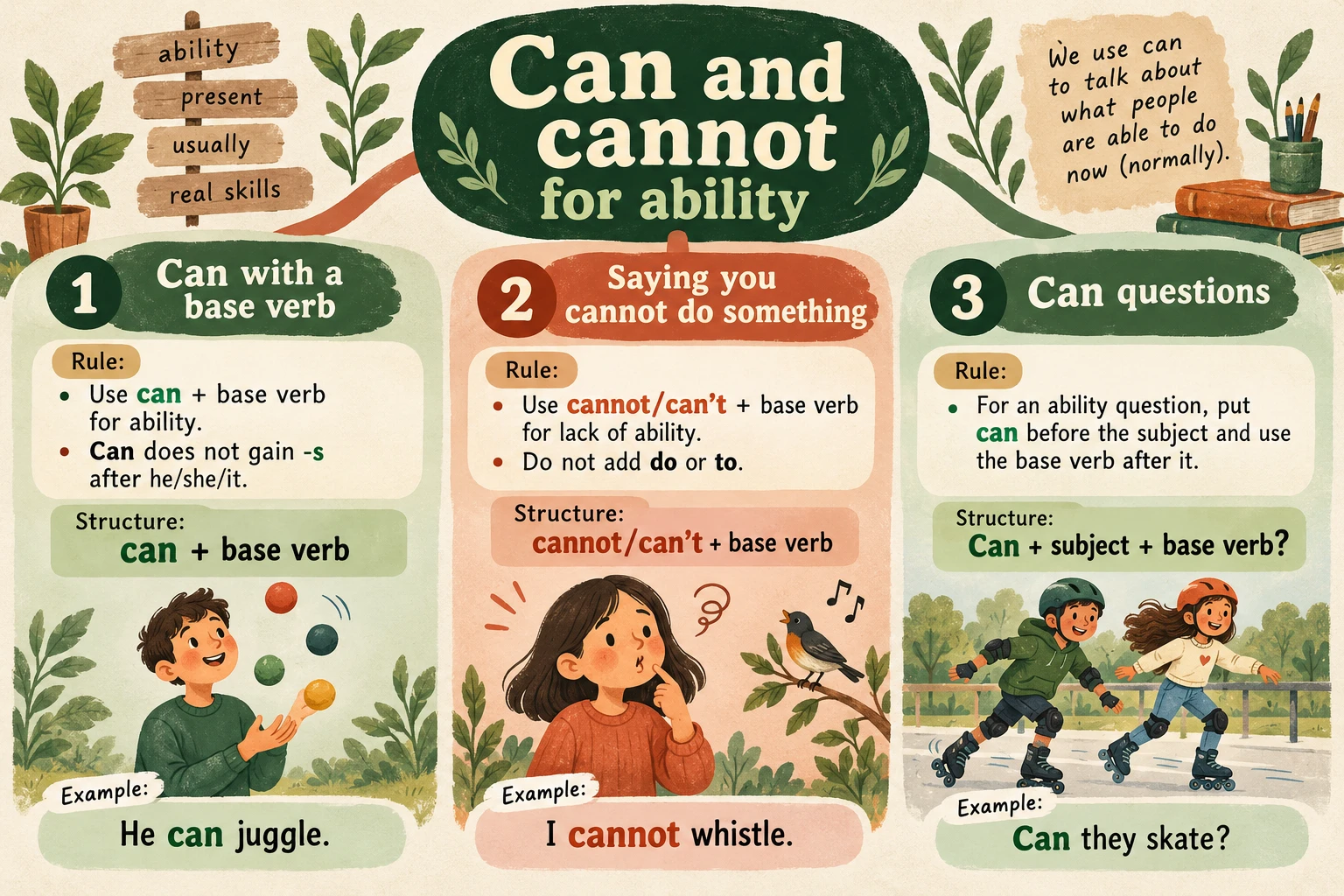
Für Fähigkeiten steht can + Grundform. Can bekommt nach he/she/it kein -s.
He can juggle.Fehlende Fähigkeit: cannot/can’t + Grundform, ohne do oder to.
I cannot whistle.Bei Fähigkeitsfragen steht can vor dem Subjekt, danach die Verbgrundform.
Can they skate?
Lea is a good swimmer. She can ___ a long way. (swim)
Für Fähigkeiten steht can + Grundform. Can bekommt nach he/she/it kein -s.
He can juggle.Fehlende Fähigkeit: cannot/can’t + Grundform, ohne do oder to.
I cannot whistle.Bei Fähigkeitsfragen steht can vor dem Subjekt, danach die Verbgrundform.
Can they skate?Bewahre den ersten Versuch. Verstehe die Änderung. Prüfe sie in einer neuen Situation.
Noch keine Lernnotizen. Starte mit einem kurzen Einstieg.
Für Fähigkeiten steht can + Grundform. Can bekommt nach he/she/it kein -s.
He can juggle.Fehlende Fähigkeit: cannot/can’t + Grundform, ohne do oder to.
I cannot whistle.Bei Fähigkeitsfragen steht can vor dem Subjekt, danach die Verbgrundform.
Can they skate?Das Öffnen einer Antwort wird für diese Aufgabe als Hilfe erfasst.
Lea is a good swimmer. She can ___ a long way. (swim)
Achte auf „Lea is a good swimmer. She can ___ a long way. (swim)“. Für Fähigkeiten steht can + Grundform. Can bekommt nach he/she/it kein -s. Vollständiger Satz: „Lea is a good swimmer. She can swim a long way. (swim)“.
I do not know how to drive. I ___ drive.
Achte auf „I do not know how to drive. I ___ drive.“. Fehlende Fähigkeit: cannot/can’t + Grundform, ohne do oder to. Vollständiger Satz: „I do not know how to drive. I cannot drive.“.
___ your brother speak Italian?
Achte auf „___ your brother speak Italian?“. Bei Fähigkeitsfragen steht can vor dem Subjekt, danach die Verbgrundform. Vollständiger Satz: „Can your brother speak Italian?“.
This bird can ___ my name. (say)
Vollständiger Beispielsatz: „This bird can say my name. (say)“. Für Fähigkeiten steht can + Grundform. Can bekommt nach he/she/it kein -s.
The baby is only two months old. She ___ walk yet.
Achte auf „The baby is only two months old. She ___ walk yet.“. Fehlende Fähigkeit: cannot/can’t + Grundform, ohne do oder to. Vollständiger Satz: „The baby is only two months old. She cannot walk yet.“.
Can Omar ___ a bicycle? (ride)
Achte auf „Can Omar ___ a bicycle? (ride)“. Bei Fähigkeitsfragen steht can vor dem Subjekt, danach die Verbgrundform. Vollständiger Satz: „Can Omar ride a bicycle? (ride)“.
My aunt can ___ three languages. (speak)
Vollständiger Beispielsatz: „My aunt can speak three languages. (speak)“. Für Fähigkeiten steht can + Grundform. Can bekommt nach he/she/it kein -s.
Our new robot can ___ stairs. (climb)
Achte auf „Our new robot can ___ stairs. (climb)“. Für Fähigkeiten steht can + Grundform. Can bekommt nach he/she/it kein -s. Vollständiger Satz: „Our new robot can climb stairs. (climb)“.
He has never learned to read music. He ___ read this score.
Achte auf „He has never learned to read music. He ___ read this score.“. Fehlende Fähigkeit: cannot/can’t + Grundform, ohne do oder to. Vollständiger Satz: „He has never learned to read music. He cannot read this score.“.
Can you ___ the letters at the back? (see)
Vollständiger Beispielsatz: „Can you see the letters at the back? (see)“. Bei Fähigkeitsfragen steht can vor dem Subjekt, danach die Verbgrundform.
I have lost my voice. I ___ sing today.
Achte auf „I have lost my voice. I ___ sing today.“. Fehlende Fähigkeit: cannot/can’t + Grundform, ohne do oder to. Vollständiger Satz: „I have lost my voice. I cannot sing today.“.
Ask about present ability using can: ___ your sister play the violin?
Vollständiger Beispielsatz: „Ask about present ability using can: Can your sister play the violin?“. Bei Fähigkeitsfragen steht can vor dem Subjekt, danach die Verbgrundform.