01Can avec la base verbale
Utilise can + base verbale pour la capacité. Can ne prend pas -s avec he/she/it.
He can juggle.
Can et cannot pour la capacité · A1. Utilise can + base verbale pour la capacité. Can ne prend pas -s avec he/she/it.
Travaille Can et cannot pour la capacité dans de courtes situations. Lis l’indice, choisis ou écris une forme, puis vérifie l’explication. Le niveau est une indication éditoriale.
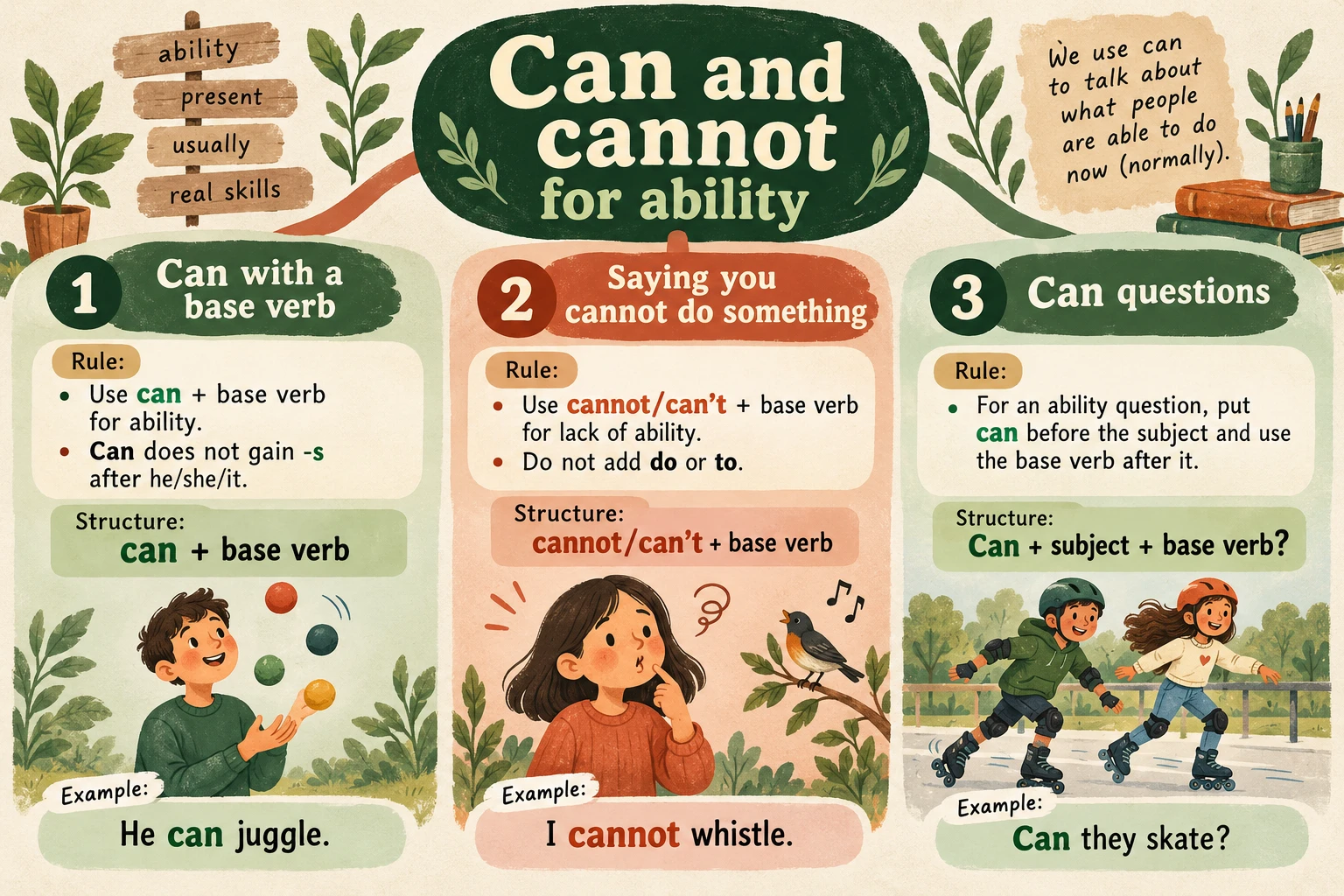
Utilise can + base verbale pour la capacité. Can ne prend pas -s avec he/she/it.
He can juggle.Pour l’incapacité, utilise cannot/can’t + base verbale, sans do ni to.
I cannot whistle.Pour une question de capacité, place can avant le sujet, suivi de la base verbale.
Can they skate?
Lea is a good swimmer. She can ___ a long way. (swim)
Utilise can + base verbale pour la capacité. Can ne prend pas -s avec he/she/it.
He can juggle.Pour l’incapacité, utilise cannot/can’t + base verbale, sans do ni to.
I cannot whistle.Pour une question de capacité, place can avant le sujet, suivi de la base verbale.
Can they skate?Gardez la première tentative, comprenez le changement et essayez dans une nouvelle situation.
Pas encore de notes. Essayez un court échauffement.
Utilise can + base verbale pour la capacité. Can ne prend pas -s avec he/she/it.
He can juggle.Pour l’incapacité, utilise cannot/can’t + base verbale, sans do ni to.
I cannot whistle.Pour une question de capacité, place can avant le sujet, suivi de la base verbale.
Can they skate?Ouvrir une réponse enregistre une aide pour cette question.
Lea is a good swimmer. She can ___ a long way. (swim)
Observe « Lea is a good swimmer. She can ___ a long way. (swim) ». Utilise can + base verbale pour la capacité. Can ne prend pas -s avec he/she/it. Phrase complète : « Lea is a good swimmer. She can swim a long way. (swim) ».
I do not know how to drive. I ___ drive.
Observe « I do not know how to drive. I ___ drive. ». Pour l’incapacité, utilise cannot/can’t + base verbale, sans do ni to. Phrase complète : « I do not know how to drive. I cannot drive. ».
___ your brother speak Italian?
Observe « ___ your brother speak Italian? ». Pour une question de capacité, place can avant le sujet, suivi de la base verbale. Phrase complète : « Can your brother speak Italian? ».
This bird can ___ my name. (say)
Phrase de référence : « This bird can say my name. (say) ». Utilise can + base verbale pour la capacité. Can ne prend pas -s avec he/she/it.
The baby is only two months old. She ___ walk yet.
Observe « The baby is only two months old. She ___ walk yet. ». Pour l’incapacité, utilise cannot/can’t + base verbale, sans do ni to. Phrase complète : « The baby is only two months old. She cannot walk yet. ».
Can Omar ___ a bicycle? (ride)
Observe « Can Omar ___ a bicycle? (ride) ». Pour une question de capacité, place can avant le sujet, suivi de la base verbale. Phrase complète : « Can Omar ride a bicycle? (ride) ».
My aunt can ___ three languages. (speak)
Phrase de référence : « My aunt can speak three languages. (speak) ». Utilise can + base verbale pour la capacité. Can ne prend pas -s avec he/she/it.
Our new robot can ___ stairs. (climb)
Observe « Our new robot can ___ stairs. (climb) ». Utilise can + base verbale pour la capacité. Can ne prend pas -s avec he/she/it. Phrase complète : « Our new robot can climb stairs. (climb) ».
He has never learned to read music. He ___ read this score.
Observe « He has never learned to read music. He ___ read this score. ». Pour l’incapacité, utilise cannot/can’t + base verbale, sans do ni to. Phrase complète : « He has never learned to read music. He cannot read this score. ».
Can you ___ the letters at the back? (see)
Phrase de référence : « Can you see the letters at the back? (see) ». Pour une question de capacité, place can avant le sujet, suivi de la base verbale.
I have lost my voice. I ___ sing today.
Observe « I have lost my voice. I ___ sing today. ». Pour l’incapacité, utilise cannot/can’t + base verbale, sans do ni to. Phrase complète : « I have lost my voice. I cannot sing today. ».
Ask about present ability using can: ___ your sister play the violin?
Phrase de référence : « Ask about present ability using can: Can your sister play the violin? ». Pour une question de capacité, place can avant le sujet, suivi de la base verbale.