01Pronomes como sujeito
O pronome sujeito realiza a ação: I, you, he, she, it, we, they.
We play tennis.
Pronomes de sujeito e objeto · A1. O pronome sujeito realiza a ação: I, you, he, she, it, we, they.
Pratique Pronomes de sujeito e objeto em situações curtas. Leia a pista, escolha ou escreva uma forma e confira a explicação. O nível é uma orientação editorial.
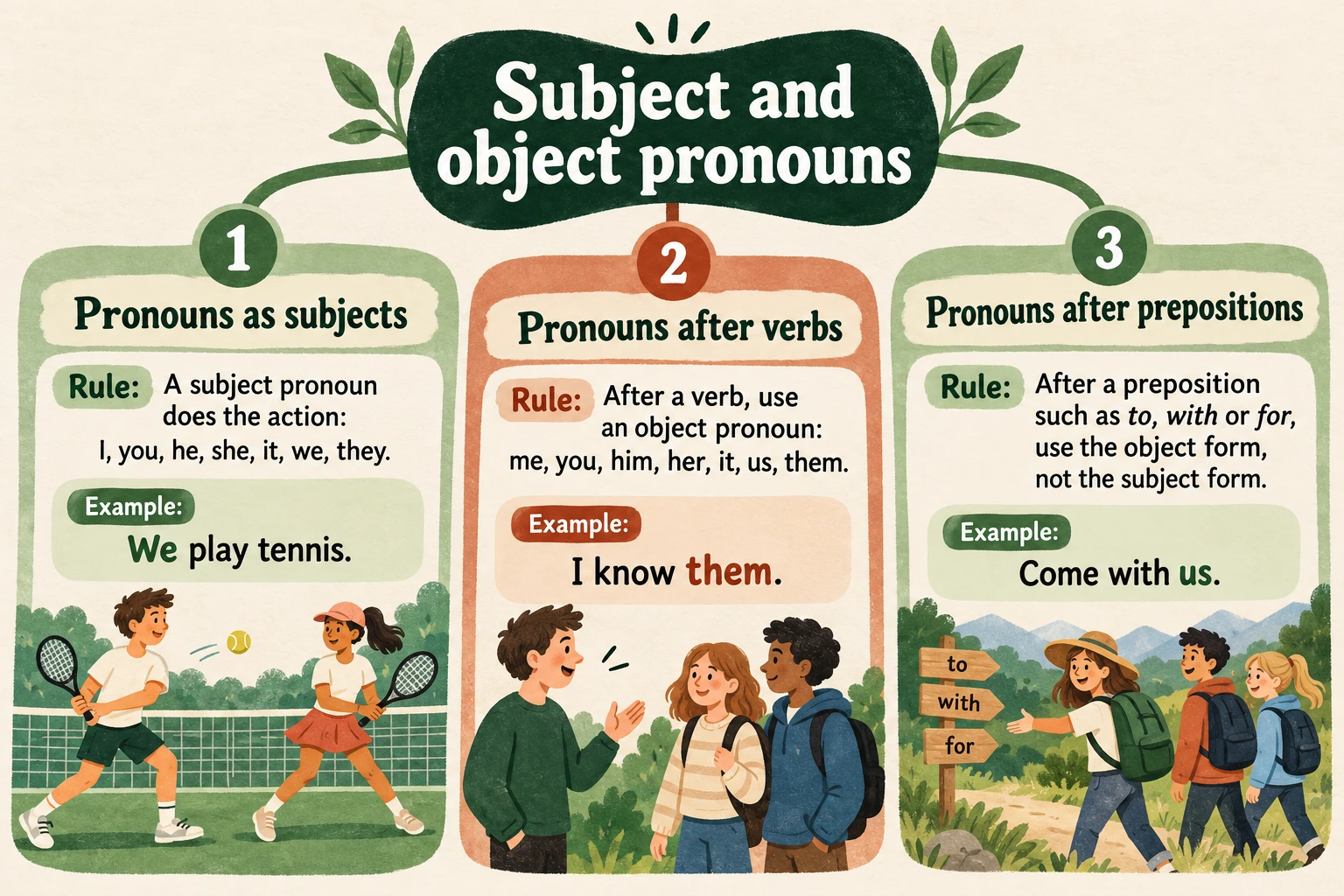
O pronome sujeito realiza a ação: I, you, he, she, it, we, they.
We play tennis.Depois do verbo, use um pronome objeto: me, you, him, her, it, us, them.
I know them.Depois de preposições como to, with ou for, use a forma de objeto.
Come with us.
My name is Rosa. ___ work at the museum.
O pronome sujeito realiza a ação: I, you, he, she, it, we, they.
We play tennis.Depois do verbo, use um pronome objeto: me, you, him, her, it, us, them.
I know them.Depois de preposições como to, with ou for, use a forma de objeto.
Come with us.Guarde a primeira tentativa, entenda a mudança e confira em outra situação.
Ainda não há revisões. Faça um aquecimento curto.
O pronome sujeito realiza a ação: I, you, he, she, it, we, they.
We play tennis.Depois do verbo, use um pronome objeto: me, you, him, her, it, us, them.
I know them.Depois de preposições como to, with ou for, use a forma de objeto.
Come with us.Abrir uma resposta registra ajuda para essa questão.
My name is Rosa. ___ work at the museum.
Observe “My name is Rosa. ___ work at the museum.”. O pronome sujeito realiza a ação: I, you, he, she, it, we, they. Frase completa: “My name is Rosa. I work at the museum.”.
Tom is waiting. Please call ___.
Observe “Tom is waiting. Please call ___.”. Depois do verbo, use um pronome objeto: me, you, him, her, it, us, them. Frase completa: “Tom is waiting. Please call him.”.
The tickets are for Anna and me. They are for ___.
Observe “The tickets are for Anna and me. They are for ___.”. Depois de preposições como to, with ou for, use a forma de objeto. Frase completa: “The tickets are for Anna and me. They are for us.”.
My brother and I live together. ___ live on King Street.
Frase de referência: “My brother and I live together. We live on King Street.”. O pronome sujeito realiza a ação: I, you, he, she, it, we, they.
These are my keys. Please give ___ back.
Observe “These are my keys. Please give ___ back.”. Depois do verbo, use um pronome objeto: me, you, him, her, it, us, them. Frase completa: “These are my keys. Please give them back.”.
I am going with Sara. I am going with ___.
Observe “I am going with Sara. I am going with ___.”. Depois de preposições como to, with ou for, use a forma de objeto. Frase completa: “I am going with Sara. I am going with her.”.
The cat is hungry. ___ wants some food.
O gato é um único animal. It é neutro; he ou she também funciona quando se conhece o sexo. As três formas usam wants. Também são aceitas estas variantes revisadas: He / She. A lista não cobre todas as expressões possíveis.
My parents are here. ___ are in the kitchen.
Observe “My parents are here. ___ are in the kitchen.”. O pronome sujeito realiza a ação: I, you, he, she, it, we, they. Frase completa: “My parents are here. They are in the kitchen.”.
I cannot hear the radio. Please turn ___ up.
Observe “I cannot hear the radio. Please turn ___ up.”. Depois do verbo, use um pronome objeto: me, you, him, her, it, us, them. Frase completa: “I cannot hear the radio. Please turn it up.”.
This parcel is for my brother. It is for ___.
Frase de referência: “This parcel is for my brother. It is for him.”. Depois de preposições como to, with ou for, use a forma de objeto.
We need a photo of our whole group, including me. Can you take a photo of ___?
Observe “We need a photo of our whole group, including me. Can you take a photo of ___?”. Depois do verbo, use um pronome objeto: me, you, him, her, it, us, them. Frase completa: “We need a photo of everyone. Can you take a photo of us?”.
Lena is new here. Please sit next to ___.
Frase de referência: “Lena is new here. Please sit next to her.”. Depois de preposições como to, with ou for, use a forma de objeto. Os pronomes de Lena não são especificados. Them também é aceito como forma de objeto de they singular. Após next to, use a forma de objeto, não a de sujeito.