Stated details
Keep the requested person, time, place or amount attached to the correct event.
The doors open at eight. The class starts at nine.

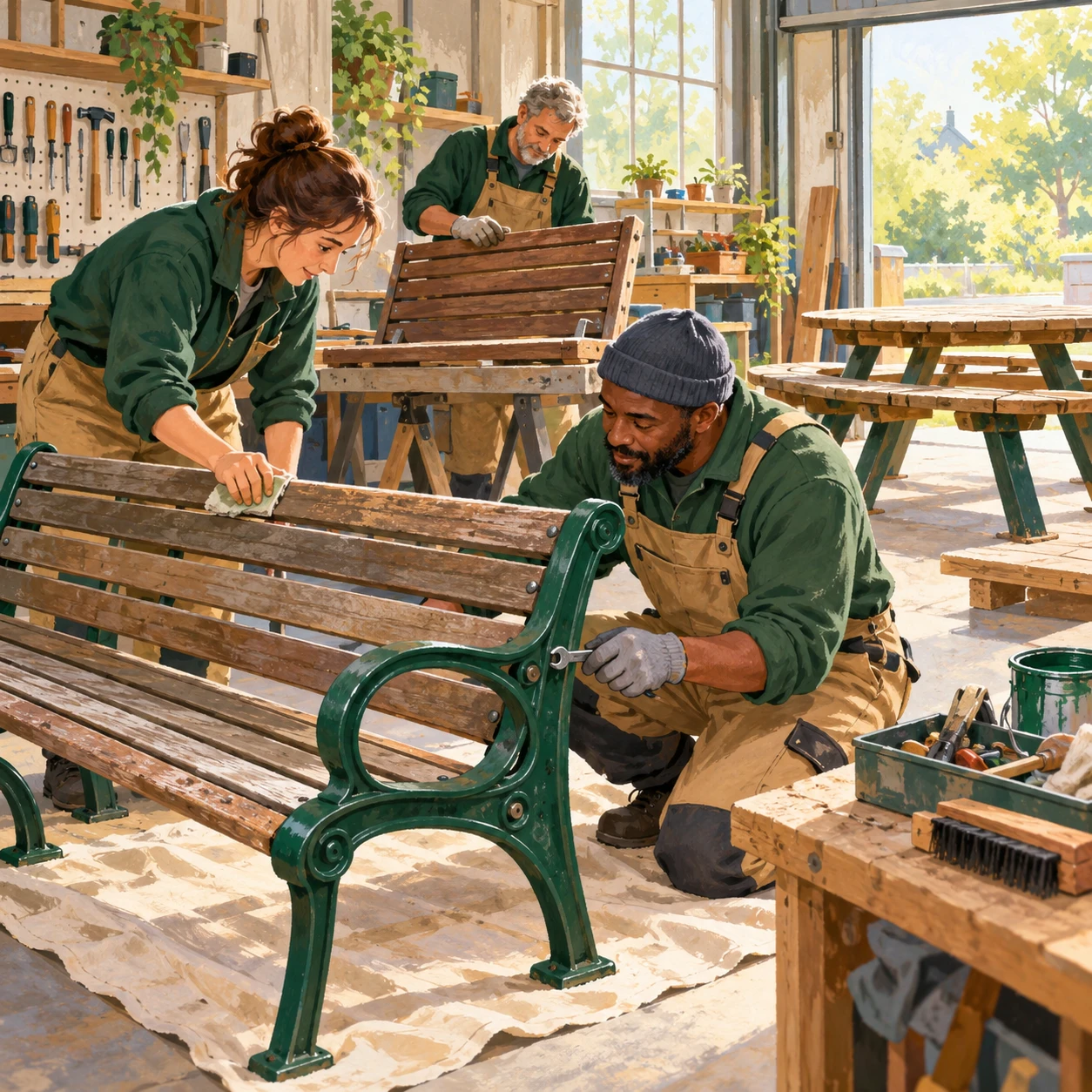
Repairing public equipment · B2. Keep the requested person, time, place or amount attached to the correct event.
Listen to the original English recording, answer the questions, then open the transcript to check the evidence. These related questions use the same recording; the level is an editorial guide, not a certified result.
Listen to the original English recording, answer the questions, then open the transcript to check the evidence. These related questions use the same recording; the level is an editorial guide, not a certified result.
Keep the requested person, time, place or amount attached to the correct event.
The doors open at eight. The class starts at nine.
Use the reason actually given; a plausible reason from outside the text is not enough.
We meet inside because it is raining.
Separate supported claims from what the evidence leaves unknown. No mention does not prove absence. Use the whole text: a true detail is not automatically the main point.
The notice gives a price, but says nothing about delivery.
Listen to the original English recording, answer the questions, then open the transcript to check the evidence. These related questions use the same recording; the level is an editorial guide, not a certified result.
Buying something we can keep using
Keep the requested person, time, place or amount attached to the correct event.
The doors open at eight. The class starts at nine.Use the reason actually given; a plausible reason from outside the text is not enough.
We meet inside because it is raining.Separate supported claims from what the evidence leaves unknown. No mention does not prove absence. Use the whole text: a true detail is not automatically the main point.
The notice gives a price, but says nothing about delivery.Keep your first attempt, check the evidence and try another question. A follow-up on the same material does not prove transfer to a new text.
No practice notes yet. Try a short warm-up.
Keep the requested person, time, place or amount attached to the correct event.
The doors open at eight. The class starts at nine.Use the reason actually given; a plausible reason from outside the text is not enough.
We meet inside because it is raining.Separate supported claims from what the evidence leaves unknown. No mention does not prove absence. Use the whole text: a true detail is not automatically the main point.
The notice gives a price, but says nothing about delivery.Opening an answer records help for that question.
Buying something we can keep using
The supported answer is “Information about replacement parts.”. Evidence: “The offer contained no information about replacement parts, and the components were joined in a way that made separate repairs difficult.”. Compare the alternative “Whether the supplier could deliver quickly.”. This describes information already supplied, whereas the question asks what was missing. Check the source wording “supplier could deliver quickly” against the question and the claim “Whether the supplier could deliver quickly.”. Compare the alternative “Whether the offer met the basic table description.”. This describes information already supplied, whereas the question asks what was missing. Check the source wording “It met the basic description” against the question and the claim “Whether the offer met the basic table description.”.
Buying something we can keep using
The supported answer is “It depended on a specialist tool available only from its manufacturer.”. Evidence: “One higher-priced product turned out to require a specialist tool available only from its manufacturer.”. Compare the alternative “It came with a parts list but no repair instructions.”. This adds a specific detail that the account does not provide; plausibility is not textual evidence. Compare the alternative “Its standard fittings depended on a single local supplier.”. This assigns a feature or action to the wrong group or speaker.
Buying something we can keep using
The supported answer is “Very little by themselves; longer experience is needed.”. Evidence: “A low number of repairs during the first few months would not yet demonstrate a long service life.”. Compare the alternative “That durability has already been demonstrated across different seasons.”. This claims more certainty or wider applicability than this evidence allows. Compare the alternative “That spare-part availability will have little relevance to later maintenance.”. This extends a qualified finding into a claim without exceptions.
Buying something we can keep using
The supported answer is “Standard fittings and separately replaceable surfaces.”. Evidence: “The product we eventually chose cost more initially than the cheapest offer but used standard fittings and separately replaceable surfaces.”. Compare the alternative “A lower initial cost than the cheapest offer, with similar repair uncertainty.”. This confuses two stages of the account: the initial situation and a later check or decision. Compare the alternative “A promise that its materials would not need maintenance.”. This extends a qualified finding into a claim without exceptions.
Buying something we can keep using
The supported answer is “People must also be able to understand them, get parts and perform safe repairs.”. Evidence: “The maintenance team needs to be able to understand them, obtain the parts and carry out the work safely within a reasonable time.”. Compare the alternative “Technicians are permitted to consult the instructions only after replacement is approved.”. This adds a specific detail that the account does not provide; plausibility is not textual evidence. Compare the alternative “A parts list is needed for initial purchase but not for subsequent work.”. This confuses two stages of the account: the initial situation and a later check or decision.
Buying something we can keep using
The supported answer is “Make practical maintenance conditions part of purchasing decisions.”. Evidence: “In future tenders, we intend to ask clearer questions about maintenance rather than add a vague requirement that products must be sustainable.”. Compare the alternative “Use successful delivery as the main test of a product’s lasting usefulness.”. This makes one indicator sufficient on its own, although the passage calls for a broader assessment. Compare the alternative “Use the highest initial price as a practical proxy for easier repair.”. This replaces the stated basis for judging a decision with a different criterion.
Buying something we can keep using
The supported answer is “Before purchase, while options remain.”. Evidence: “the possibility of repair should be considered before purchase, when we still have choices, rather than only after something breaks.”. Compare the alternative “When a fault has occurred and the range of repair choices is already fixed.”. This confuses two stages of the account: the initial situation and a later check or decision. Compare the alternative “After confirming that every supplier offers interchangeable parts.”. This removes or changes a condition that limits the recommendation or claim.
Buying something we can keep using
The supported answer is “Time spent waiting for parts.”. Evidence: “We are recording repairs to the new tables, including time spent waiting for parts.”. Compare the alternative “How long the original delivery took to reach the council.”. This substitutes a different outcome for the one that was measured or reported. Compare the alternative “How much initial purchase prices vary across every park.”. This substitutes a different outcome for the one that was measured or reported.
Buying something we can keep using
The supported answer is “To acknowledge that repair is not always appropriate or safe.”. Evidence: “A badly damaged item may be unsafe to keep using”. Compare the alternative “To report that the newly chosen tables have already failed the safety test.”. This assigns a feature or action to the wrong group or speaker. Compare the alternative “To show that the cost of purchasing replacements should be ignored.”. This extends a qualified finding into a claim without exceptions.
Buying something we can keep using
The supported answer is “That one successful purchase proves the design suits every location.”. Evidence: “Nor can one successful purchase prove that the same design is appropriate for every park or building.”. Compare the alternative “That obtaining a replacement part can affect the time needed for a repair.”. This statement is consistent with the account. It is not the answer because the question asks for a claim rejected, avoided or not justified by the evidence. Compare the alternative “That maintenance conditions influence usefulness after delivery.”. This statement is consistent with the account. It is not the answer because the question asks for a claim rejected, avoided or not justified by the evidence.