
B2

Redesigning an exhibition

About this lesson

Redesigning an exhibition · B2. Combine the actual clues without adding an unsupported fact. Keep the requested person, time, place or amount attached to the correct event.

Listen to the original English recording, answer the questions, then open the transcript to check the evidence. These related questions use the same recording; the level is an editorial guide, not a certified result.

10 items
Save it to find it in My collection.
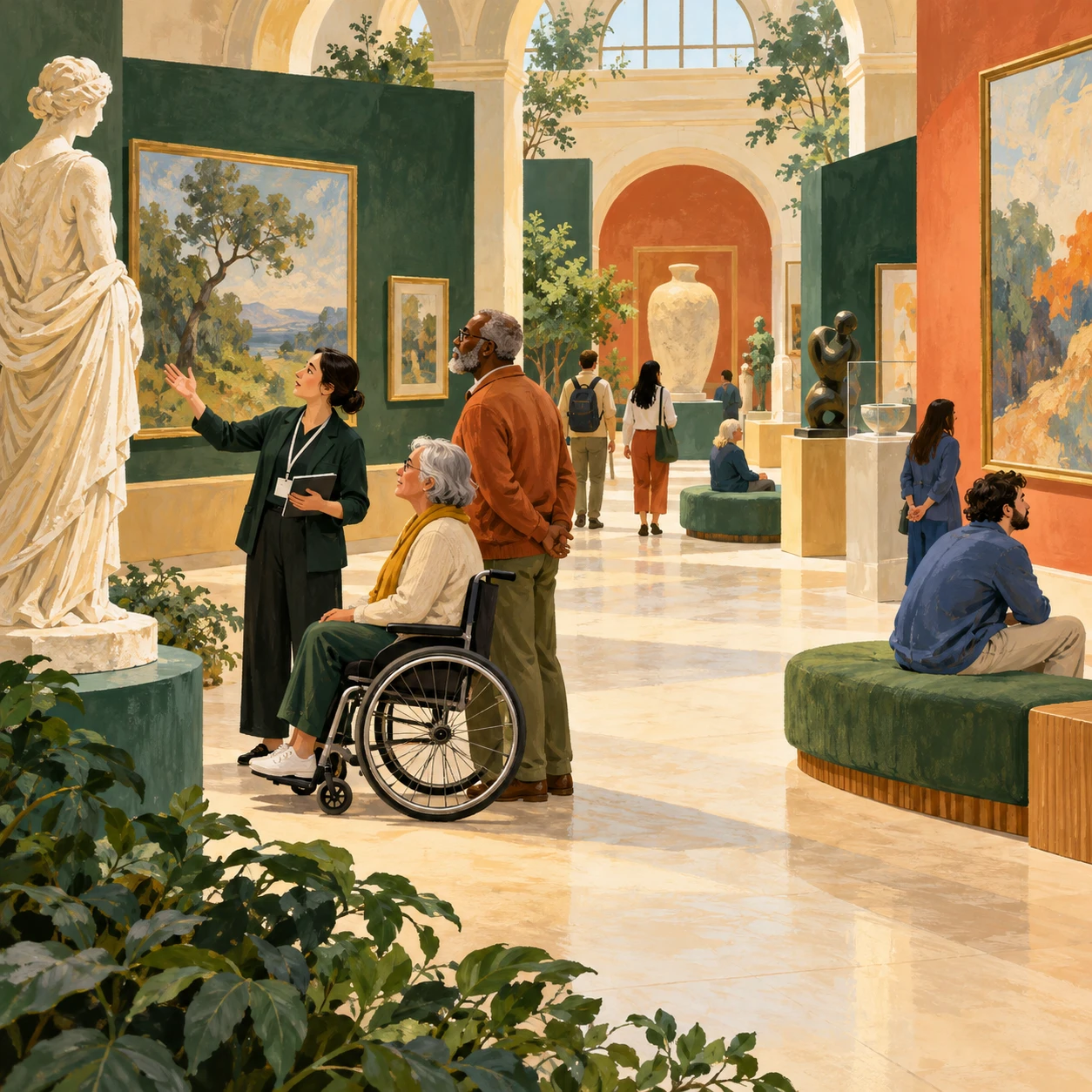
Redesigning an exhibition — context illustration
ListeningB2

Access is more than an entrance

Listen to the original English recording, answer the questions, then open the transcript to check the evidence. These related questions use the same recording; the level is an editorial guide, not a certified result.

A little clarity first

Inference from clues · Stated details

Combine the actual clues without adding an unsupported fact. Keep the requested person, time, place or amount attached to the correct event.

The bag is wet and the umbrella is open: these are clues, not a complete history.

Stated details · Reasons

Keep the requested person, time, place or amount attached to the correct event. Use the reason actually given; a plausible reason from outside the text is not enough.

The doors open at eight. The class starts at nine.

Limits of the evidence · Main point

Separate supported claims from what the evidence leaves unknown. No mention does not prove absence. Use the whole text: a true detail is not automatically the main point.

The notice gives a price, but says nothing about delivery.

Learning material
Redesigning an exhibition — context illustration
ListeningB2

Access is more than an entrance

Listen to the original English recording, answer the questions, then open the transcript to check the evidence. These related questions use the same recording; the level is an editorial guide, not a certified result.

0/10
Questions
01 / 10D01Save it to find it in My collection.

Access is more than an entrance

What did the initial question about a ramp reveal to the speaker?

Your answer
1 / 10

Your learning route

01
Step 1 · Warm-up

Warm-up

0/3
02
Step 2 · Build the skill

Inference from clues · Stated details

0/1

Combine the actual clues without adding an unsupported fact. Keep the requested person, time, place or amount attached to the correct event.

The bag is wet and the umbrella is open: these are clues, not a complete history.
03
Step 3 · Build the skill

Stated details · Reasons

0/1

Keep the requested person, time, place or amount attached to the correct event. Use the reason actually given; a plausible reason from outside the text is not enough.

The doors open at eight. The class starts at nine.
04
Step 4 · Build the skill

Limits of the evidence · Main point

0/1

Separate supported claims from what the evidence leaves unknown. No mention does not prove absence. Use the whole text: a true detail is not automatically the main point.

The notice gives a price, but says nothing about delivery.
05
Step 5 · Related practice

Related practice

0/2
06
Step 6 · Text challenge

Text challenge

0/2
Practice notes in this unit

Make mistakes useful.

Keep your first attempt, check the evidence and try another question. A follow-up on the same material does not prove transfer to a new text.

0

No practice notes yet. Try a short warm-up.

Lesson map

Redesigning an exhibition

B2
Redesigning an exhibition

Lesson points

01

Inference from clues · Stated details

Combine the actual clues without adding an unsupported fact. Keep the requested person, time, place or amount attached to the correct event.

The bag is wet and the umbrella is open: these are clues, not a complete history.
02

Stated details · Reasons

Keep the requested person, time, place or amount attached to the correct event. Use the reason actually given; a plausible reason from outside the text is not enough.

The doors open at eight. The class starts at nine.
03

Limits of the evidence · Main point

Separate supported claims from what the evidence leaves unknown. No mention does not prove absence. Use the whole text: a true detail is not automatically the main point.

The notice gives a price, but says nothing about delivery.

Questions & answers

Opening an answer records help for that question.

D01 · Warm-up

Access is more than an entrance

What did the initial question about a ramp reveal to the speaker?

  1. That visitors had asked for ramps instead of different explanation formats.
  2. That solving the entrance problem would make the exhibition accessible overall.
  3. That access had been discussed too narrowly.
  4. That the museum had decided to prioritise written information over physical access.
Answer & explanation
That access had been discussed too narrowly.

The supported answer is “That access had been discussed too narrowly.”. Evidence: “it also revealed how narrowly we had discussed access.”. Compare the alternative “That the museum had decided to prioritise written information over physical access.”. This adds a specific detail that the account does not provide; plausibility is not textual evidence. Compare the alternative “That solving the entrance problem would make the exhibition accessible overall.”. This makes one indicator sufficient on its own, although the passage calls for a broader assessment.

D02 · Warm-up

Access is more than an entrance

How did conversations challenge the museum’s first explanation for visitors moving towards the bench?

  1. Visitors who could read the text easily had no other barrier to staying.
  2. The language was easy enough that text difficulty could be ruled out.
  3. Everyone heading for the bench had difficulty understanding the panels.
  4. Difficulty standing mattered as well as text difficulty.
Answer & explanation
Difficulty standing mattered as well as text difficulty.

The supported answer is “Difficulty standing mattered as well as text difficulty.”. Evidence: “Some found the language demanding, while others could read it easily but could not stand in one position for long enough.”. Compare the alternative “The language was easy enough that text difficulty could be ruled out.”. This reverses the relationship stated in the passage. Compare the alternative “Everyone heading for the bench had difficulty understanding the panels.”. This extends a qualified finding into a claim without exceptions.

D03 · Warm-up

Access is more than an entrance

Why does the small audio trial not justify an immediate description of every object?

  1. The availability of detailed booklets makes audio description unnecessary.
  2. The trial established that recorded descriptions were less helpful than written ones.
  3. Feedback had already settled which objects would need descriptions.
  4. Production and maintenance need time, and the trial’s coverage was limited.
Answer & explanation
Production and maintenance need time, and the trial’s coverage was limited.

The supported answer is “Production and maintenance need time, and the trial’s coverage was limited.”. Evidence: “Producing and maintaining accurate descriptions takes time, and our trial covered only a small group of objects.”. Compare the alternative “The trial established that recorded descriptions were less helpful than written ones.”. This claims more certainty or wider applicability than this evidence allows. Compare the alternative “Feedback had already settled which objects would need descriptions.”. This reverses the relationship stated in the passage.

P01 · Build the skill

Access is more than an entrance

Where was fuller background information retained in the trial?

  1. In a separate booklet.
  2. In the initial office plan rather than materials available to visitors.
  3. In the audio description produced for every object.
  4. On the shortened main panels themselves.
Answer & explanation
In a separate booklet.

The supported answer is “In a separate booklet.”. Evidence: “We shortened the main text, kept fuller explanations available in a separate booklet”. Compare the alternative “On the shortened main panels themselves.”. This reverses the relationship stated in the passage. Compare the alternative “In the audio description produced for every object.”. This adds a specific detail that the account does not provide; plausibility is not textual evidence.

P02 · Build the skill

Access is more than an entrance

Why were some seats moved twice?

  1. Observation showed problems with how people moved around them.
  2. The initial office drawing showed that the trial positions were correct.
  3. Regular visitors preferred every bench to remain beside the exit.
  4. Visitors could hear the audio only from seats placed near the entrance.
Answer & explanation
Observation showed problems with how people moved around them.

The supported answer is “Observation showed problems with how people moved around them.”. Evidence: “a seat in the wrong place could obstruct a wheelchair’s turning space. We changed the positions twice after watching how people moved”. Compare the alternative “Visitors could hear the audio only from seats placed near the entrance.”. This adds a specific detail that the account does not provide; plausibility is not textual evidence. Compare the alternative “The initial office drawing showed that the trial positions were correct.”. This reverses the relationship stated in the passage.

P03 · Build the skill

Access is more than an entrance

What is the speaker’s central argument?

  1. Openness means that every visitor suggestion must be adopted without delay.
  2. A physical access improvement is sufficient grounds to finish the design review.
  3. Equal access is best achieved by requiring one common explanation format.
  4. Access should shape ongoing design decisions, not just a final check.
Answer & explanation
Access should shape ongoing design decisions, not just a final check.

The supported answer is “Access should shape ongoing design decisions, not just a final check.”. Evidence: “the important shift is away from treating access as a final check on an otherwise finished exhibition.”. Compare the alternative “A physical access improvement is sufficient grounds to finish the design review.”. This treats availability, completion or documentation as sufficient proof of practical quality. Compare the alternative “Equal access is best achieved by requiring one common explanation format.”. This extends a qualified finding into a claim without exceptions.

R01 · Related practice

Access is more than an entrance

What did visitors gain from the different explanation formats?

  1. A fixed order requiring each visitor to use text, booklet and audio.
  2. A promise that the different formats would all contain equally short explanations.
  3. The ability to revise the factual content of the museum’s records.
  4. A choice of how to access information.
Answer & explanation
A choice of how to access information.

The supported answer is “A choice of how to access information.”. Evidence: “Visitors could choose which explanation to use instead of being required to follow one route through identical information.”. Compare the alternative “A fixed order requiring each visitor to use text, booklet and audio.”. This reverses the relationship stated in the passage. Compare the alternative “The ability to revise the factual content of the museum’s records.”. Visitors can choose how to receive an explanation. That choice does not grant authority to revise the museum’s historical records.

R02 · Related practice

Access is more than an entrance

Which changes has the museum decided to retain?

  1. An immediate programme to describe every object in audio.
  2. Different text formats and seating near displays.
  3. The seat layout originally selected in the office.
  4. A single bench by the exit and longer panels.
Answer & explanation
Different text formats and seating near displays.

The supported answer is “Different text formats and seating near displays.”. Evidence: “We have decided to keep the choice of text formats and the seating close to displays.”. Compare the alternative “A single bench by the exit and longer panels.”. This confuses two stages of the account: the initial situation and a later check or decision. Compare the alternative “The seat layout originally selected in the office.”. This confuses two stages of the account: the initial situation and a later check or decision.

X01 · Text challenge

Access is more than an entrance

What did some regular visitors initially miss?

  1. The fuller explanation that the trial removed from every available format.
  2. The background detail omitted from the shorter panels.
  3. The longer standing time expected in the original gallery.
  4. The single route through the same information for all visitors.
Answer & explanation
The background detail omitted from the shorter panels.

The supported answer is “The background detail omitted from the shorter panels.”. Evidence: “several regular visitors missed the background detail until they discovered the booklet.”. Compare the alternative “The fuller explanation that the trial removed from every available format.”. This reverses the relationship stated in the passage. Compare the alternative “The longer standing time expected in the original gallery.”. This substitutes a different outcome for the one that was measured or reported.

X02 · Text challenge

Access is more than an entrance

What does openness to revision mean here?

  1. Avoiding any design choice until it removes every possible access barrier.
  2. Explaining decisions and reconsidering assumptions when feedback challenges them.
  3. Letting visitors approve all historical interpretation before any display opens.
  4. Treating each suggestion as an instruction that must be implemented immediately.
Answer & explanation
Explaining decisions and reconsidering assumptions when feedback challenges them.

The supported answer is “Explaining decisions and reconsidering assumptions when feedback challenges them.”. Evidence: “It means that the reasons for our decisions should be visible and open to revision, especially when the people affected tell us that our assumptions were wrong.”. Compare the alternative “Treating each suggestion as an instruction that must be implemented immediately.”. This extends a qualified finding into a claim without exceptions. Compare the alternative “Letting visitors approve all historical interpretation before any display opens.”. This adds a specific detail that the account does not provide; plausibility is not textual evidence.