01형태 만들기
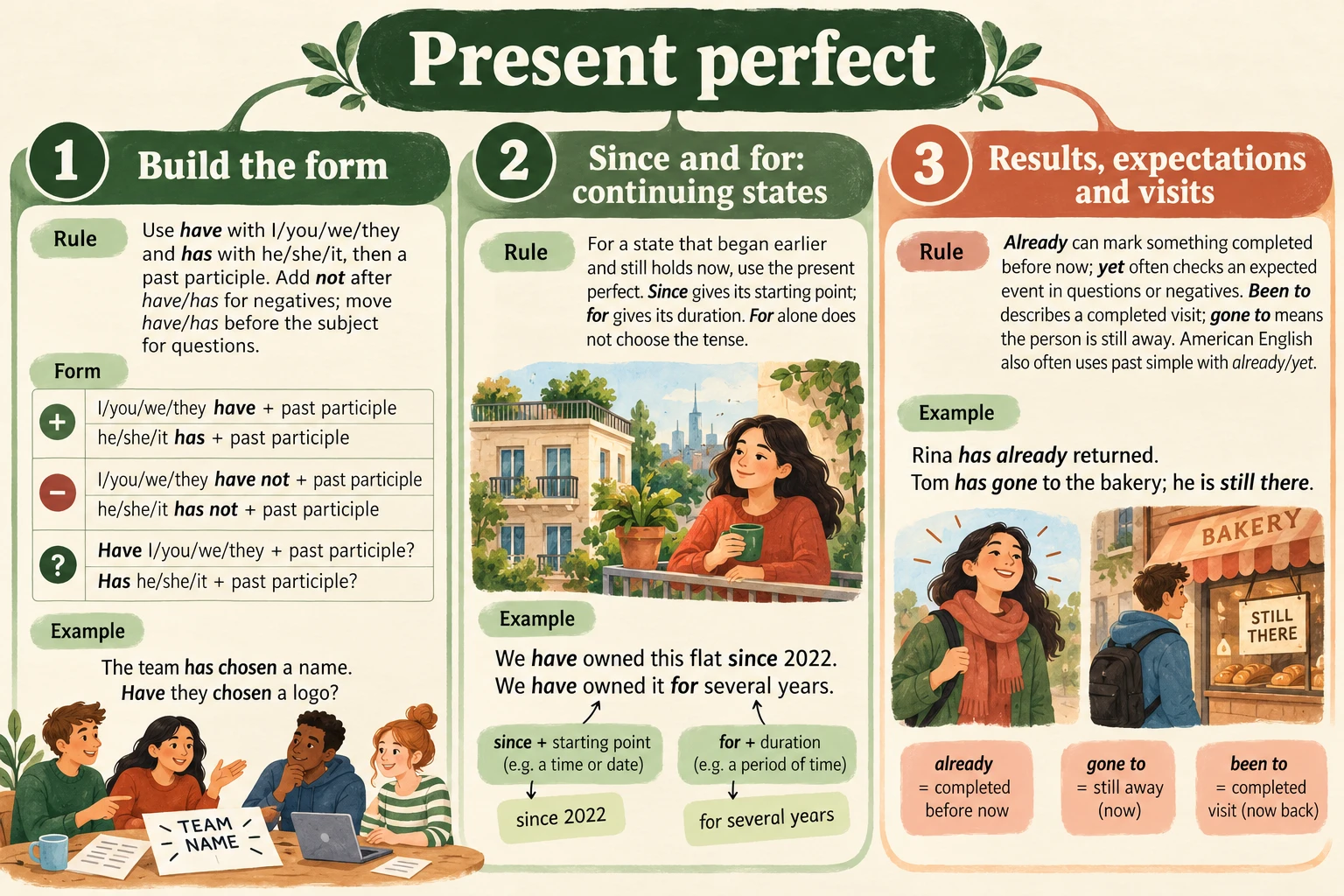
I/you/we/they에는 have, he/she/it에는 has를 쓰고 뒤에 과거분사를 둡니다. 부정문은 have/has 뒤에 not을 넣고, 의문문은 have/has를 주어 앞에 놓습니다.
have/has + past participle
현재완료 · A2. I/you/we/they에는 have, he/she/it에는 has를 쓰고 뒤에 과거분사를 둡니다. 부정문은 have/has 뒤에 not을 넣고, 의문문은 have/has를 주어 앞에 놓습니다.
과거와 현재를 연결해 보세요. have/has, 과거분사, since/for, been/gone를 연습합니다.
I/you/we/they에는 have, he/she/it에는 has를 쓰고 뒤에 과거분사를 둡니다. 부정문은 have/has 뒤에 not을 넣고, 의문문은 have/has를 주어 앞에 놓습니다.
have/has + past participle과거에 시작해 지금도 계속되는 상태는 현재완료로 나타냅니다. since는 시작 시점, for는 기간을 나타냅니다. for만으로 시제가 결정되지는 않습니다.
since + starting point · for + durationalready는 이미 끝난 일을 나타낼 수 있고, yet은 예상한 일에 대한 의문문이나 부정문에 자주 씁니다. been to는 다녀온 방문을, gone to는 아직 돌아오지 않은 상태를 나타냅니다. 미국 영어에서는 already/yet과 과거형도 자주 씁니다.
has gone → still away · has been → returnedI have finished.She has finished.
I haven’t finished.She hasn’t finished.
Have you finished?Has she finished?
Yes, I have.No, she hasn’t.

The team needs an introduction before it can send its report. Ask whether Maya has completed it.
I/you/we/they에는 have, he/she/it에는 has를 쓰고 뒤에 과거분사를 둡니다. 부정문은 have/has 뒤에 not을 넣고, 의문문은 have/has를 주어 앞에 놓습니다.
The team has chosen a name. Have they chosen a logo?과거에 시작해 지금도 계속되는 상태는 현재완료로 나타냅니다. since는 시작 시점, for는 기간을 나타냅니다. for만으로 시제가 결정되지는 않습니다.
We have owned this flat since 2022. We have owned it for several years.already는 이미 끝난 일을 나타낼 수 있고, yet은 예상한 일에 대한 의문문이나 부정문에 자주 씁니다. been to는 다녀온 방문을, gone to는 아직 돌아오지 않은 상태를 나타냅니다. 미국 영어에서는 already/yet과 과거형도 자주 씁니다.
Rina has already returned. Tom has gone to the bakery; he is still there.첫 시도를 남기고 변화의 이유를 이해한 뒤 새로운 상황에서 확인해 보세요.
아직 복습 노트가 없어요. 짧은 워밍업부터 해보세요.
I/you/we/they에는 have, he/she/it에는 has를 쓰고 뒤에 과거분사를 둡니다. 부정문은 have/has 뒤에 not을 넣고, 의문문은 have/has를 주어 앞에 놓습니다.
The team has chosen a name. Have they chosen a logo?과거에 시작해 지금도 계속되는 상태는 현재완료로 나타냅니다. since는 시작 시점, for는 기간을 나타냅니다. for만으로 시제가 결정되지는 않습니다.
We have owned this flat since 2022. We have owned it for several years.already는 이미 끝난 일을 나타낼 수 있고, yet은 예상한 일에 대한 의문문이나 부정문에 자주 씁니다. been to는 다녀온 방문을, gone to는 아직 돌아오지 않은 상태를 나타냅니다. 미국 영어에서는 already/yet과 과거형도 자주 씁니다.
Rina has already returned. Tom has gone to the bakery; he is still there.정답을 열면 해당 문제에 도움 사용이 기록돼요.
The team needs an introduction before it can send its report. Ask whether Maya has completed it.
“The team needs an introduction before it can send its report. Ask whether Maya has completed it.”를 보세요. I/you/we/they에는 have, he/she/it에는 has를 쓰고 뒤에 과거분사를 둡니다. 부정문은 have/has 뒤에 not을 넣고, 의문문은 have/has를 주어 앞에 놓습니다. 완성 문장: “Has Maya written the introduction?”.
I met Leila in 2020. We became friends then and are still friends. I have known Leila ___ 2020.
“I met Leila in 2020. We became friends then and are still friends. I have known Leila ___ 2020.”를 보세요. 과거에 시작해 지금도 계속되는 상태는 현재완료로 나타냅니다. since는 시작 시점, for는 기간을 나타냅니다. for만으로 시제가 결정되지는 않습니다. 완성 문장: “I met Leila in 2020. We became friends then and are still friends. I have known Leila since 2020.”.
Omar left for the library. He is there now and will return at six.
“Omar left for the library. He is there now and will return at six.”를 보세요. already는 이미 끝난 일을 나타낼 수 있고, yet은 예상한 일에 대한 의문문이나 부정문에 자주 씁니다. been to는 다녀온 방문을, gone to는 아직 돌아오지 않은 상태를 나타냅니다. 미국 영어에서는 already/yet과 과거형도 자주 씁니다. 완성 문장: “Omar has gone to the library.”.
We need to see the new timetable before choosing a class. We ___ the new timetable. Please show it to us now.
'We'에는 'have not' 또는 'haven't'를 씁니다. 과거분사는 'saw'가 아니라 'seen'입니다. 이 문제에서는 다음 표현도 확인된 답으로 인정합니다: 've not seen. 가능한 모든 영어 표현의 목록은 아닙니다.
This is my current bicycle. I bought it three years ago and still own it. I have had it ___ three years.
“This is my current bicycle. I bought it three years ago and still own it. I have had it ___ three years.”를 보세요. 과거에 시작해 지금도 계속되는 상태는 현재완료로 나타냅니다. since는 시작 시점, for는 기간을 나타냅니다. for만으로 시제가 결정되지는 않습니다. 완성 문장: “This is my current bicycle. I bought it three years ago and still own it. I have had it for three years.”.
You offer to reserve a table for us. I completed the reservation earlier, so you do not need to do it.
“You offer to reserve a table for us. I completed the reservation earlier, so you do not need to do it.”를 보세요. already는 이미 끝난 일을 나타낼 수 있고, yet은 예상한 일에 대한 의문문이나 부정문에 자주 씁니다. been to는 다녀온 방문을, gone to는 아직 돌아오지 않은 상태를 나타냅니다. 미국 영어에서는 already/yet과 과거형도 자주 씁니다. 완성 문장: “I have already reserved a table.”.
I moved to this town in 2019 and still live here. I have lived here ___ 2019.
2019년에 살기 시작해 지금도 살고 있습니다. 시작 연도 앞에 'since'를 씁니다.
Find the verb-form error: Jon has eat his lunch, so he is not hungry.
Jon은 점심을 먹어서 지금 배가 고프지 않습니다. 'has' 뒤에는 과거분사 'eaten'을 씁니다.
Ava started her current job five years ago and still has it. Find the error: Ava has had this job since five years.
“Ava started her current job five years ago and still has it. Find the error: Ava has had this job since five years.”를 보세요. 과거에 시작해 지금도 계속되는 상태는 현재완료로 나타냅니다. since는 시작 시점, for는 기간을 나타냅니다. for만으로 시제가 결정되지는 않습니다. 완성 문장: “Ava has had this job for five years.”.
Nora visited the post office and is back home now. A message incorrectly says: Nora has gone to the post office.
“Nora visited the post office and is back home now. A message incorrectly says: Nora has gone to the post office.”를 보세요. already는 이미 끝난 일을 나타낼 수 있고, yet은 예상한 일에 대한 의문문이나 부정문에 자주 씁니다. been to는 다녀온 방문을, gone to는 아직 돌아오지 않은 상태를 나타냅니다. 미국 영어에서는 already/yet과 과거형도 자주 씁니다. 완성 문장: “Nora has been to the post office.”.
We are waiting at the stop. The bus is late, and it is not here now. We still expect it to come.
“We are waiting at the stop. The bus is late, and it is not here now. We still expect it to come.”를 보세요. already는 이미 끝난 일을 나타낼 수 있고, yet은 예상한 일에 대한 의문문이나 부정문에 자주 씁니다. been to는 다녀온 방문을, gone to는 아직 돌아오지 않은 상태를 나타냅니다. 미국 영어에서는 already/yet과 과거형도 자주 씁니다. 완성 문장: “The bus has not arrived yet.”.
The paper tray was broken. I repaired it, and the printer works now.
수리한 결과 지금 프린터를 쓸 수 있습니다. 'have fixed'를 쓰며 축약형 'I've fixed'도 인정합니다.