01Construye la forma
Usa have con I/you/we/they y has con he/she/it, seguido de un participio. Añade not después de have/has para negar; coloca have/has antes del sujeto para preguntar.
have/has + past participle
Presente perfecto · A2. Usa have con I/you/we/they y has con he/she/it, seguido de un participio. Añade not después de have/has para negar; coloca have/has antes del sujeto para preguntar.
Conecta el pasado con el presente. Practica have/has, participios, since/for, been y gone.
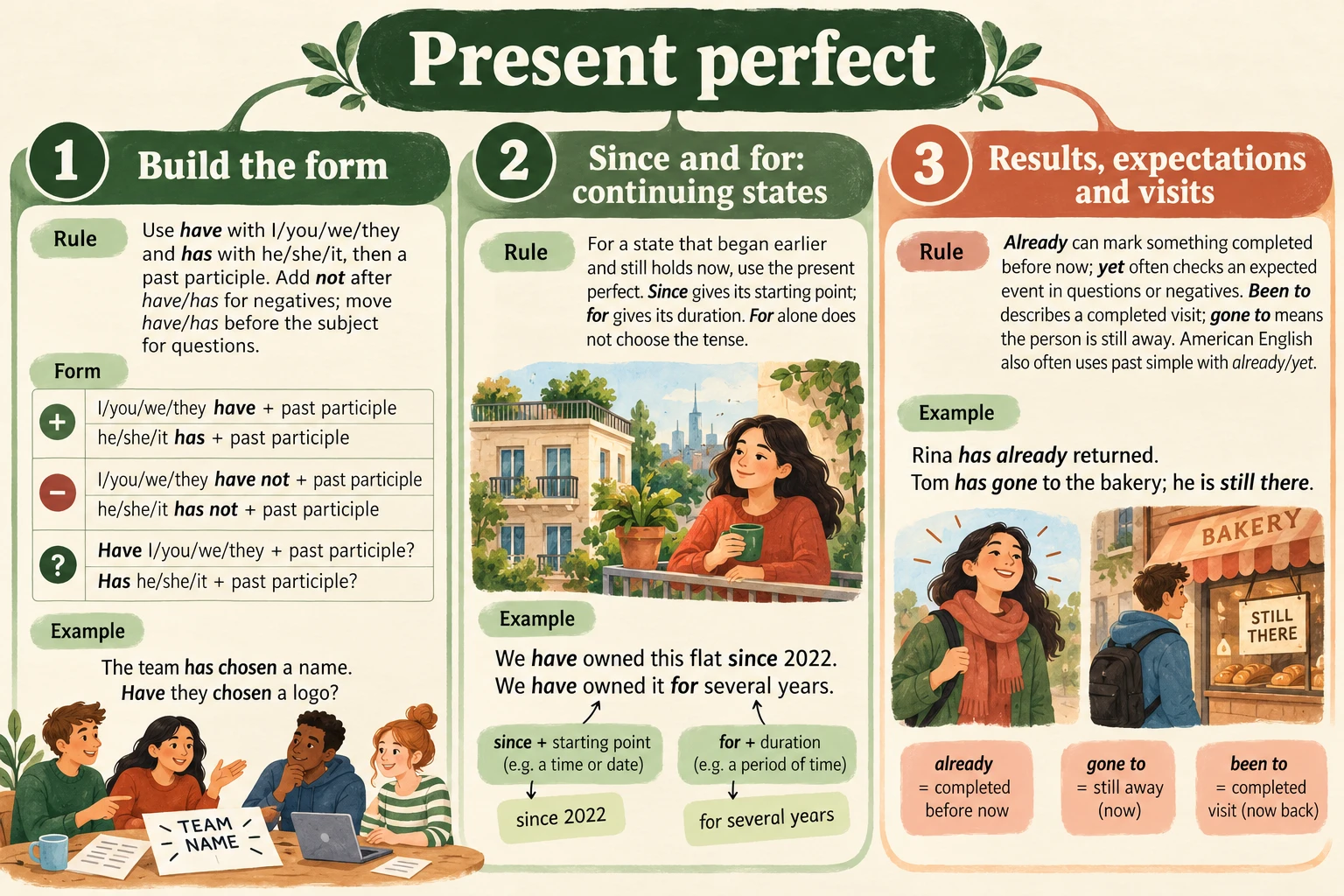
Usa have con I/you/we/they y has con he/she/it, seguido de un participio. Añade not después de have/has para negar; coloca have/has antes del sujeto para preguntar.
have/has + past participlePara un estado que empezó antes y continúa ahora, usa el presente perfecto. Since indica el punto de inicio; for, la duración. For por sí solo no determina el tiempo verbal.
since + starting point · for + durationAlready puede señalar algo ya terminado; yet suele usarse para un hecho esperado en preguntas o negativas. Been to indica una visita con regreso; gone to, que la persona sigue fuera. El inglés estadounidense también usa a menudo el pasado simple con already/yet.
has gone → still away · has been → returnedI have finished.She has finished.
I haven’t finished.She hasn’t finished.
Have you finished?Has she finished?
Yes, I have.No, she hasn’t.
The team needs an introduction before it can send its report. Ask whether Maya has completed it.
Usa have con I/you/we/they y has con he/she/it, seguido de un participio. Añade not después de have/has para negar; coloca have/has antes del sujeto para preguntar.
The team has chosen a name. Have they chosen a logo?Para un estado que empezó antes y continúa ahora, usa el presente perfecto. Since indica el punto de inicio; for, la duración. For por sí solo no determina el tiempo verbal.
We have owned this flat since 2022. We have owned it for several years.Already puede señalar algo ya terminado; yet suele usarse para un hecho esperado en preguntas o negativas. Been to indica una visita con regreso; gone to, que la persona sigue fuera. El inglés estadounidense también usa a menudo el pasado simple con already/yet.
Rina has already returned. Tom has gone to the bakery; he is still there.Conserva el primer intento, entiende el cambio y compruébalo en otra situación.
Aún no hay repasos. Prueba un calentamiento corto.
Usa have con I/you/we/they y has con he/she/it, seguido de un participio. Añade not después de have/has para negar; coloca have/has antes del sujeto para preguntar.
The team has chosen a name. Have they chosen a logo?Para un estado que empezó antes y continúa ahora, usa el presente perfecto. Since indica el punto de inicio; for, la duración. For por sí solo no determina el tiempo verbal.
We have owned this flat since 2022. We have owned it for several years.Already puede señalar algo ya terminado; yet suele usarse para un hecho esperado en preguntas o negativas. Been to indica una visita con regreso; gone to, que la persona sigue fuera. El inglés estadounidense también usa a menudo el pasado simple con already/yet.
Rina has already returned. Tom has gone to the bakery; he is still there.Abrir una respuesta registra ayuda para esa pregunta.
The team needs an introduction before it can send its report. Ask whether Maya has completed it.
Mira «The team needs an introduction before it can send its report. Ask whether Maya has completed it.». Usa have con I/you/we/they y has con he/she/it, seguido de un participio. Añade not después de have/has para negar; coloca have/has antes del sujeto para preguntar. Oración completa: «Has Maya written the introduction?».
I met Leila in 2020. We became friends then and are still friends. I have known Leila ___ 2020.
Mira «I met Leila in 2020. We became friends then and are still friends. I have known Leila ___ 2020.». Para un estado que empezó antes y continúa ahora, usa el presente perfecto. Since indica el punto de inicio; for, la duración. For por sí solo no determina el tiempo verbal. Oración completa: «I met Leila in 2020. We became friends then and are still friends. I have known Leila since 2020.».
Omar left for the library. He is there now and will return at six.
Mira «Omar left for the library. He is there now and will return at six.». Already puede señalar algo ya terminado; yet suele usarse para un hecho esperado en preguntas o negativas. Been to indica una visita con regreso; gone to, que la persona sigue fuera. El inglés estadounidense también usa a menudo el pasado simple con already/yet. Oración completa: «Omar has gone to the library.».
We need to see the new timetable before choosing a class. We ___ the new timetable. Please show it to us now.
Con «we», usa «have not» o «haven't». El participio es «seen», no «saw». También se admiten estas variantes revisadas: 've not seen. No es una lista de todas las expresiones posibles.
This is my current bicycle. I bought it three years ago and still own it. I have had it ___ three years.
Mira «This is my current bicycle. I bought it three years ago and still own it. I have had it ___ three years.». Para un estado que empezó antes y continúa ahora, usa el presente perfecto. Since indica el punto de inicio; for, la duración. For por sí solo no determina el tiempo verbal. Oración completa: «This is my current bicycle. I bought it three years ago and still own it. I have had it for three years.».
You offer to reserve a table for us. I completed the reservation earlier, so you do not need to do it.
Mira «You offer to reserve a table for us. I completed the reservation earlier, so you do not need to do it.». Already puede señalar algo ya terminado; yet suele usarse para un hecho esperado en preguntas o negativas. Been to indica una visita con regreso; gone to, que la persona sigue fuera. El inglés estadounidense también usa a menudo el pasado simple con already/yet. Oración completa: «I have already reserved a table.».
I moved to this town in 2019 and still live here. I have lived here ___ 2019.
Vivir aquí empezó en 2019 y continúa ahora. «Since» introduce ese año de inicio.
Find the verb-form error: Jon has eat his lunch, so he is not hungry.
La comida ha terminado y Jon no tiene hambre ahora. Después de «has», usa el participio «eaten».
Ava started her current job five years ago and still has it. Find the error: Ava has had this job since five years.
Mira «Ava started her current job five years ago and still has it. Find the error: Ava has had this job since five years.». Para un estado que empezó antes y continúa ahora, usa el presente perfecto. Since indica el punto de inicio; for, la duración. For por sí solo no determina el tiempo verbal. Oración completa: «Ava has had this job for five years.».
Nora visited the post office and is back home now. A message incorrectly says: Nora has gone to the post office.
Mira «Nora visited the post office and is back home now. A message incorrectly says: Nora has gone to the post office.». Already puede señalar algo ya terminado; yet suele usarse para un hecho esperado en preguntas o negativas. Been to indica una visita con regreso; gone to, que la persona sigue fuera. El inglés estadounidense también usa a menudo el pasado simple con already/yet. Oración completa: «Nora has been to the post office.».
We are waiting at the stop. The bus is late, and it is not here now. We still expect it to come.
Mira «We are waiting at the stop. The bus is late, and it is not here now. We still expect it to come.». Already puede señalar algo ya terminado; yet suele usarse para un hecho esperado en preguntas o negativas. Been to indica una visita con regreso; gone to, que la persona sigue fuera. El inglés estadounidense también usa a menudo el pasado simple con already/yet. Oración completa: «The bus has not arrived yet.».
The paper tray was broken. I repaired it, and the printer works now.
La reparación tiene un resultado actual: la impresora funciona. Usa «have fixed»; también se acepta «I've fixed».