01Die Form bilden
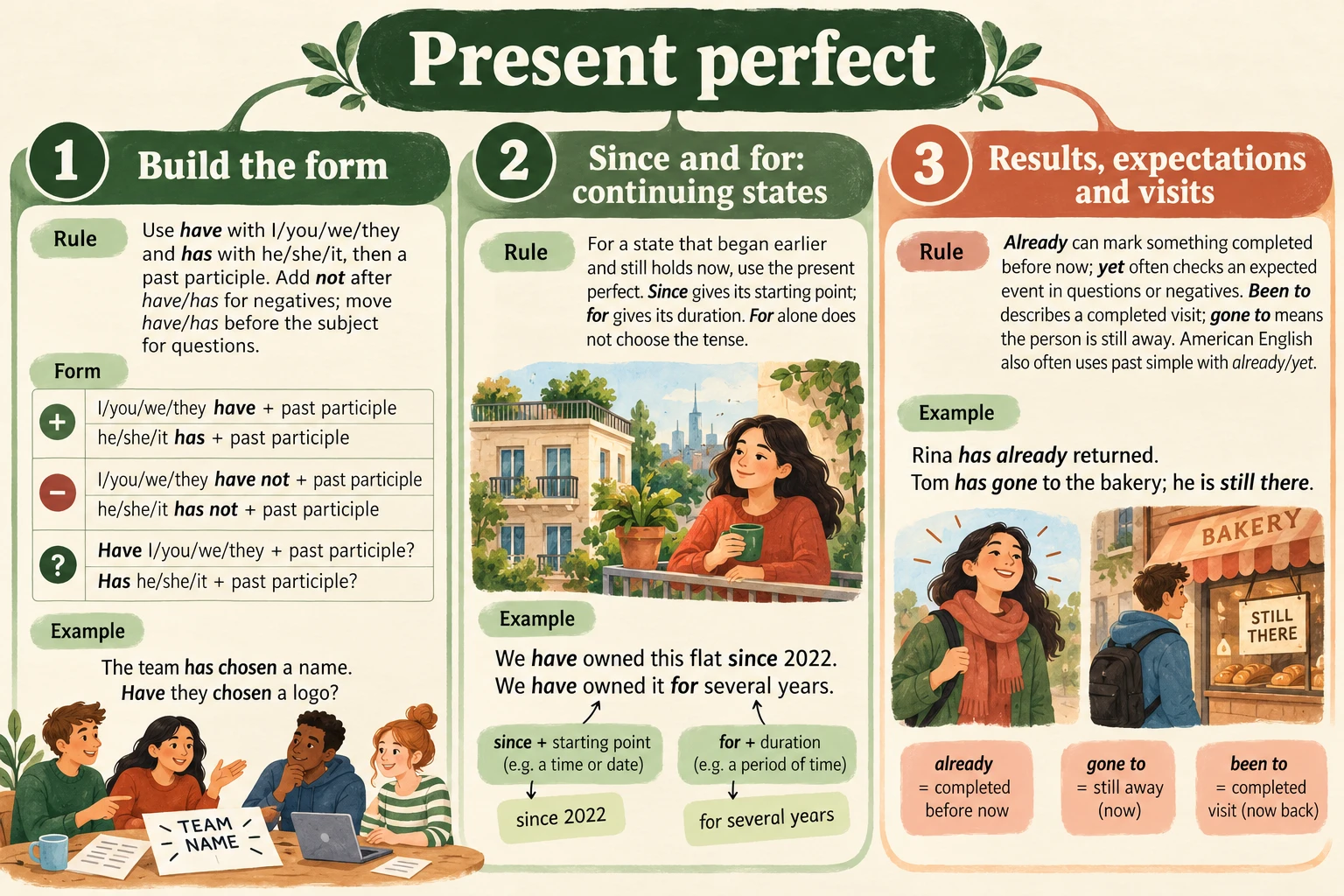
Verwende have bei I/you/we/they und has bei he/she/it, danach das Past Participle. Setze not hinter have/has für Verneinungen; in Fragen steht have/has vor dem Subjekt.
have/has + past participle
Englisches Present Perfect · A2. Verwende have bei I/you/we/they und has bei he/she/it, danach das Past Participle. Setze not hinter have/has für Verneinungen; in Fragen steht have/has vor dem Subjekt.
Verbinde Vergangenes mit der Gegenwart. Übe have/has, Partizipien, since/for sowie been und gone.
Verwende have bei I/you/we/they und has bei he/she/it, danach das Past Participle. Setze not hinter have/has für Verneinungen; in Fragen steht have/has vor dem Subjekt.
have/has + past participleFür einen früher begonnenen Zustand, der noch gilt, verwendest du das Present Perfect. Since nennt den Anfangspunkt, for die Dauer. For allein bestimmt die Zeitform nicht.
since + starting point · for + durationAlready kann etwas bereits Erledigtes markieren; yet fragt oft nach einem erwarteten Ereignis oder steht in Verneinungen. Been to beschreibt einen abgeschlossenen Besuch, gone to eine noch andauernde Abwesenheit. Im amerikanischen Englisch steht bei already/yet oft auch das Simple Past.
has gone → still away · has been → returnedI have finished.She has finished.
I haven’t finished.She hasn’t finished.
Have you finished?Has she finished?
Yes, I have.No, she hasn’t.

The team needs an introduction before it can send its report. Ask whether Maya has completed it.
Verwende have bei I/you/we/they und has bei he/she/it, danach das Past Participle. Setze not hinter have/has für Verneinungen; in Fragen steht have/has vor dem Subjekt.
The team has chosen a name. Have they chosen a logo?Für einen früher begonnenen Zustand, der noch gilt, verwendest du das Present Perfect. Since nennt den Anfangspunkt, for die Dauer. For allein bestimmt die Zeitform nicht.
We have owned this flat since 2022. We have owned it for several years.Already kann etwas bereits Erledigtes markieren; yet fragt oft nach einem erwarteten Ereignis oder steht in Verneinungen. Been to beschreibt einen abgeschlossenen Besuch, gone to eine noch andauernde Abwesenheit. Im amerikanischen Englisch steht bei already/yet oft auch das Simple Past.
Rina has already returned. Tom has gone to the bakery; he is still there.Bewahre den ersten Versuch. Verstehe die Änderung. Prüfe sie in einer neuen Situation.
Noch keine Lernnotizen. Starte mit einem kurzen Einstieg.
Verwende have bei I/you/we/they und has bei he/she/it, danach das Past Participle. Setze not hinter have/has für Verneinungen; in Fragen steht have/has vor dem Subjekt.
The team has chosen a name. Have they chosen a logo?Für einen früher begonnenen Zustand, der noch gilt, verwendest du das Present Perfect. Since nennt den Anfangspunkt, for die Dauer. For allein bestimmt die Zeitform nicht.
We have owned this flat since 2022. We have owned it for several years.Already kann etwas bereits Erledigtes markieren; yet fragt oft nach einem erwarteten Ereignis oder steht in Verneinungen. Been to beschreibt einen abgeschlossenen Besuch, gone to eine noch andauernde Abwesenheit. Im amerikanischen Englisch steht bei already/yet oft auch das Simple Past.
Rina has already returned. Tom has gone to the bakery; he is still there.Das Öffnen einer Antwort wird für diese Aufgabe als Hilfe erfasst.
The team needs an introduction before it can send its report. Ask whether Maya has completed it.
Achte auf „The team needs an introduction before it can send its report. Ask whether Maya has completed it.“. Verwende have bei I/you/we/they und has bei he/she/it, danach das Past Participle. Setze not hinter have/has für Verneinungen; in Fragen steht have/has vor dem Subjekt. Vollständiger Satz: „Has Maya written the introduction?“.
I met Leila in 2020. We became friends then and are still friends. I have known Leila ___ 2020.
Achte auf „I met Leila in 2020. We became friends then and are still friends. I have known Leila ___ 2020.“. Für einen früher begonnenen Zustand, der noch gilt, verwendest du das Present Perfect. Since nennt den Anfangspunkt, for die Dauer. For allein bestimmt die Zeitform nicht. Vollständiger Satz: „I met Leila in 2020. We became friends then and are still friends. I have known Leila since 2020.“.
Omar left for the library. He is there now and will return at six.
Achte auf „Omar left for the library. He is there now and will return at six.“. Already kann etwas bereits Erledigtes markieren; yet fragt oft nach einem erwarteten Ereignis oder steht in Verneinungen. Been to beschreibt einen abgeschlossenen Besuch, gone to eine noch andauernde Abwesenheit. Im amerikanischen Englisch steht bei already/yet oft auch das Simple Past. Vollständiger Satz: „Omar has gone to the library.“.
We need to see the new timetable before choosing a class. We ___ the new timetable. Please show it to us now.
Bei „we“ steht „have not“ oder „haven't“. Das Participle heißt „seen“, nicht „saw“. In dieser Aufgabe sind auch diese Formen geprüft: 've not seen. Die Liste ist nicht vollständig.
This is my current bicycle. I bought it three years ago and still own it. I have had it ___ three years.
Achte auf „This is my current bicycle. I bought it three years ago and still own it. I have had it ___ three years.“. Für einen früher begonnenen Zustand, der noch gilt, verwendest du das Present Perfect. Since nennt den Anfangspunkt, for die Dauer. For allein bestimmt die Zeitform nicht. Vollständiger Satz: „This is my current bicycle. I bought it three years ago and still own it. I have had it for three years.“.
You offer to reserve a table for us. I completed the reservation earlier, so you do not need to do it.
Achte auf „You offer to reserve a table for us. I completed the reservation earlier, so you do not need to do it.“. Already kann etwas bereits Erledigtes markieren; yet fragt oft nach einem erwarteten Ereignis oder steht in Verneinungen. Been to beschreibt einen abgeschlossenen Besuch, gone to eine noch andauernde Abwesenheit. Im amerikanischen Englisch steht bei already/yet oft auch das Simple Past. Vollständiger Satz: „I have already reserved a table.“.
I moved to this town in 2019 and still live here. I have lived here ___ 2019.
Das Wohnen hier begann 2019 und dauert an. „Since“ leitet dieses Anfangsjahr ein.
Find the verb-form error: Jon has eat his lunch, so he is not hungry.
Jon hat fertig gegessen und ist jetzt nicht hungrig. Nach „has“ steht das Participle „eaten“.
Ava started her current job five years ago and still has it. Find the error: Ava has had this job since five years.
Achte auf „Ava started her current job five years ago and still has it. Find the error: Ava has had this job since five years.“. Für einen früher begonnenen Zustand, der noch gilt, verwendest du das Present Perfect. Since nennt den Anfangspunkt, for die Dauer. For allein bestimmt die Zeitform nicht. Vollständiger Satz: „Ava has had this job for five years.“.
Nora visited the post office and is back home now. A message incorrectly says: Nora has gone to the post office.
Achte auf „Nora visited the post office and is back home now. A message incorrectly says: Nora has gone to the post office.“. Already kann etwas bereits Erledigtes markieren; yet fragt oft nach einem erwarteten Ereignis oder steht in Verneinungen. Been to beschreibt einen abgeschlossenen Besuch, gone to eine noch andauernde Abwesenheit. Im amerikanischen Englisch steht bei already/yet oft auch das Simple Past. Vollständiger Satz: „Nora has been to the post office.“.
We are waiting at the stop. The bus is late, and it is not here now. We still expect it to come.
Achte auf „We are waiting at the stop. The bus is late, and it is not here now. We still expect it to come.“. Already kann etwas bereits Erledigtes markieren; yet fragt oft nach einem erwarteten Ereignis oder steht in Verneinungen. Been to beschreibt einen abgeschlossenen Besuch, gone to eine noch andauernde Abwesenheit. Im amerikanischen Englisch steht bei already/yet oft auch das Simple Past. Vollständiger Satz: „The bus has not arrived yet.“.
The paper tray was broken. I repaired it, and the printer works now.
Die Reparatur hat ein aktuelles Ergebnis: Der Drucker funktioniert jetzt. Verwende „have fixed“; auch „I've fixed“ wird akzeptiert.