01Build the form
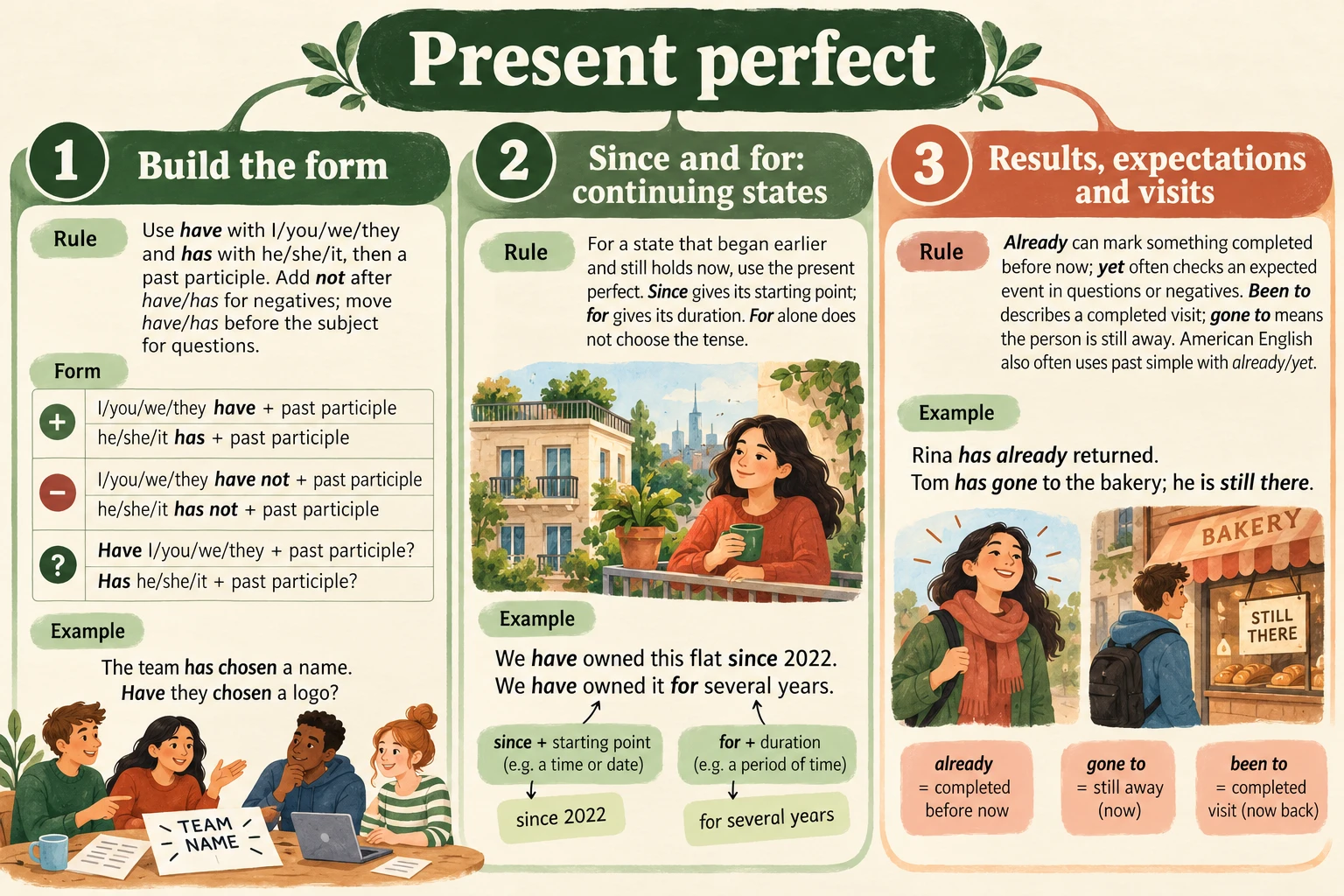
Use have with I/you/we/they and has with he/she/it, then a past participle. Add not after have/has for negatives; move have/has before the subject for questions.
have/has + past participle
Present perfect · A2. Use have with I/you/we/they and has with he/she/it, then a past participle. Add not after have/has for negatives; move have/has before the subject for questions.
Connect past events with now. Practise have/has, participles, since/for, been and gone.
Use have with I/you/we/they and has with he/she/it, then a past participle. Add not after have/has for negatives; move have/has before the subject for questions.
have/has + past participleFor a state that began earlier and still holds now, use the present perfect. Since gives its starting point; for gives its duration. For alone does not choose the tense.
since + starting point · for + durationAlready can mark something completed before now; yet often checks an expected event in questions or negatives. Been to describes a completed visit; gone to means the person is still away. American English also often uses past simple with already/yet.
has gone → still away · has been → returnedI have finished.She has finished.
I haven’t finished.She hasn’t finished.
Have you finished?Has she finished?
Yes, I have.No, she hasn’t.
The team needs an introduction before it can send its report. Ask whether Maya has completed it.
Use have with I/you/we/they and has with he/she/it, then a past participle. Add not after have/has for negatives; move have/has before the subject for questions.
The team has chosen a name. Have they chosen a logo?For a state that began earlier and still holds now, use the present perfect. Since gives its starting point; for gives its duration. For alone does not choose the tense.
We have owned this flat since 2022. We have owned it for several years.Already can mark something completed before now; yet often checks an expected event in questions or negatives. Been to describes a completed visit; gone to means the person is still away. American English also often uses past simple with already/yet.
Rina has already returned. Tom has gone to the bakery; he is still there.Keep the first try. Understand the change. Check it in a fresh situation.
No practice notes yet. Try a short warm-up.
Use have with I/you/we/they and has with he/she/it, then a past participle. Add not after have/has for negatives; move have/has before the subject for questions.
The team has chosen a name. Have they chosen a logo?For a state that began earlier and still holds now, use the present perfect. Since gives its starting point; for gives its duration. For alone does not choose the tense.
We have owned this flat since 2022. We have owned it for several years.Already can mark something completed before now; yet often checks an expected event in questions or negatives. Been to describes a completed visit; gone to means the person is still away. American English also often uses past simple with already/yet.
Rina has already returned. Tom has gone to the bakery; he is still there.Opening an answer records help for that question.
The team needs an introduction before it can send its report. Ask whether Maya has completed it.
Look at “The team needs an introduction before it can send its report. Ask whether Maya has completed it.”. Use have with I/you/we/they and has with he/she/it, then a past participle. Add not after have/has for negatives; move have/has before the subject for questions. Complete sentence: “Has Maya written the introduction?”.
I met Leila in 2020. We became friends then and are still friends. I have known Leila ___ 2020.
Look at “I met Leila in 2020. We became friends then and are still friends. I have known Leila ___ 2020.”. For a state that began earlier and still holds now, use the present perfect. Since gives its starting point; for gives its duration. For alone does not choose the tense. Complete sentence: “I met Leila in 2020. We became friends then and are still friends. I have known Leila since 2020.”.
Omar left for the library. He is there now and will return at six.
Look at “Omar left for the library. He is there now and will return at six.”. Already can mark something completed before now; yet often checks an expected event in questions or negatives. Been to describes a completed visit; gone to means the person is still away. American English also often uses past simple with already/yet. Complete sentence: “Omar has gone to the library.”.
We need to see the new timetable before choosing a class. We ___ the new timetable. Please show it to us now.
With 'we', use 'have not' or 'haven't'. The participle is 'seen', not 'saw'. Also accepted in this task: 've not seen. These are reviewed alternatives, not an exhaustive list of all possible English.
This is my current bicycle. I bought it three years ago and still own it. I have had it ___ three years.
Look at “This is my current bicycle. I bought it three years ago and still own it. I have had it ___ three years.”. For a state that began earlier and still holds now, use the present perfect. Since gives its starting point; for gives its duration. For alone does not choose the tense. Complete sentence: “This is my current bicycle. I bought it three years ago and still own it. I have had it for three years.”.
You offer to reserve a table for us. I completed the reservation earlier, so you do not need to do it.
Look at “You offer to reserve a table for us. I completed the reservation earlier, so you do not need to do it.”. Already can mark something completed before now; yet often checks an expected event in questions or negatives. Been to describes a completed visit; gone to means the person is still away. American English also often uses past simple with already/yet. Complete sentence: “I have already reserved a table.”.
I moved to this town in 2019 and still live here. I have lived here ___ 2019.
Living here started in 2019 and continues now. 'Since' introduces that starting year.
Find the verb-form error: Jon has eat his lunch, so he is not hungry.
The lunch is finished and Jon is not hungry now. After 'has', use the participle 'eaten'.
Ava started her current job five years ago and still has it. Find the error: Ava has had this job since five years.
Look at “Ava started her current job five years ago and still has it. Find the error: Ava has had this job since five years.”. For a state that began earlier and still holds now, use the present perfect. Since gives its starting point; for gives its duration. For alone does not choose the tense. Complete sentence: “Ava has had this job for five years.”.
Nora visited the post office and is back home now. A message incorrectly says: Nora has gone to the post office.
Look at “Nora visited the post office and is back home now. A message incorrectly says: Nora has gone to the post office.”. Already can mark something completed before now; yet often checks an expected event in questions or negatives. Been to describes a completed visit; gone to means the person is still away. American English also often uses past simple with already/yet. Complete sentence: “Nora has been to the post office.”.
We are waiting at the stop. The bus is late, and it is not here now. We still expect it to come.
Look at “We are waiting at the stop. The bus is late, and it is not here now. We still expect it to come.”. Already can mark something completed before now; yet often checks an expected event in questions or negatives. Been to describes a completed visit; gone to means the person is still away. American English also often uses past simple with already/yet. Complete sentence: “The bus has not arrived yet.”.
The paper tray was broken. I repaired it, and the printer works now.
The repair has a present result: the printer works now. Use 'have fixed'; 'I've fixed' is also accepted.