01Construire la forme
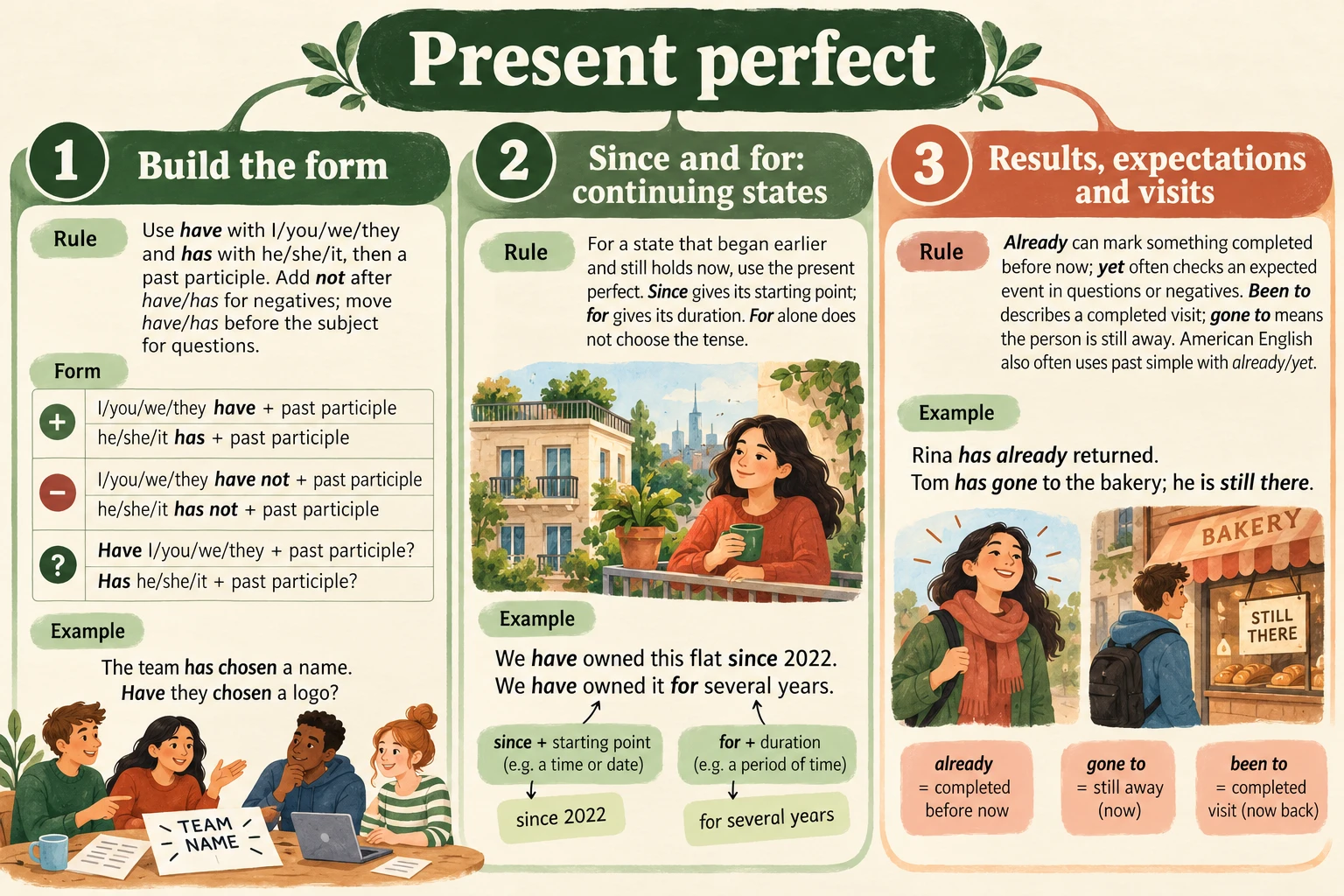
Utilisez have avec I/you/we/they et has avec he/she/it, puis un participe passé. Ajoutez not après have/has pour nier ; placez have/has avant le sujet pour poser une question.
have/has + past participle
Present perfect anglais · A2. Utilisez have avec I/you/we/they et has avec he/she/it, puis un participe passé. Ajoutez not après have/has pour nier ; placez have/has avant le sujet pour poser une question.
Reliez le passé au présent. Pratiquez have/has, les participes, since/for, been et gone.
Utilisez have avec I/you/we/they et has avec he/she/it, puis un participe passé. Ajoutez not après have/has pour nier ; placez have/has avant le sujet pour poser une question.
have/has + past participlePour un état commencé dans le passé et toujours actuel, utilisez le present perfect. Since indique le point de départ ; for indique la durée. For seul ne détermine pas le temps verbal.
since + starting point · for + durationAlready peut marquer un fait déjà accompli ; yet s’emploie souvent dans une question ou négation concernant un événement attendu. Been to décrit une visite terminée ; gone to indique que la personne est encore absente. L’anglais américain emploie aussi souvent le prétérit avec already/yet.
has gone → still away · has been → returnedI have finished.She has finished.
I haven’t finished.She hasn’t finished.
Have you finished?Has she finished?
Yes, I have.No, she hasn’t.

The team needs an introduction before it can send its report. Ask whether Maya has completed it.
Utilisez have avec I/you/we/they et has avec he/she/it, puis un participe passé. Ajoutez not après have/has pour nier ; placez have/has avant le sujet pour poser une question.
The team has chosen a name. Have they chosen a logo?Pour un état commencé dans le passé et toujours actuel, utilisez le present perfect. Since indique le point de départ ; for indique la durée. For seul ne détermine pas le temps verbal.
We have owned this flat since 2022. We have owned it for several years.Already peut marquer un fait déjà accompli ; yet s’emploie souvent dans une question ou négation concernant un événement attendu. Been to décrit une visite terminée ; gone to indique que la personne est encore absente. L’anglais américain emploie aussi souvent le prétérit avec already/yet.
Rina has already returned. Tom has gone to the bakery; he is still there.Gardez la première tentative, comprenez le changement et essayez dans une nouvelle situation.
Pas encore de notes. Essayez un court échauffement.
Utilisez have avec I/you/we/they et has avec he/she/it, puis un participe passé. Ajoutez not après have/has pour nier ; placez have/has avant le sujet pour poser une question.
The team has chosen a name. Have they chosen a logo?Pour un état commencé dans le passé et toujours actuel, utilisez le present perfect. Since indique le point de départ ; for indique la durée. For seul ne détermine pas le temps verbal.
We have owned this flat since 2022. We have owned it for several years.Already peut marquer un fait déjà accompli ; yet s’emploie souvent dans une question ou négation concernant un événement attendu. Been to décrit une visite terminée ; gone to indique que la personne est encore absente. L’anglais américain emploie aussi souvent le prétérit avec already/yet.
Rina has already returned. Tom has gone to the bakery; he is still there.Ouvrir une réponse enregistre une aide pour cette question.
The team needs an introduction before it can send its report. Ask whether Maya has completed it.
Observe « The team needs an introduction before it can send its report. Ask whether Maya has completed it. ». Utilisez have avec I/you/we/they et has avec he/she/it, puis un participe passé. Ajoutez not après have/has pour nier ; placez have/has avant le sujet pour poser une question. Phrase complète : « Has Maya written the introduction? ».
I met Leila in 2020. We became friends then and are still friends. I have known Leila ___ 2020.
Observe « I met Leila in 2020. We became friends then and are still friends. I have known Leila ___ 2020. ». Pour un état commencé dans le passé et toujours actuel, utilisez le present perfect. Since indique le point de départ ; for indique la durée. For seul ne détermine pas le temps verbal. Phrase complète : « I met Leila in 2020. We became friends then and are still friends. I have known Leila since 2020. ».
Omar left for the library. He is there now and will return at six.
Observe « Omar left for the library. He is there now and will return at six. ». Already peut marquer un fait déjà accompli ; yet s’emploie souvent dans une question ou négation concernant un événement attendu. Been to décrit une visite terminée ; gone to indique que la personne est encore absente. L’anglais américain emploie aussi souvent le prétérit avec already/yet. Phrase complète : « Omar has gone to the library. ».
We need to see the new timetable before choosing a class. We ___ the new timetable. Please show it to us now.
Avec « we », utilisez « have not » ou « haven't ». Le participe est « seen », et non « saw ». Autres variantes vérifiées pour cette tâche : 've not seen. La liste ne couvre pas toutes les formulations possibles.
This is my current bicycle. I bought it three years ago and still own it. I have had it ___ three years.
Observe « This is my current bicycle. I bought it three years ago and still own it. I have had it ___ three years. ». Pour un état commencé dans le passé et toujours actuel, utilisez le present perfect. Since indique le point de départ ; for indique la durée. For seul ne détermine pas le temps verbal. Phrase complète : « This is my current bicycle. I bought it three years ago and still own it. I have had it for three years. ».
You offer to reserve a table for us. I completed the reservation earlier, so you do not need to do it.
Observe « You offer to reserve a table for us. I completed the reservation earlier, so you do not need to do it. ». Already peut marquer un fait déjà accompli ; yet s’emploie souvent dans une question ou négation concernant un événement attendu. Been to décrit une visite terminée ; gone to indique que la personne est encore absente. L’anglais américain emploie aussi souvent le prétérit avec already/yet. Phrase complète : « I have already reserved a table. ».
I moved to this town in 2019 and still live here. I have lived here ___ 2019.
La résidence a commencé en 2019 et continue. « Since » introduit cette année de départ.
Find the verb-form error: Jon has eat his lunch, so he is not hungry.
Jon a fini de déjeuner et n'a pas faim maintenant. Après « has », utilisez le participe « eaten ».
Ava started her current job five years ago and still has it. Find the error: Ava has had this job since five years.
Observe « Ava started her current job five years ago and still has it. Find the error: Ava has had this job since five years. ». Pour un état commencé dans le passé et toujours actuel, utilisez le present perfect. Since indique le point de départ ; for indique la durée. For seul ne détermine pas le temps verbal. Phrase complète : « Ava has had this job for five years. ».
Nora visited the post office and is back home now. A message incorrectly says: Nora has gone to the post office.
Observe « Nora visited the post office and is back home now. A message incorrectly says: Nora has gone to the post office. ». Already peut marquer un fait déjà accompli ; yet s’emploie souvent dans une question ou négation concernant un événement attendu. Been to décrit une visite terminée ; gone to indique que la personne est encore absente. L’anglais américain emploie aussi souvent le prétérit avec already/yet. Phrase complète : « Nora has been to the post office. ».
We are waiting at the stop. The bus is late, and it is not here now. We still expect it to come.
Observe « We are waiting at the stop. The bus is late, and it is not here now. We still expect it to come. ». Already peut marquer un fait déjà accompli ; yet s’emploie souvent dans une question ou négation concernant un événement attendu. Been to décrit une visite terminée ; gone to indique que la personne est encore absente. L’anglais américain emploie aussi souvent le prétérit avec already/yet. Phrase complète : « The bus has not arrived yet. ».
The paper tray was broken. I repaired it, and the printer works now.
La réparation a un résultat présent : l'imprimante fonctionne. Utilisez « have fixed » ; « I've fixed » est aussi accepté.