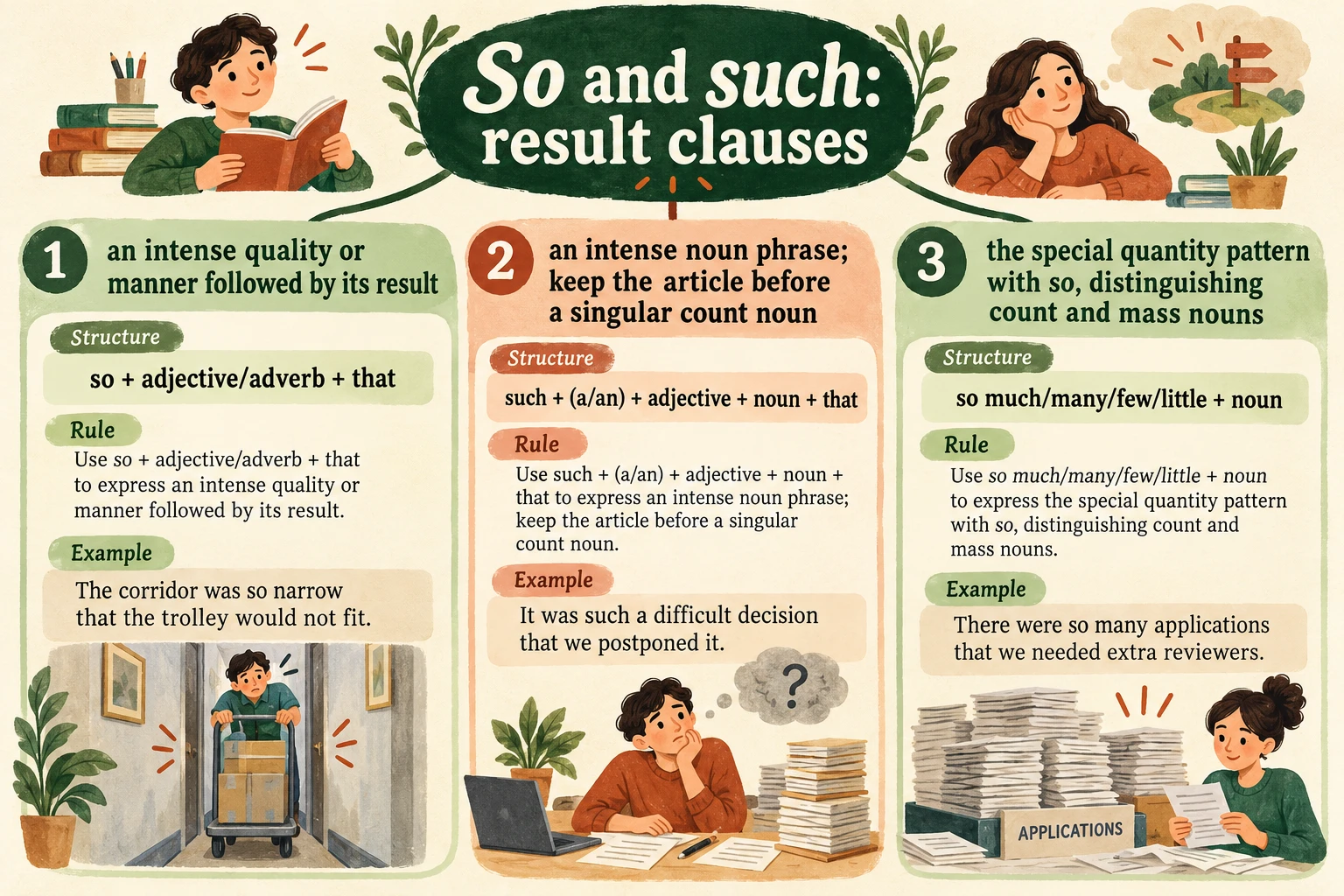
01an intense quality or manner followed by its result
Use so + adjective/adverb + that to express an intense quality or manner followed by its result.
The corridor was so narrow that the trolley would not fit.
So and such: result clauses · B1. Use so + adjective/adverb + that to express an intense quality or manner followed by its result.
Complete 12 original tasks. Use the situation to choose the intended meaning, practise the form, then apply it in a fresh context.
Use so + adjective/adverb + that to express an intense quality or manner followed by its result.
The corridor was so narrow that the trolley would not fit.Use such + (a/an) + adjective + noun + that to express an intense noun phrase; keep the article before a singular count noun.
It was such a difficult decision that we postponed it.Use so much/many/few/little + noun to express the special quantity pattern with so, distinguishing count and mass nouns.
There were so many applications that we needed extra reviewers.
The gap directly modifies an adjective.
Use so + adjective/adverb + that to express an intense quality or manner followed by its result.
The corridor was so narrow that the trolley would not fit.Use such + (a/an) + adjective + noun + that to express an intense noun phrase; keep the article before a singular count noun.
It was such a difficult decision that we postponed it.Use so much/many/few/little + noun to express the special quantity pattern with so, distinguishing count and mass nouns.
There were so many applications that we needed extra reviewers.Keep the first try. Understand the change. Check it in a fresh situation.
No practice notes yet. Try a short warm-up.
Use so + adjective/adverb + that to express an intense quality or manner followed by its result.
The corridor was so narrow that the trolley would not fit.Use such + (a/an) + adjective + noun + that to express an intense noun phrase; keep the article before a singular count noun.
It was such a difficult decision that we postponed it.Use so much/many/few/little + noun to express the special quantity pattern with so, distinguishing count and mass nouns.
There were so many applications that we needed extra reviewers.Opening an answer records help for that question.
The gap directly modifies an adjective.
Look at “The corridor was ___ narrow that the trolley would not fit.”. Use so + adjective/adverb + that to express an intense quality or manner followed by its result. Complete sentence: “The corridor was so narrow that the trolley would not fit.”.
The noun is singular and countable.
Look at “It was ___ difficult decision that we postponed it.”. Use such + (a/an) + adjective + noun + that to express an intense noun phrase; keep the article before a singular count noun. Complete sentence: “It was such a difficult decision that we postponed it.”.
The following plural count noun requires a quantity pattern.
Look at “There were ___ applications that we needed extra reviewers.”. Use so much/many/few/little + noun to express the special quantity pattern with so, distinguishing count and mass nouns. Complete sentence: “There were so many applications that we needed extra reviewers.”.
The gap modifies an adverb.
Look at “She spoke ___ softly that nobody at the back heard.”. Use so + adjective/adverb + that to express an intense quality or manner followed by its result. Complete sentence: “She spoke so softly that nobody at the back heard.”.
Complete the result construction before a singular countable noun phrase.
Complete sentence: “It was such a convincing argument that the committee changed its view.” Use such + (a/an) + adjective + noun + that to express an intense noun phrase; keep the article before a singular count noun. The subject, time and meaning in the task determine this form. Only reviewed responses are matched automatically; other wording is not automatically wrong.
Noise is uncountable in this context.
Look at “There was ___ noise that we could not record.”. Use so much/many/few/little + noun to express the special quantity pattern with so, distinguishing count and mass nouns. Complete sentence: “There was so much noise that we could not record.”.
Complete the result construction directly before the adjective.
Complete sentence: “The instructions were so vague that nobody knew where to start.” Use so + adjective/adverb + that to express an intense quality or manner followed by its result. The subject, time and meaning in the task determine this form. Only reviewed responses are matched automatically; other wording is not automatically wrong.
The gap modifies the adjective bright.
Look at “The sign was ___ bright that drivers complained.”. Use so + adjective/adverb + that to express an intense quality or manner followed by its result. Complete sentence: “The sign was so bright that drivers complained.”.
Complete the result construction before a plural noun phrase.
Complete sentence: “They were such helpful volunteers that we invited them back.” Use such + (a/an) + adjective + noun + that to express an intense noun phrase; keep the article before a singular count noun. The subject, time and meaning in the task determine this form. Only reviewed responses are matched automatically; other wording is not automatically wrong.
There was a very small amount of time, so lunch was skipped. Use the quantity pattern for that small amount.
Look at “There was a very small amount of time, so lunch was skipped. Use the quantity pattern for that small amount.”. Use so much/many/few/little + noun to express the special quantity pattern with so, distinguishing count and mass nouns. Complete sentence: “We had so little time left that we skipped lunch.”.
The number of mistakes was very small, so checking was quick. Use the quantity pattern for that small number.
Look at “The number of mistakes was very small, so checking was quick. Use the quantity pattern for that small number.”. Use such + (a/an) + adjective + noun + that to express an intense noun phrase; keep the article before a singular count noun. Complete sentence: “She made so few mistakes that checking took minutes.”.
Complete the result construction expressing a large number of countable delays.
Complete sentence: “There were so many delays that we missed the final connection.” Use so much/many/few/little + noun to express the special quantity pattern with so, distinguishing count and mass nouns. The subject, time and meaning in the task determine this form. Only reviewed responses are matched automatically; other wording is not automatically wrong.