01una cualidad o manera intensa seguida de su resultado
Usa so + adjective/adverb + that para expresar una cualidad o manera intensa seguida de su resultado.
The corridor was so narrow that the trolley would not fit.
So y such: consecuencias · B1. Usa so + adjective/adverb + that para expresar una cualidad o manera intensa seguida de su resultado.
Completa 12 tareas originales. Deduce el sentido por la situación, practica la forma y aplícala en un contexto nuevo.
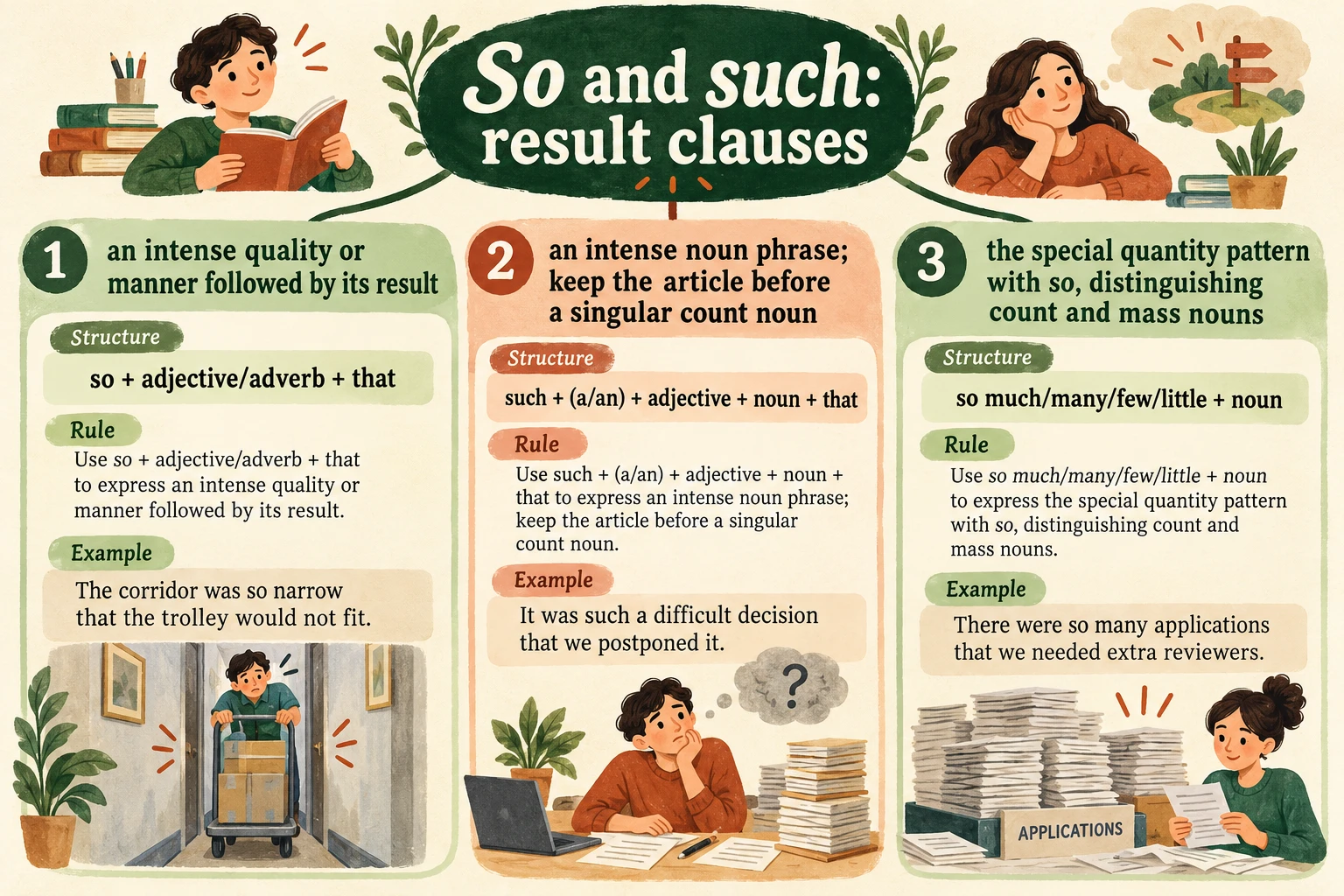
Usa so + adjective/adverb + that para expresar una cualidad o manera intensa seguida de su resultado.
The corridor was so narrow that the trolley would not fit.Usa such + (a/an) + adjective + noun + that para expresar un sintagma nominal intenso; conserva el artículo ante un contable singular.
It was such a difficult decision that we postponed it.Usa so much/many/few/little + noun para expresar la pauta especial de cantidad con so, según sea contable o incontable.
There were so many applications that we needed extra reviewers.
The gap directly modifies an adjective.
Usa so + adjective/adverb + that para expresar una cualidad o manera intensa seguida de su resultado.
The corridor was so narrow that the trolley would not fit.Usa such + (a/an) + adjective + noun + that para expresar un sintagma nominal intenso; conserva el artículo ante un contable singular.
It was such a difficult decision that we postponed it.Usa so much/many/few/little + noun para expresar la pauta especial de cantidad con so, según sea contable o incontable.
There were so many applications that we needed extra reviewers.Conserva el primer intento, entiende el cambio y compruébalo en otra situación.
Aún no hay repasos. Prueba un calentamiento corto.
Usa so + adjective/adverb + that para expresar una cualidad o manera intensa seguida de su resultado.
The corridor was so narrow that the trolley would not fit.Usa such + (a/an) + adjective + noun + that para expresar un sintagma nominal intenso; conserva el artículo ante un contable singular.
It was such a difficult decision that we postponed it.Usa so much/many/few/little + noun para expresar la pauta especial de cantidad con so, según sea contable o incontable.
There were so many applications that we needed extra reviewers.Abrir una respuesta registra ayuda para esa pregunta.
The gap directly modifies an adjective.
Mira «The corridor was ___ narrow that the trolley would not fit.». Usa so + adjective/adverb + that para expresar una cualidad o manera intensa seguida de su resultado. Oración completa: «The corridor was so narrow that the trolley would not fit.».
The noun is singular and countable.
Mira «It was ___ difficult decision that we postponed it.». Usa such + (a/an) + adjective + noun + that para expresar un sintagma nominal intenso; conserva el artículo ante un contable singular. Oración completa: «It was such a difficult decision that we postponed it.».
The following plural count noun requires a quantity pattern.
Mira «There were ___ applications that we needed extra reviewers.». Usa so much/many/few/little + noun para expresar la pauta especial de cantidad con so, según sea contable o incontable. Oración completa: «There were so many applications that we needed extra reviewers.».
The gap modifies an adverb.
Mira «She spoke ___ softly that nobody at the back heard.». Usa so + adjective/adverb + that para expresar una cualidad o manera intensa seguida de su resultado. Oración completa: «She spoke so softly that nobody at the back heard.».
Complete the result construction before a singular countable noun phrase.
Oración completa: «It was such a convincing argument that the committee changed its view.» Usa such + (a/an) + adjective + noun + that para expresar un sintagma nominal intenso; conserva el artículo ante un contable singular. El sujeto, el tiempo y el sentido de la tarea determinan la forma. Solo se cotejan automáticamente las respuestas revisadas; otra redacción no es automáticamente incorrecta.
Noise is uncountable in this context.
Mira «There was ___ noise that we could not record.». Usa so much/many/few/little + noun para expresar la pauta especial de cantidad con so, según sea contable o incontable. Oración completa: «There was so much noise that we could not record.».
Complete the result construction directly before the adjective.
Oración completa: «The instructions were so vague that nobody knew where to start.» Usa so + adjective/adverb + that para expresar una cualidad o manera intensa seguida de su resultado. El sujeto, el tiempo y el sentido de la tarea determinan la forma. Solo se cotejan automáticamente las respuestas revisadas; otra redacción no es automáticamente incorrecta.
The gap modifies the adjective bright.
Mira «The sign was ___ bright that drivers complained.». Usa so + adjective/adverb + that para expresar una cualidad o manera intensa seguida de su resultado. Oración completa: «The sign was so bright that drivers complained.».
Complete the result construction before a plural noun phrase.
Oración completa: «They were such helpful volunteers that we invited them back.» Usa such + (a/an) + adjective + noun + that para expresar un sintagma nominal intenso; conserva el artículo ante un contable singular. El sujeto, el tiempo y el sentido de la tarea determinan la forma. Solo se cotejan automáticamente las respuestas revisadas; otra redacción no es automáticamente incorrecta.
There was a very small amount of time, so lunch was skipped. Use the quantity pattern for that small amount.
Mira «There was a very small amount of time, so lunch was skipped. Use the quantity pattern for that small amount.». Usa so much/many/few/little + noun para expresar la pauta especial de cantidad con so, según sea contable o incontable. Oración completa: «We had so little time left that we skipped lunch.».
The number of mistakes was very small, so checking was quick. Use the quantity pattern for that small number.
Mira «The number of mistakes was very small, so checking was quick. Use the quantity pattern for that small number.». Usa such + (a/an) + adjective + noun + that para expresar un sintagma nominal intenso; conserva el artículo ante un contable singular. Oración completa: «She made so few mistakes that checking took minutes.».
Complete the result construction expressing a large number of countable delays.
Oración completa: «There were so many delays that we missed the final connection.» Usa so much/many/few/little + noun para expresar la pauta especial de cantidad con so, según sea contable o incontable. El sujeto, el tiempo y el sentido de la tarea determinan la forma. Solo se cotejan automáticamente las respuestas revisadas; otra redacción no es automáticamente incorrecta.