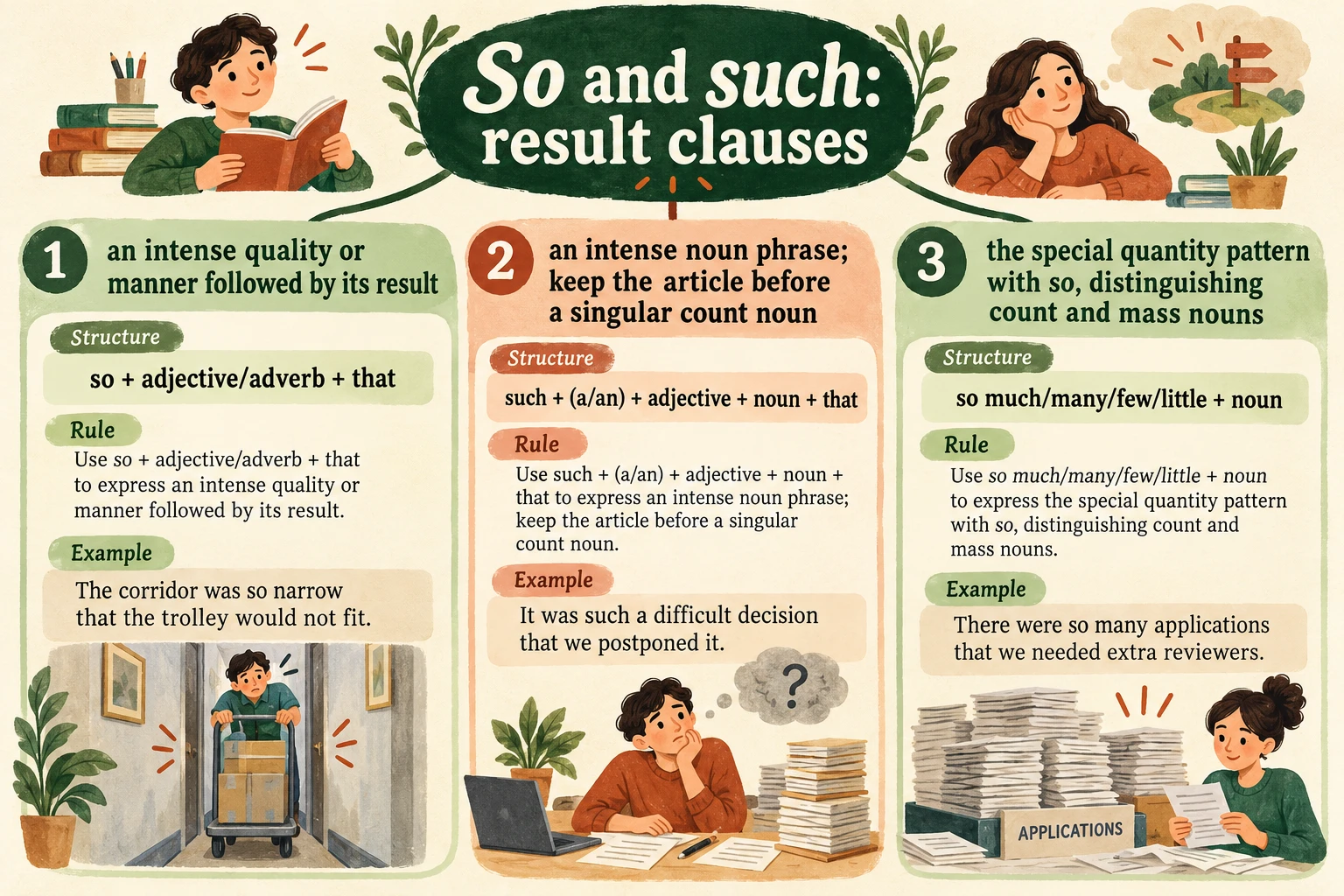
01eine starke Eigenschaft oder Art mit anschließendem Ergebnis
Verwende so + adjective/adverb + that für eine starke Eigenschaft oder Art mit anschließendem Ergebnis.
The corridor was so narrow that the trolley would not fit.
So und such: Folgesätze · B1. Verwende so + adjective/adverb + that für eine starke Eigenschaft oder Art mit anschließendem Ergebnis.
Bearbeite 12 neue Aufgaben. Erschließe die beabsichtigte Bedeutung aus der Situation, übe die Form und wende sie in einem neuen Kontext an.
Verwende so + adjective/adverb + that für eine starke Eigenschaft oder Art mit anschließendem Ergebnis.
The corridor was so narrow that the trolley would not fit.Verwende such + (a/an) + adjective + noun + that für eine verstärkte Nominalgruppe; vor einem zählbaren Singular steht ein Artikel.
It was such a difficult decision that we postponed it.Verwende so much/many/few/little + noun für das besondere Mengenmuster mit so; zählbare und unzählbare Nomen unterscheiden.
There were so many applications that we needed extra reviewers.
The gap directly modifies an adjective.
Verwende so + adjective/adverb + that für eine starke Eigenschaft oder Art mit anschließendem Ergebnis.
The corridor was so narrow that the trolley would not fit.Verwende such + (a/an) + adjective + noun + that für eine verstärkte Nominalgruppe; vor einem zählbaren Singular steht ein Artikel.
It was such a difficult decision that we postponed it.Verwende so much/many/few/little + noun für das besondere Mengenmuster mit so; zählbare und unzählbare Nomen unterscheiden.
There were so many applications that we needed extra reviewers.Bewahre den ersten Versuch. Verstehe die Änderung. Prüfe sie in einer neuen Situation.
Noch keine Lernnotizen. Starte mit einem kurzen Einstieg.
Verwende so + adjective/adverb + that für eine starke Eigenschaft oder Art mit anschließendem Ergebnis.
The corridor was so narrow that the trolley would not fit.Verwende such + (a/an) + adjective + noun + that für eine verstärkte Nominalgruppe; vor einem zählbaren Singular steht ein Artikel.
It was such a difficult decision that we postponed it.Verwende so much/many/few/little + noun für das besondere Mengenmuster mit so; zählbare und unzählbare Nomen unterscheiden.
There were so many applications that we needed extra reviewers.Das Öffnen einer Antwort wird für diese Aufgabe als Hilfe erfasst.
The gap directly modifies an adjective.
Achte auf „The corridor was ___ narrow that the trolley would not fit.“. Verwende so + adjective/adverb + that für eine starke Eigenschaft oder Art mit anschließendem Ergebnis. Vollständiger Satz: „The corridor was so narrow that the trolley would not fit.“.
The noun is singular and countable.
Achte auf „It was ___ difficult decision that we postponed it.“. Verwende such + (a/an) + adjective + noun + that für eine verstärkte Nominalgruppe; vor einem zählbaren Singular steht ein Artikel. Vollständiger Satz: „It was such a difficult decision that we postponed it.“.
The following plural count noun requires a quantity pattern.
Achte auf „There were ___ applications that we needed extra reviewers.“. Verwende so much/many/few/little + noun für das besondere Mengenmuster mit so; zählbare und unzählbare Nomen unterscheiden. Vollständiger Satz: „There were so many applications that we needed extra reviewers.“.
The gap modifies an adverb.
Achte auf „She spoke ___ softly that nobody at the back heard.“. Verwende so + adjective/adverb + that für eine starke Eigenschaft oder Art mit anschließendem Ergebnis. Vollständiger Satz: „She spoke so softly that nobody at the back heard.“.
Complete the result construction before a singular countable noun phrase.
Vollständiger Satz: „It was such a convincing argument that the committee changed its view.“ Verwende such + (a/an) + adjective + noun + that für eine verstärkte Nominalgruppe; vor einem zählbaren Singular steht ein Artikel. Subjekt, Zeit und Bedeutung der Aufgabe bestimmen diese Form. Nur geprüfte Antworten werden automatisch abgeglichen; andere Formulierungen sind nicht automatisch falsch.
Noise is uncountable in this context.
Achte auf „There was ___ noise that we could not record.“. Verwende so much/many/few/little + noun für das besondere Mengenmuster mit so; zählbare und unzählbare Nomen unterscheiden. Vollständiger Satz: „There was so much noise that we could not record.“.
Complete the result construction directly before the adjective.
Vollständiger Satz: „The instructions were so vague that nobody knew where to start.“ Verwende so + adjective/adverb + that für eine starke Eigenschaft oder Art mit anschließendem Ergebnis. Subjekt, Zeit und Bedeutung der Aufgabe bestimmen diese Form. Nur geprüfte Antworten werden automatisch abgeglichen; andere Formulierungen sind nicht automatisch falsch.
The gap modifies the adjective bright.
Achte auf „The sign was ___ bright that drivers complained.“. Verwende so + adjective/adverb + that für eine starke Eigenschaft oder Art mit anschließendem Ergebnis. Vollständiger Satz: „The sign was so bright that drivers complained.“.
Complete the result construction before a plural noun phrase.
Vollständiger Satz: „They were such helpful volunteers that we invited them back.“ Verwende such + (a/an) + adjective + noun + that für eine verstärkte Nominalgruppe; vor einem zählbaren Singular steht ein Artikel. Subjekt, Zeit und Bedeutung der Aufgabe bestimmen diese Form. Nur geprüfte Antworten werden automatisch abgeglichen; andere Formulierungen sind nicht automatisch falsch.
There was a very small amount of time, so lunch was skipped. Use the quantity pattern for that small amount.
Achte auf „There was a very small amount of time, so lunch was skipped. Use the quantity pattern for that small amount.“. Verwende so much/many/few/little + noun für das besondere Mengenmuster mit so; zählbare und unzählbare Nomen unterscheiden. Vollständiger Satz: „We had so little time left that we skipped lunch.“.
The number of mistakes was very small, so checking was quick. Use the quantity pattern for that small number.
Achte auf „The number of mistakes was very small, so checking was quick. Use the quantity pattern for that small number.“. Verwende such + (a/an) + adjective + noun + that für eine verstärkte Nominalgruppe; vor einem zählbaren Singular steht ein Artikel. Vollständiger Satz: „She made so few mistakes that checking took minutes.“.
Complete the result construction expressing a large number of countable delays.
Vollständiger Satz: „There were so many delays that we missed the final connection.“ Verwende so much/many/few/little + noun für das besondere Mengenmuster mit so; zählbare und unzählbare Nomen unterscheiden. Subjekt, Zeit und Bedeutung der Aufgabe bestimmen diese Form. Nur geprüfte Antworten werden automatisch abgeglichen; andere Formulierungen sind nicht automatisch falsch.