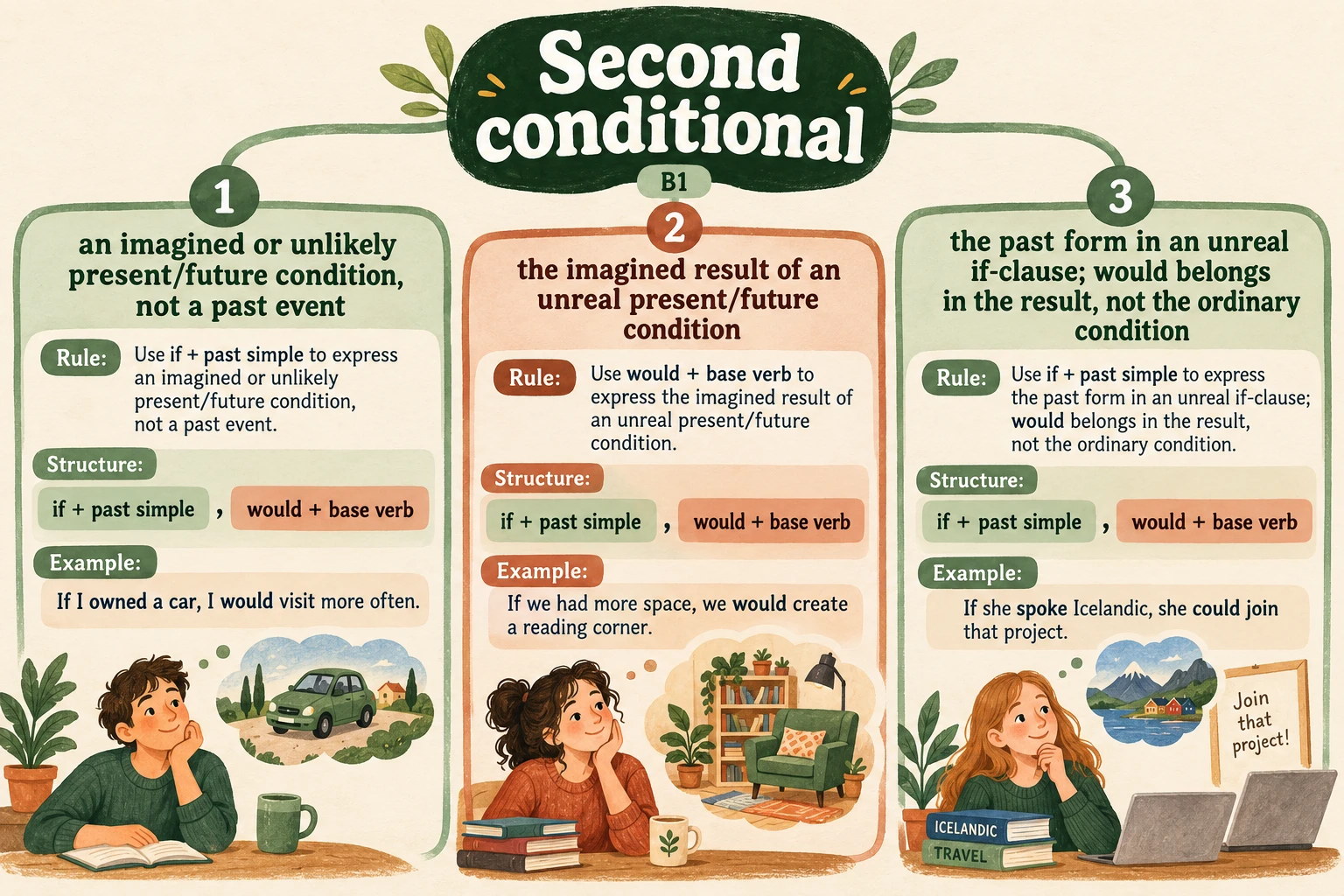
01an imagined or unlikely present/future condition, not a past event
Use if + past simple to express an imagined or unlikely present/future condition, not a past event.
If I owned a car, I would visit more often.
Second conditional · B1. Use if + past simple to express an imagined or unlikely present/future condition, not a past event.
Complete 12 original tasks. Use the situation to choose the intended meaning, practise the form, then apply it in a fresh context.
Use if + past simple to express an imagined or unlikely present/future condition, not a past event.
If I owned a car, I would visit more often.Use would + base verb to express the imagined result of an unreal present/future condition.
If we had more space, we would create a reading corner.Use if + past simple to express the past form in an unreal if-clause; would belongs in the result, not the ordinary condition.
If she spoke Icelandic, she could join that project.
I do not own a car; imagine the opposite now. Use the ordinary hypothetical-present/future second-conditional pattern.
Use if + past simple to express an imagined or unlikely present/future condition, not a past event.
If I owned a car, I would visit more often.Use would + base verb to express the imagined result of an unreal present/future condition.
If we had more space, we would create a reading corner.Use if + past simple to express the past form in an unreal if-clause; would belongs in the result, not the ordinary condition.
If she spoke Icelandic, she could join that project.Keep the first try. Understand the change. Check it in a fresh situation.
No practice notes yet. Try a short warm-up.
Use if + past simple to express an imagined or unlikely present/future condition, not a past event.
If I owned a car, I would visit more often.Use would + base verb to express the imagined result of an unreal present/future condition.
If we had more space, we would create a reading corner.Use if + past simple to express the past form in an unreal if-clause; would belongs in the result, not the ordinary condition.
If she spoke Icelandic, she could join that project.Opening an answer records help for that question.
I do not own a car; imagine the opposite now. Use the ordinary hypothetical-present/future second-conditional pattern.
Look at “I do not own a car; imagine the opposite now. Use the ordinary hypothetical-present/future second-conditional pattern.”. Use if + past simple to express an imagined or unlikely present/future condition, not a past event. Complete sentence: “If I owned a car, I would visit more often.”.
The shop is too small in reality. Imagine a larger one. Use the ordinary hypothetical-present/future second-conditional pattern.
Look at “The shop is too small in reality. Imagine a larger one. Use the ordinary hypothetical-present/future second-conditional pattern.”. Use would + base verb to express the imagined result of an unreal present/future condition. Complete sentence: “If we had more space, we would create a reading corner.”.
She cannot speak Icelandic; this is an imagined ability. Use the ordinary hypothetical-present/future second-conditional pattern.
Look at “She cannot speak Icelandic; this is an imagined ability. Use the ordinary hypothetical-present/future second-conditional pattern.”. Use if + past simple to express the past form in an unreal if-clause; would belongs in the result, not the ordinary condition. Complete sentence: “If she spoke Icelandic, she could join that project.”.
We do not live near the sea; imagine a different present. Use the ordinary hypothetical-present/future second-conditional pattern.
Look at “We do not live near the sea; imagine a different present. Use the ordinary hypothetical-present/future second-conditional pattern.”. Use if + past simple to express an imagined or unlikely present/future condition, not a past event. Complete sentence: “If we lived near the sea, we would sail every weekend.”.
Use a would-result with the verb reduce for the imagined situation.
Complete sentence: “If the route were shorter, it would reduce our costs.” Use would + base verb to express the imagined result of an unreal present/future condition. The subject, time and meaning in the task determine this form. Only reviewed responses are matched automatically; other wording is not automatically wrong.
He is not the manager; the condition is hypothetical. Use the ordinary hypothetical-present/future second-conditional pattern.
Look at “He is not the manager; the condition is hypothetical. Use the ordinary hypothetical-present/future second-conditional pattern.”. Use if + past simple to express the past form in an unreal if-clause; would belongs in the result, not the ordinary condition. Complete sentence: “If he were the manager, he would change the rota.”.
Use the past simple of know to express an unreal present condition.
Complete sentence: “If I knew the answer, I would tell you.” Use if + past simple to express an imagined or unlikely present/future condition, not a past event. The subject, time and meaning in the task determine this form. Only reviewed responses are matched automatically; other wording is not automatically wrong.
The museum does not have a larger budget now. Use the ordinary hypothetical-present/future second-conditional pattern.
Look at “The museum does not have a larger budget now. Use the ordinary hypothetical-present/future second-conditional pattern.”. Use if + past simple to express an imagined or unlikely present/future condition, not a past event. Complete sentence: “If the museum received more funding, it would restore the roof.”.
Use a would-result with the verb hire for the imagined consequence.
Complete sentence: “If I ran the theatre, I would hire more technicians.” Use would + base verb to express the imagined result of an unreal present/future condition. The subject, time and meaning in the task determine this form. Only reviewed responses are matched automatically; other wording is not automatically wrong.
It is not possible for us to move now; imagine that it were. Use the ordinary hypothetical-present/future second-conditional pattern.
Look at “It is not possible for us to move now; imagine that it were. Use the ordinary hypothetical-present/future second-conditional pattern.”. Use if + past simple to express the past form in an unreal if-clause; would belongs in the result, not the ordinary condition. Complete sentence: “If we moved to the coast, we would miss our neighbours.”.
No such opportunity exists at present. Use the ordinary hypothetical-present/future second-conditional pattern.
Look at “No such opportunity exists at present. Use the ordinary hypothetical-present/future second-conditional pattern.”. Use would + base verb to express the imagined result of an unreal present/future condition. Complete sentence: “If someone offered me that role, I would accept it.”.
Use the past simple of have for the unreal present condition.
Complete sentence: “If our flat had a balcony, we would grow herbs.” Use if + past simple to express the past form in an unreal if-clause; would belongs in the result, not the ordinary condition. The subject, time and meaning in the task determine this form. Only reviewed responses are matched automatically; other wording is not automatically wrong.