01過去の出来事ではなく、現在・未来の仮定や可能性の低い条件
if + past simple を用います。表す内容:過去の出来事ではなく、現在・未来の仮定や可能性の低い条件。
If I owned a car, I would visit more often.
第二条件文 · B1. if + past simple を用います。表す内容:過去の出来事ではなく、現在・未来の仮定や可能性の低い条件。
12問のオリジナル問題です。状況から意味を読み取り、形を練習して、新しい場面で応用します。
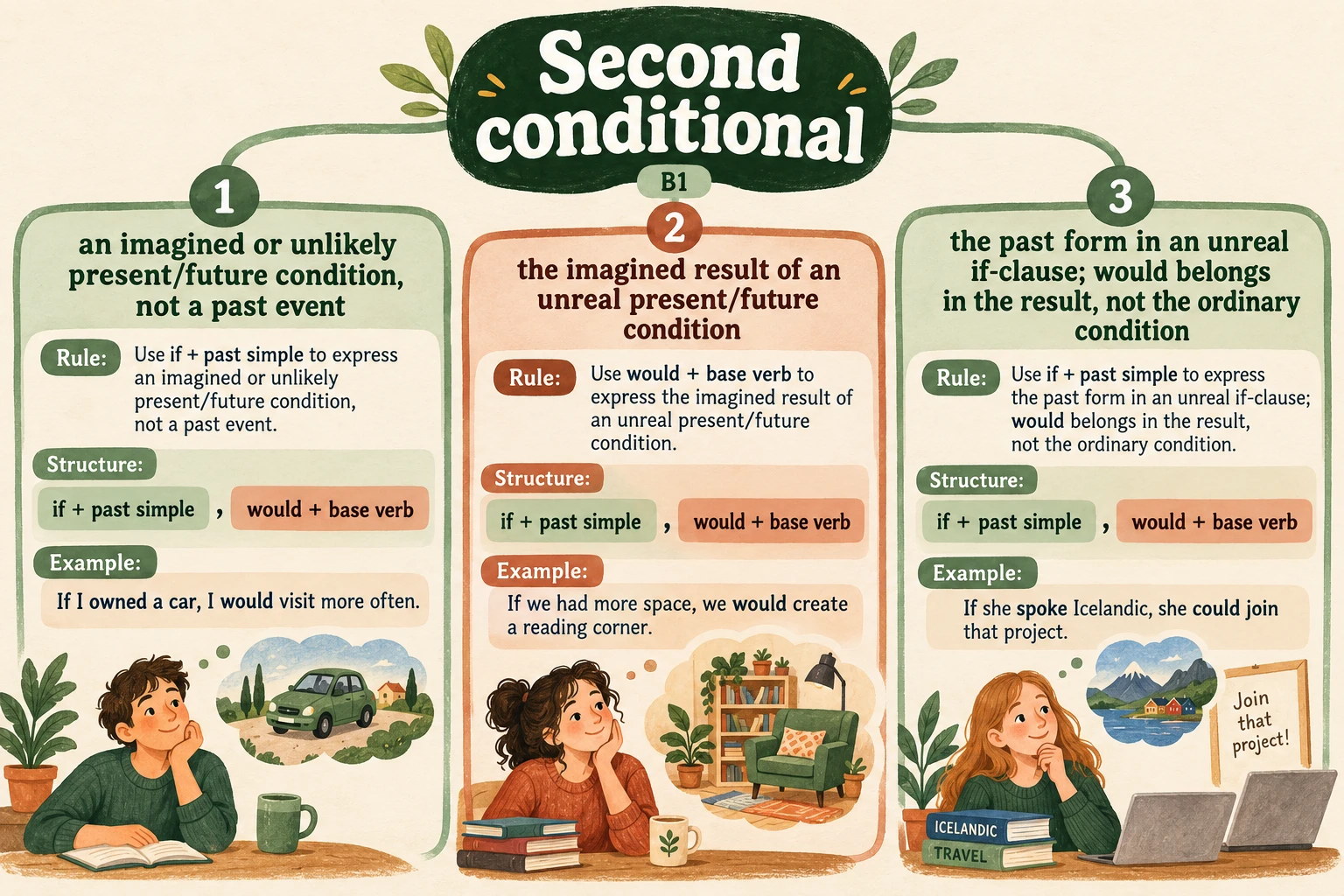
if + past simple を用います。表す内容:過去の出来事ではなく、現在・未来の仮定や可能性の低い条件。
If I owned a car, I would visit more often.would + base verb を用います。表す内容:現在・未来の非現実的な条件から想定される結果。
If we had more space, we would create a reading corner.if + past simple を用います。表す内容:反実の if 節の過去形。通常 would は条件節ではなく結果節に置く。
If she spoke Icelandic, she could join that project.
I do not own a car; imagine the opposite now. Use the ordinary hypothetical-present/future second-conditional pattern.
if + past simple を用います。表す内容:過去の出来事ではなく、現在・未来の仮定や可能性の低い条件。
If I owned a car, I would visit more often.would + base verb を用います。表す内容:現在・未来の非現実的な条件から想定される結果。
If we had more space, we would create a reading corner.if + past simple を用います。表す内容:反実の if 節の過去形。通常 would は条件節ではなく結果節に置く。
If she spoke Icelandic, she could join that project.初回答を残し、変化の理由を理解して、別の場面で確かめます。
まだ復習ノートはありません。まずは短いウォームアップを。
if + past simple を用います。表す内容:過去の出来事ではなく、現在・未来の仮定や可能性の低い条件。
If I owned a car, I would visit more often.would + base verb を用います。表す内容:現在・未来の非現実的な条件から想定される結果。
If we had more space, we would create a reading corner.if + past simple を用います。表す内容:反実の if 節の過去形。通常 would は条件節ではなく結果節に置く。
If she spoke Icelandic, she could join that project.解答を開くと、その問題にヒント利用が記録されます。
I do not own a car; imagine the opposite now. Use the ordinary hypothetical-present/future second-conditional pattern.
「I do not own a car; imagine the opposite now. Use the ordinary hypothetical-present/future second-conditional pattern.」に注目しましょう。if + past simple を用います。表す内容:過去の出来事ではなく、現在・未来の仮定や可能性の低い条件。 完成文:「If I owned a car, I would visit more often.」。
The shop is too small in reality. Imagine a larger one. Use the ordinary hypothetical-present/future second-conditional pattern.
「The shop is too small in reality. Imagine a larger one. Use the ordinary hypothetical-present/future second-conditional pattern.」に注目しましょう。would + base verb を用います。表す内容:現在・未来の非現実的な条件から想定される結果。 完成文:「If we had more space, we would create a reading corner.」。
She cannot speak Icelandic; this is an imagined ability. Use the ordinary hypothetical-present/future second-conditional pattern.
「She cannot speak Icelandic; this is an imagined ability. Use the ordinary hypothetical-present/future second-conditional pattern.」に注目しましょう。if + past simple を用います。表す内容:反実の if 節の過去形。通常 would は条件節ではなく結果節に置く。 完成文:「If she spoke Icelandic, she could join that project.」。
We do not live near the sea; imagine a different present. Use the ordinary hypothetical-present/future second-conditional pattern.
「We do not live near the sea; imagine a different present. Use the ordinary hypothetical-present/future second-conditional pattern.」に注目しましょう。if + past simple を用います。表す内容:過去の出来事ではなく、現在・未来の仮定や可能性の低い条件。 完成文:「If we lived near the sea, we would sail every weekend.」。
Use a would-result with the verb reduce for the imagined situation.
完成文:「If the route were shorter, it would reduce our costs.」 would + base verb を用います。表す内容:現在・未来の非現実的な条件から想定される結果。 問題の主語・時間・意味に合わせた形です。確認済みの解答だけを自動照合します。別の表現を自動的に誤りとはしません。
He is not the manager; the condition is hypothetical. Use the ordinary hypothetical-present/future second-conditional pattern.
「He is not the manager; the condition is hypothetical. Use the ordinary hypothetical-present/future second-conditional pattern.」に注目しましょう。if + past simple を用います。表す内容:反実の if 節の過去形。通常 would は条件節ではなく結果節に置く。 完成文:「If he were the manager, he would change the rota.」。
Use the past simple of know to express an unreal present condition.
完成文:「If I knew the answer, I would tell you.」 if + past simple を用います。表す内容:過去の出来事ではなく、現在・未来の仮定や可能性の低い条件。 問題の主語・時間・意味に合わせた形です。確認済みの解答だけを自動照合します。別の表現を自動的に誤りとはしません。
The museum does not have a larger budget now. Use the ordinary hypothetical-present/future second-conditional pattern.
「The museum does not have a larger budget now. Use the ordinary hypothetical-present/future second-conditional pattern.」に注目しましょう。if + past simple を用います。表す内容:過去の出来事ではなく、現在・未来の仮定や可能性の低い条件。 完成文:「If the museum received more funding, it would restore the roof.」。
Use a would-result with the verb hire for the imagined consequence.
完成文:「If I ran the theatre, I would hire more technicians.」 would + base verb を用います。表す内容:現在・未来の非現実的な条件から想定される結果。 問題の主語・時間・意味に合わせた形です。確認済みの解答だけを自動照合します。別の表現を自動的に誤りとはしません。
It is not possible for us to move now; imagine that it were. Use the ordinary hypothetical-present/future second-conditional pattern.
「It is not possible for us to move now; imagine that it were. Use the ordinary hypothetical-present/future second-conditional pattern.」に注目しましょう。if + past simple を用います。表す内容:反実の if 節の過去形。通常 would は条件節ではなく結果節に置く。 完成文:「If we moved to the coast, we would miss our neighbours.」。
No such opportunity exists at present. Use the ordinary hypothetical-present/future second-conditional pattern.
「No such opportunity exists at present. Use the ordinary hypothetical-present/future second-conditional pattern.」に注目しましょう。would + base verb を用います。表す内容:現在・未来の非現実的な条件から想定される結果。 完成文:「If someone offered me that role, I would accept it.」。
Use the past simple of have for the unreal present condition.
完成文:「If our flat had a balcony, we would grow herbs.」 if + past simple を用います。表す内容:反実の if 節の過去形。通常 would は条件節ではなく結果節に置く。 問題の主語・時間・意味に合わせた形です。確認済みの解答だけを自動照合します。別の表現を自動的に誤りとはしません。