
B1

Zweiter Konditional Übungen

Über diese Lektion

Zweiter Konditional · B1. Verwende if + past simple für eine gedachte oder unwahrscheinliche Bedingung der Gegenwart/Zukunft, kein vergangenes Ereignis.

Bearbeite 12 neue Aufgaben. Erschließe die beabsichtigte Bedeutung aus der Situation, übe die Form und wende sie in einem neuen Kontext an.

12 Aufgaben
Speichere es für deine Sammlung.
Wissensübersicht

Second conditional

Jetzt üben
Second conditional — Wissensübersicht

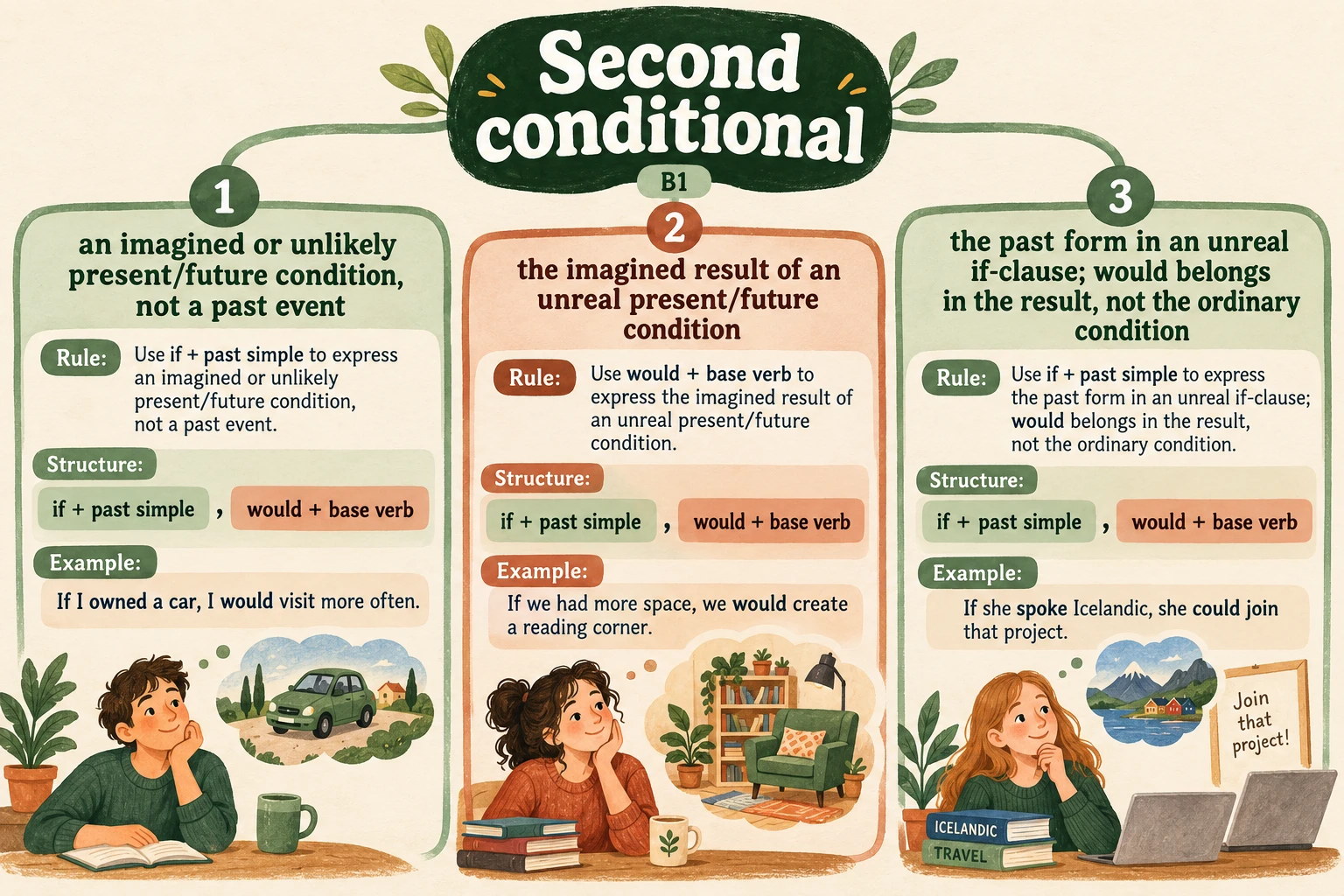
01eine gedachte oder unwahrscheinliche Bedingung der Gegenwart/Zukunft, kein vergangenes Ereignis

Verwende if + past simple für eine gedachte oder unwahrscheinliche Bedingung der Gegenwart/Zukunft, kein vergangenes Ereignis.

If I owned a car, I would visit more often.
02das gedachte Ergebnis einer irrealen Gegenwarts-/Zukunftsbedingung

Verwende would + base verb für das gedachte Ergebnis einer irrealen Gegenwarts-/Zukunftsbedingung.

If we had more space, we would create a reading corner.

03die Vergangenheitsform im irrealen if-Satz; would steht im Ergebnis, nicht in der normalen Bedingung

Verwende if + past simple für die Vergangenheitsform im irrealen if-Satz; would steht im Ergebnis, nicht in der normalen Bedingung.

If she spoke Icelandic, she could join that project.

Illustrierte Übersicht

0/12
Aufgaben
01 / 12D01Speichere es für deine Sammlung.

I do not own a car; imagine the opposite now. Use the ordinary hypothetical-present/future second-conditional pattern.

If I ___ a car, I would visit more often.

Deine Antwort
1 / 12

Dein Lernweg

01
Schritt 1 · Einstieg

Einstieg

0/3
02
Schritt 2 · Gezielt üben

eine gedachte oder unwahrscheinliche Bedingung der Gegenwart/Zukunft, kein vergangenes Ereignis

0/2

Verwende if + past simple für eine gedachte oder unwahrscheinliche Bedingung der Gegenwart/Zukunft, kein vergangenes Ereignis.

If I owned a car, I would visit more often.
03
Schritt 3 · Gezielt üben

das gedachte Ergebnis einer irrealen Gegenwarts-/Zukunftsbedingung

0/1

Verwende would + base verb für das gedachte Ergebnis einer irrealen Gegenwarts-/Zukunftsbedingung.

If we had more space, we would create a reading corner.
04
Schritt 4 · Gezielt üben

die Vergangenheitsform im irrealen if-Satz; would steht im Ergebnis, nicht in der normalen Bedingung

0/1

Verwende if + past simple für die Vergangenheitsform im irrealen if-Satz; would steht im Ergebnis, nicht in der normalen Bedingung.

If she spoke Icelandic, she could join that project.
05
Schritt 5 · Neue Situationen

Neue Situationen

0/3
06
Schritt 6 · Neue Herausforderung

Neue Herausforderung

0/2
Lernnotizen dieser Einheit

Aus Fehlern lernen.

Bewahre den ersten Versuch. Verstehe die Änderung. Prüfe sie in einer neuen Situation.

0

Noch keine Lernnotizen. Starte mit einem kurzen Einstieg.

Lernübersicht

Zweiter Konditional

B1
Second conditional

Lektionspunkte

01

eine gedachte oder unwahrscheinliche Bedingung der Gegenwart/Zukunft, kein vergangenes Ereignis

Verwende if + past simple für eine gedachte oder unwahrscheinliche Bedingung der Gegenwart/Zukunft, kein vergangenes Ereignis.

If I owned a car, I would visit more often.
02

das gedachte Ergebnis einer irrealen Gegenwarts-/Zukunftsbedingung

Verwende would + base verb für das gedachte Ergebnis einer irrealen Gegenwarts-/Zukunftsbedingung.

If we had more space, we would create a reading corner.
03

die Vergangenheitsform im irrealen if-Satz; would steht im Ergebnis, nicht in der normalen Bedingung

Verwende if + past simple für die Vergangenheitsform im irrealen if-Satz; would steht im Ergebnis, nicht in der normalen Bedingung.

If she spoke Icelandic, she could join that project.

Fragen & Antworten

Das Öffnen einer Antwort wird für diese Aufgabe als Hilfe erfasst.

D01 · Einstieg

I do not own a car; imagine the opposite now. Use the ordinary hypothetical-present/future second-conditional pattern.

If I ___ a car, I would visit more often.

  1. will own
  2. owned
  3. own
  4. would own
Antwort und Erklärung
owned

Achte auf „I do not own a car; imagine the opposite now. Use the ordinary hypothetical-present/future second-conditional pattern.“. Verwende if + past simple für eine gedachte oder unwahrscheinliche Bedingung der Gegenwart/Zukunft, kein vergangenes Ereignis. Vollständiger Satz: „If I owned a car, I would visit more often.“.

D02 · Einstieg

The shop is too small in reality. Imagine a larger one. Use the ordinary hypothetical-present/future second-conditional pattern.

If we had more space, we ___ a reading corner.

  1. created
  2. will create
  3. would create
  4. have create
Antwort und Erklärung
would create

Achte auf „The shop is too small in reality. Imagine a larger one. Use the ordinary hypothetical-present/future second-conditional pattern.“. Verwende would + base verb für das gedachte Ergebnis einer irrealen Gegenwarts-/Zukunftsbedingung. Vollständiger Satz: „If we had more space, we would create a reading corner.“.

D03 · Einstieg

She cannot speak Icelandic; this is an imagined ability. Use the ordinary hypothetical-present/future second-conditional pattern.

If she ___ Icelandic, she could join that project.

  1. will speak
  2. spoke
  3. would speak
  4. speaks
Antwort und Erklärung
spoke

Achte auf „She cannot speak Icelandic; this is an imagined ability. Use the ordinary hypothetical-present/future second-conditional pattern.“. Verwende if + past simple für die Vergangenheitsform im irrealen if-Satz; would steht im Ergebnis, nicht in der normalen Bedingung. Vollständiger Satz: „If she spoke Icelandic, she could join that project.“.

P01 · Gezielt üben

We do not live near the sea; imagine a different present. Use the ordinary hypothetical-present/future second-conditional pattern.

If we ___ near the sea, we would sail every weekend.

  1. lived
  2. live
  3. will live
  4. would live
Antwort und Erklärung
lived

Achte auf „We do not live near the sea; imagine a different present. Use the ordinary hypothetical-present/future second-conditional pattern.“. Verwende if + past simple für eine gedachte oder unwahrscheinliche Bedingung der Gegenwart/Zukunft, kein vergangenes Ereignis. Vollständiger Satz: „If we lived near the sea, we would sail every weekend.“.

P02 · Gezielt üben

Use a would-result with the verb reduce for the imagined situation.

If the route were shorter, it ___ our costs.

Antwort und Erklärung
would reduce

Vollständiger Satz: „If the route were shorter, it would reduce our costs.“ Verwende would + base verb für das gedachte Ergebnis einer irrealen Gegenwarts-/Zukunftsbedingung. Subjekt, Zeit und Bedeutung der Aufgabe bestimmen diese Form. Nur geprüfte Antworten werden automatisch abgeglichen; andere Formulierungen sind nicht automatisch falsch.

P03 · Gezielt üben

He is not the manager; the condition is hypothetical. Use the ordinary hypothetical-present/future second-conditional pattern.

If he ___ the manager, he would change the rota.

  1. will be
  2. were
  3. would be
  4. is
Antwort und Erklärung
were

Achte auf „He is not the manager; the condition is hypothetical. Use the ordinary hypothetical-present/future second-conditional pattern.“. Verwende if + past simple für die Vergangenheitsform im irrealen if-Satz; would steht im Ergebnis, nicht in der normalen Bedingung. Vollständiger Satz: „If he were the manager, he would change the rota.“.

P04 · Gezielt üben

Use the past simple of know to express an unreal present condition.

If I ___ the answer, I would tell you.

Antwort und Erklärung
knew

Vollständiger Satz: „If I knew the answer, I would tell you.“ Verwende if + past simple für eine gedachte oder unwahrscheinliche Bedingung der Gegenwart/Zukunft, kein vergangenes Ereignis. Subjekt, Zeit und Bedeutung der Aufgabe bestimmen diese Form. Nur geprüfte Antworten werden automatisch abgeglichen; andere Formulierungen sind nicht automatisch falsch.

R01 · Neue Situationen

The museum does not have a larger budget now. Use the ordinary hypothetical-present/future second-conditional pattern.

If the museum ___ more funding, it would restore the roof.

  1. receives
  2. would receive
  3. will receive
  4. received
Antwort und Erklärung
received

Achte auf „The museum does not have a larger budget now. Use the ordinary hypothetical-present/future second-conditional pattern.“. Verwende if + past simple für eine gedachte oder unwahrscheinliche Bedingung der Gegenwart/Zukunft, kein vergangenes Ereignis. Vollständiger Satz: „If the museum received more funding, it would restore the roof.“.

R02 · Neue Situationen

Use a would-result with the verb hire for the imagined consequence.

If I ran the theatre, I ___ more technicians.

Antwort und Erklärung
would hire

Vollständiger Satz: „If I ran the theatre, I would hire more technicians.“ Verwende would + base verb für das gedachte Ergebnis einer irrealen Gegenwarts-/Zukunftsbedingung. Subjekt, Zeit und Bedeutung der Aufgabe bestimmen diese Form. Nur geprüfte Antworten werden automatisch abgeglichen; andere Formulierungen sind nicht automatisch falsch.

R03 · Neue Situationen

It is not possible for us to move now; imagine that it were. Use the ordinary hypothetical-present/future second-conditional pattern.

If we ___ to the coast, we would miss our neighbours.

  1. move
  2. would move
  3. will move
  4. moved
Antwort und Erklärung
moved

Achte auf „It is not possible for us to move now; imagine that it were. Use the ordinary hypothetical-present/future second-conditional pattern.“. Verwende if + past simple für die Vergangenheitsform im irrealen if-Satz; would steht im Ergebnis, nicht in der normalen Bedingung. Vollständiger Satz: „If we moved to the coast, we would miss our neighbours.“.

X01 · Neue Herausforderung

No such opportunity exists at present. Use the ordinary hypothetical-present/future second-conditional pattern.

If someone offered me that role, I ___ it.

  1. will accept
  2. would accept
  3. accepted
  4. have accept
Antwort und Erklärung
would accept

Achte auf „No such opportunity exists at present. Use the ordinary hypothetical-present/future second-conditional pattern.“. Verwende would + base verb für das gedachte Ergebnis einer irrealen Gegenwarts-/Zukunftsbedingung. Vollständiger Satz: „If someone offered me that role, I would accept it.“.

X02 · Neue Herausforderung

Use the past simple of have for the unreal present condition.

If our flat ___ a balcony, we would grow herbs.

Antwort und Erklärung
had

Vollständiger Satz: „If our flat had a balcony, we would grow herbs.“ Verwende if + past simple für die Vergangenheitsform im irrealen if-Satz; would steht im Ergebnis, nicht in der normalen Bedingung. Subjekt, Zeit und Bedeutung der Aufgabe bestimmen diese Form. Nur geprüfte Antworten werden automatisch abgeglichen; andere Formulierungen sind nicht automatisch falsch.