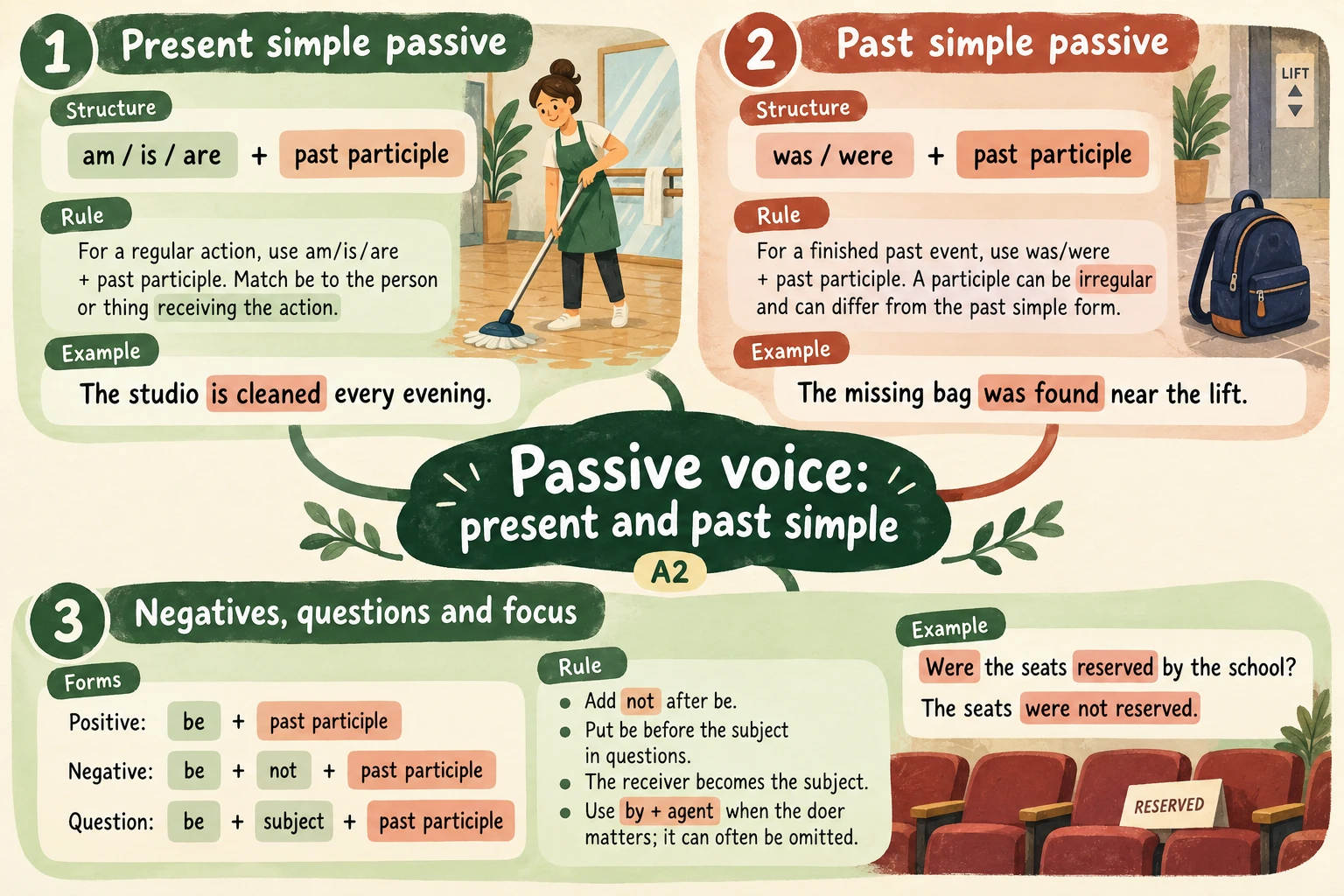
01Present simple passive
For a regular action, use am/is/are + past participle. Match be to the person or thing receiving the action.
am/is/are + past participle
Passive voice: present and past simple · A2. For a regular action, use am/is/are + past participle. Match be to the person or thing receiving the action.
Show what happens to someone or something. Practise present and past simple passives.
For a regular action, use am/is/are + past participle. Match be to the person or thing receiving the action.
am/is/are + past participleFor a finished past event, use was/were + past participle. A participle can be irregular and can differ from the past simple form.
was/were + past participleAdd not after be; put be before the subject in questions. The receiver becomes the subject. Use by + agent when the doer matters; it can often be omitted.
Was the room cleaned? · It wasn’t cleaned.The room is cleaned daily.It was cleaned yesterday.
The room isn’t cleaned daily.It wasn’t cleaned yesterday.
Is the room cleaned daily?Was it cleaned yesterday?
Yes, it is.No, it wasn’t.
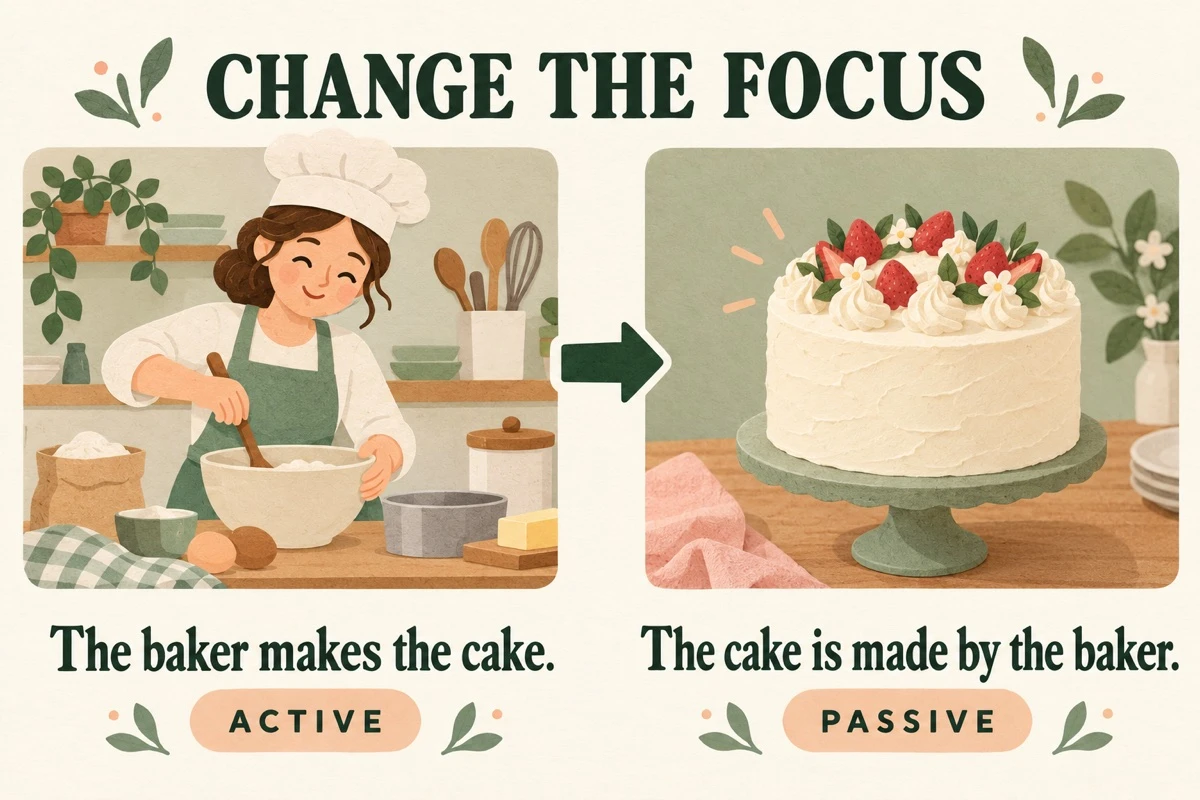
A cleaner cleans one entrance every morning. Focus on the entrance.
For a regular action, use am/is/are + past participle. Match be to the person or thing receiving the action.
The studio is cleaned every evening.For a finished past event, use was/were + past participle. A participle can be irregular and can differ from the past simple form.
The missing bag was found near the lift.Add not after be; put be before the subject in questions. The receiver becomes the subject. Use by + agent when the doer matters; it can often be omitted.
Were the seats reserved by the school? The seats were not reserved.Keep the first try. Understand the change. Check it in a fresh situation.
No practice notes yet. Try a short warm-up.
For a regular action, use am/is/are + past participle. Match be to the person or thing receiving the action.
The studio is cleaned every evening.For a finished past event, use was/were + past participle. A participle can be irregular and can differ from the past simple form.
The missing bag was found near the lift.Add not after be; put be before the subject in questions. The receiver becomes the subject. Use by + agent when the doer matters; it can often be omitted.
Were the seats reserved by the school? The seats were not reserved.Opening an answer records help for that question.
A cleaner cleans one entrance every morning. Focus on the entrance.
Look at “A cleaner cleans one entrance every morning. Focus on the entrance.”. For a regular action, use am/is/are + past participle. Match be to the person or thing receiving the action. Complete sentence: “The entrance is cleaned every morning.”.
The secretary wrote the meeting minutes yesterday. Minutes means the written record of a meeting.
Look at “The secretary wrote the meeting minutes yesterday. Minutes means the written record of a meeting.”. For a finished past event, use was/were + past participle. A participle can be irregular and can differ from the past simple form. Complete sentence: “The minutes were written yesterday.”.
The club checks its bikes before each ride. Ask about this routine, focusing on the bikes.
Look at “The club checks its bikes before each ride. Ask about this routine, focusing on the bikes.”. Add not after be; put be before the subject in questions. The receiver becomes the subject. Use by + agent when the doer matters; it can often be omitted. Complete sentence: “Are the bikes checked before each ride?”.
The cafe makes these sandwiches here every morning. The sandwiches ___ here every morning.
The sandwiches receive this regular action. Plural 'sandwiches' needs 'are made'.
Last night's storm broke two windows. Focus on the windows.
Look at “Last night's storm broke two windows. Focus on the windows.”. For a finished past event, use was/were + past participle. A participle can be irregular and can differ from the past simple form. Complete sentence: “The two windows were broken during last night's storm.”.
The caretaker forgot to lock the doors last night. Nobody else locked them. Focus on the doors.
Look at “The caretaker forgot to lock the doors last night. Nobody else locked them. Focus on the doors.”. Add not after be; put be before the subject in questions. The receiver becomes the subject. Use by + agent when the doer matters; it can often be omitted. Complete sentence: “The doors were not locked last night.”.
A local artist painted this mural in 2021.
'This mural' receives the painting. Use 'was painted' and retain the artist with 'by'.
Find the agreement error: The invitations is sent every May.
'Invitations' is plural, so change 'is' to 'are'. Keep the participle 'sent' and the routine time phrase.
Find the verb-form error: The parcel was took to the office yesterday.
Look at “Find the verb-form error: The parcel was took to the office yesterday.”. For a finished past event, use was/were + past participle. A participle can be irregular and can differ from the past simple form. Complete sentence: “The parcel was taken to the office yesterday.”.
Find the error in this question: Did the tickets checked at the gate yesterday?
Look at “Find the error in this question: Did the tickets checked at the gate yesterday?”. Add not after be; put be before the subject in questions. The receiver becomes the subject. Use by + agent when the doer matters; it can often be omitted. Complete sentence: “Were the tickets checked at the gate yesterday?”.
Our workshop prints these labels every Friday. Focus on the labels.
Look at “Our workshop prints these labels every Friday. Focus on the labels.”. For a regular action, use am/is/are + past participle. Match be to the person or thing receiving the action. Complete sentence: “These labels are printed in our workshop every Friday.”.
The storm damaged the roof last winter.
The roof receives damage in a finished past event. Use 'was damaged'; 'by the storm' preserves the cause.