01Pasiva en presente simple
Para una acción habitual, usa am/is/are + participio. «Be» concuerda con la persona o cosa que recibe la acción.
am/is/are + past participle
Voz pasiva: presente y pasado simples · A2. Para una acción habitual, usa am/is/are + participio. «Be» concuerda con la persona o cosa que recibe la acción.
Expresa lo que le ocurre a alguien o a algo. Practica la pasiva en presente y pasado simples.
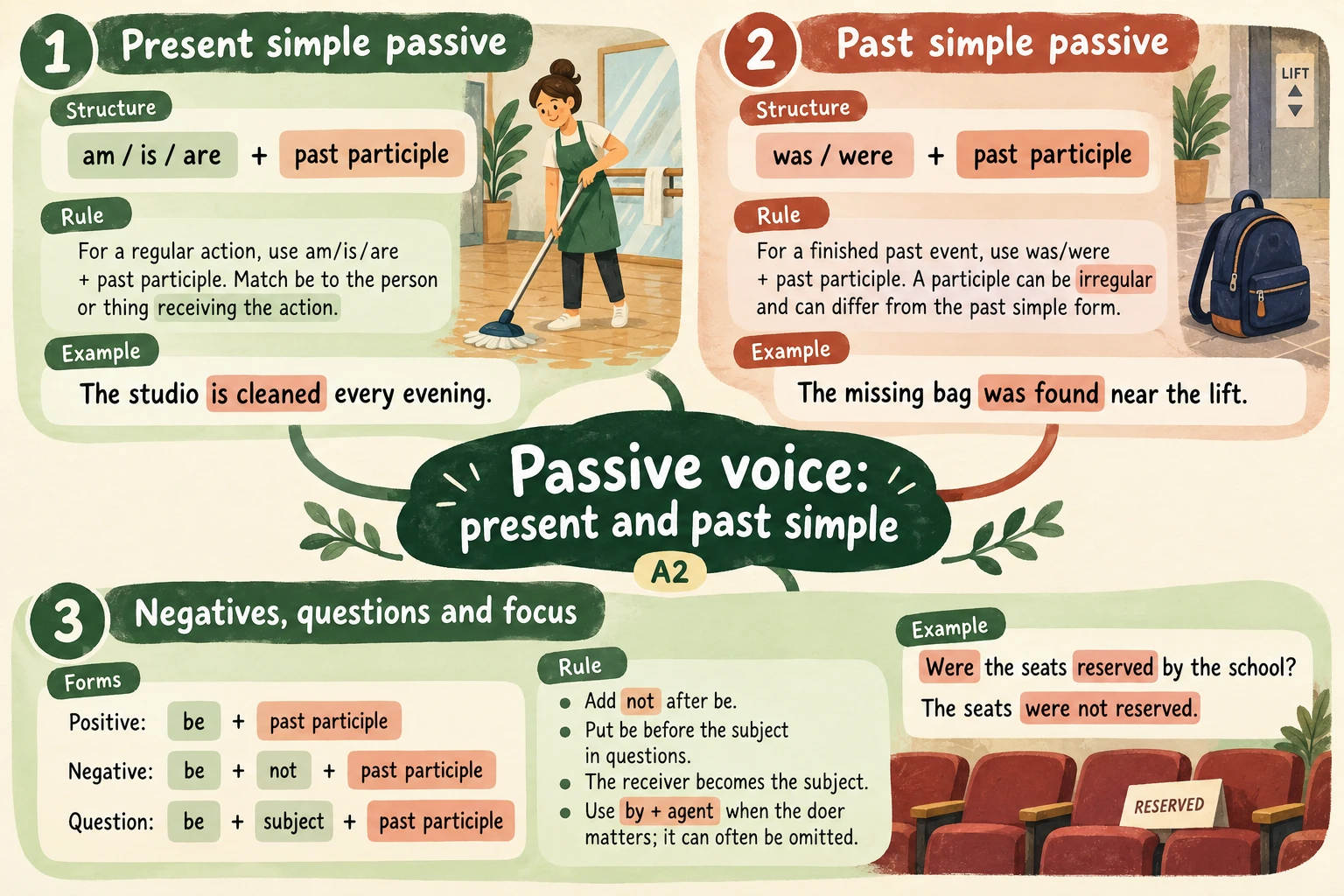
Para una acción habitual, usa am/is/are + participio. «Be» concuerda con la persona o cosa que recibe la acción.
am/is/are + past participlePara un hecho pasado terminado, usa was/were + participio. El participio puede ser irregular y no siempre coincide con el pasado simple.
was/were + past participleAñade not después de be; en preguntas, coloca be antes del sujeto. El receptor pasa a ser sujeto. Usa by + agente si importa quién actúa; a menudo puede omitirse.
Was the room cleaned? · It wasn’t cleaned.The room is cleaned daily.It was cleaned yesterday.
The room isn’t cleaned daily.It wasn’t cleaned yesterday.
Is the room cleaned daily?Was it cleaned yesterday?
Yes, it is.No, it wasn’t.
A cleaner cleans one entrance every morning. Focus on the entrance.
Para una acción habitual, usa am/is/are + participio. «Be» concuerda con la persona o cosa que recibe la acción.
The studio is cleaned every evening.Para un hecho pasado terminado, usa was/were + participio. El participio puede ser irregular y no siempre coincide con el pasado simple.
The missing bag was found near the lift.Añade not después de be; en preguntas, coloca be antes del sujeto. El receptor pasa a ser sujeto. Usa by + agente si importa quién actúa; a menudo puede omitirse.
Were the seats reserved by the school? The seats were not reserved.Conserva el primer intento, entiende el cambio y compruébalo en otra situación.
Aún no hay repasos. Prueba un calentamiento corto.
Para una acción habitual, usa am/is/are + participio. «Be» concuerda con la persona o cosa que recibe la acción.
The studio is cleaned every evening.Para un hecho pasado terminado, usa was/were + participio. El participio puede ser irregular y no siempre coincide con el pasado simple.
The missing bag was found near the lift.Añade not después de be; en preguntas, coloca be antes del sujeto. El receptor pasa a ser sujeto. Usa by + agente si importa quién actúa; a menudo puede omitirse.
Were the seats reserved by the school? The seats were not reserved.Abrir una respuesta registra ayuda para esa pregunta.
A cleaner cleans one entrance every morning. Focus on the entrance.
Mira «A cleaner cleans one entrance every morning. Focus on the entrance.». Para una acción habitual, usa am/is/are + participio. «Be» concuerda con la persona o cosa que recibe la acción. Oración completa: «The entrance is cleaned every morning.».
The secretary wrote the meeting minutes yesterday. Minutes means the written record of a meeting.
Mira «The secretary wrote the meeting minutes yesterday. Minutes means the written record of a meeting.». Para un hecho pasado terminado, usa was/were + participio. El participio puede ser irregular y no siempre coincide con el pasado simple. Oración completa: «The minutes were written yesterday.».
The club checks its bikes before each ride. Ask about this routine, focusing on the bikes.
Mira «The club checks its bikes before each ride. Ask about this routine, focusing on the bikes.». Añade not después de be; en preguntas, coloca be antes del sujeto. El receptor pasa a ser sujeto. Usa by + agente si importa quién actúa; a menudo puede omitirse. Oración completa: «Are the bikes checked before each ride?».
The cafe makes these sandwiches here every morning. The sandwiches ___ here every morning.
Los sándwiches reciben esta acción habitual. El plural «sandwiches» requiere «are made».
Last night's storm broke two windows. Focus on the windows.
Mira «Last night's storm broke two windows. Focus on the windows.». Para un hecho pasado terminado, usa was/were + participio. El participio puede ser irregular y no siempre coincide con el pasado simple. Oración completa: «The two windows were broken during last night's storm.».
The caretaker forgot to lock the doors last night. Nobody else locked them. Focus on the doors.
Mira «The caretaker forgot to lock the doors last night. Nobody else locked them. Focus on the doors.». Añade not después de be; en preguntas, coloca be antes del sujeto. El receptor pasa a ser sujeto. Usa by + agente si importa quién actúa; a menudo puede omitirse. Oración completa: «The doors were not locked last night.».
A local artist painted this mural in 2021.
«This mural» recibe la acción. Usa «was painted» y conserva al artista con «by».
Find the agreement error: The invitations is sent every May.
«Invitations» está en plural: cambia «is» por «are». Conserva «sent» y la expresión de frecuencia.
Find the verb-form error: The parcel was took to the office yesterday.
Mira «Find the verb-form error: The parcel was took to the office yesterday.». Para un hecho pasado terminado, usa was/were + participio. El participio puede ser irregular y no siempre coincide con el pasado simple. Oración completa: «The parcel was taken to the office yesterday.».
Find the error in this question: Did the tickets checked at the gate yesterday?
Mira «Find the error in this question: Did the tickets checked at the gate yesterday?». Añade not después de be; en preguntas, coloca be antes del sujeto. El receptor pasa a ser sujeto. Usa by + agente si importa quién actúa; a menudo puede omitirse. Oración completa: «Were the tickets checked at the gate yesterday?».
Our workshop prints these labels every Friday. Focus on the labels.
Mira «Our workshop prints these labels every Friday. Focus on the labels.». Para una acción habitual, usa am/is/are + participio. «Be» concuerda con la persona o cosa que recibe la acción. Oración completa: «These labels are printed in our workshop every Friday.».
The storm damaged the roof last winter.
El tejado recibe el daño en un hecho pasado terminado. Usa «was damaged»; «by the storm» conserva la causa.