01Passiva no presente simples
Para uma ação habitual, use am/is/are + particípio. A forma de be concorda com a pessoa ou coisa que recebe a ação.
am/is/are + past participle
Voz passiva: presente e passado simples · A2. Para uma ação habitual, use am/is/are + particípio. A forma de be concorda com a pessoa ou coisa que recebe a ação.
Mostre o que acontece com alguém ou algo. Pratique a voz passiva no presente e no passado simples.
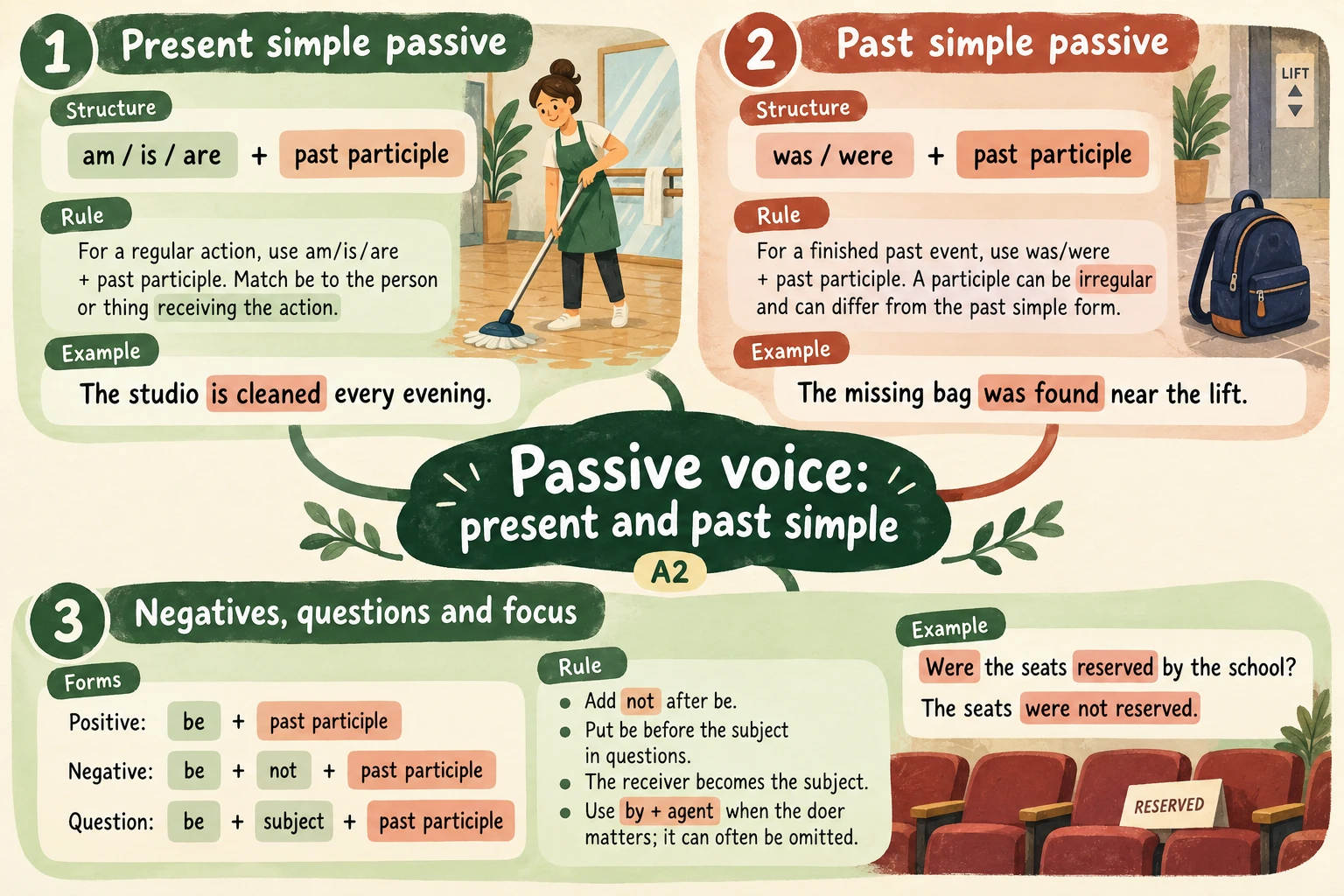
Para uma ação habitual, use am/is/are + particípio. A forma de be concorda com a pessoa ou coisa que recebe a ação.
am/is/are + past participlePara um fato passado encerrado, use was/were + particípio. O particípio pode ser irregular e diferente do passado simples.
was/were + past participleAcrescente not depois de be; nas perguntas, coloque be antes do sujeito. Quem recebe a ação vira sujeito. Use by + agente quando importa dizer quem age; muitas vezes é possível omiti-lo.
Was the room cleaned? · It wasn’t cleaned.The room is cleaned daily.It was cleaned yesterday.
The room isn’t cleaned daily.It wasn’t cleaned yesterday.
Is the room cleaned daily?Was it cleaned yesterday?
Yes, it is.No, it wasn’t.
A cleaner cleans one entrance every morning. Focus on the entrance.
Para uma ação habitual, use am/is/are + particípio. A forma de be concorda com a pessoa ou coisa que recebe a ação.
The studio is cleaned every evening.Para um fato passado encerrado, use was/were + particípio. O particípio pode ser irregular e diferente do passado simples.
The missing bag was found near the lift.Acrescente not depois de be; nas perguntas, coloque be antes do sujeito. Quem recebe a ação vira sujeito. Use by + agente quando importa dizer quem age; muitas vezes é possível omiti-lo.
Were the seats reserved by the school? The seats were not reserved.Guarde a primeira tentativa, entenda a mudança e confira em outra situação.
Ainda não há revisões. Faça um aquecimento curto.
Para uma ação habitual, use am/is/are + particípio. A forma de be concorda com a pessoa ou coisa que recebe a ação.
The studio is cleaned every evening.Para um fato passado encerrado, use was/were + particípio. O particípio pode ser irregular e diferente do passado simples.
The missing bag was found near the lift.Acrescente not depois de be; nas perguntas, coloque be antes do sujeito. Quem recebe a ação vira sujeito. Use by + agente quando importa dizer quem age; muitas vezes é possível omiti-lo.
Were the seats reserved by the school? The seats were not reserved.Abrir uma resposta registra ajuda para essa questão.
A cleaner cleans one entrance every morning. Focus on the entrance.
Observe “A cleaner cleans one entrance every morning. Focus on the entrance.”. Para uma ação habitual, use am/is/are + particípio. A forma de be concorda com a pessoa ou coisa que recebe a ação. Frase completa: “The entrance is cleaned every morning.”.
The secretary wrote the meeting minutes yesterday. Minutes means the written record of a meeting.
Observe “The secretary wrote the meeting minutes yesterday. Minutes means the written record of a meeting.”. Para um fato passado encerrado, use was/were + particípio. O particípio pode ser irregular e diferente do passado simples. Frase completa: “The minutes were written yesterday.”.
The club checks its bikes before each ride. Ask about this routine, focusing on the bikes.
Observe “The club checks its bikes before each ride. Ask about this routine, focusing on the bikes.”. Acrescente not depois de be; nas perguntas, coloque be antes do sujeito. Quem recebe a ação vira sujeito. Use by + agente quando importa dizer quem age; muitas vezes é possível omiti-lo. Frase completa: “Are the bikes checked before each ride?”.
The cafe makes these sandwiches here every morning. The sandwiches ___ here every morning.
Os sanduíches recebem esta ação habitual. O plural 'sandwiches' pede 'are made'.
Last night's storm broke two windows. Focus on the windows.
Observe “Last night's storm broke two windows. Focus on the windows.”. Para um fato passado encerrado, use was/were + particípio. O particípio pode ser irregular e diferente do passado simples. Frase completa: “The two windows were broken during last night's storm.”.
The caretaker forgot to lock the doors last night. Nobody else locked them. Focus on the doors.
Observe “The caretaker forgot to lock the doors last night. Nobody else locked them. Focus on the doors.”. Acrescente not depois de be; nas perguntas, coloque be antes do sujeito. Quem recebe a ação vira sujeito. Use by + agente quando importa dizer quem age; muitas vezes é possível omiti-lo. Frase completa: “The doors were not locked last night.”.
A local artist painted this mural in 2021.
'This mural' recebe a ação. Use 'was painted' e mantenha o artista com 'by'.
Find the agreement error: The invitations is sent every May.
'Invitations' está no plural: troque 'is' por 'are'. Mantenha 'sent' e a expressão de frequência.
Find the verb-form error: The parcel was took to the office yesterday.
Observe “Find the verb-form error: The parcel was took to the office yesterday.”. Para um fato passado encerrado, use was/were + particípio. O particípio pode ser irregular e diferente do passado simples. Frase completa: “The parcel was taken to the office yesterday.”.
Find the error in this question: Did the tickets checked at the gate yesterday?
Observe “Find the error in this question: Did the tickets checked at the gate yesterday?”. Acrescente not depois de be; nas perguntas, coloque be antes do sujeito. Quem recebe a ação vira sujeito. Use by + agente quando importa dizer quem age; muitas vezes é possível omiti-lo. Frase completa: “Were the tickets checked at the gate yesterday?”.
Our workshop prints these labels every Friday. Focus on the labels.
Observe “Our workshop prints these labels every Friday. Focus on the labels.”. Para uma ação habitual, use am/is/are + particípio. A forma de be concorda com a pessoa ou coisa que recebe a ação. Frase completa: “These labels are printed in our workshop every Friday.”.
The storm damaged the roof last winter.
O telhado recebe o dano em um fato passado encerrado. Use 'was damaged'; 'by the storm' mantém a causa.