01Passif au présent simple
Pour une action habituelle, utilisez am/is/are + participe passé. Accordez « be » avec la personne ou la chose qui subit l’action.
am/is/are + past participle
Voix passive : présent et prétérit · A2. Pour une action habituelle, utilisez am/is/are + participe passé. Accordez « be » avec la personne ou la chose qui subit l’action.
Exprimez ce qui arrive à une personne ou une chose. Pratiquez le passif au présent simple et au prétérit.
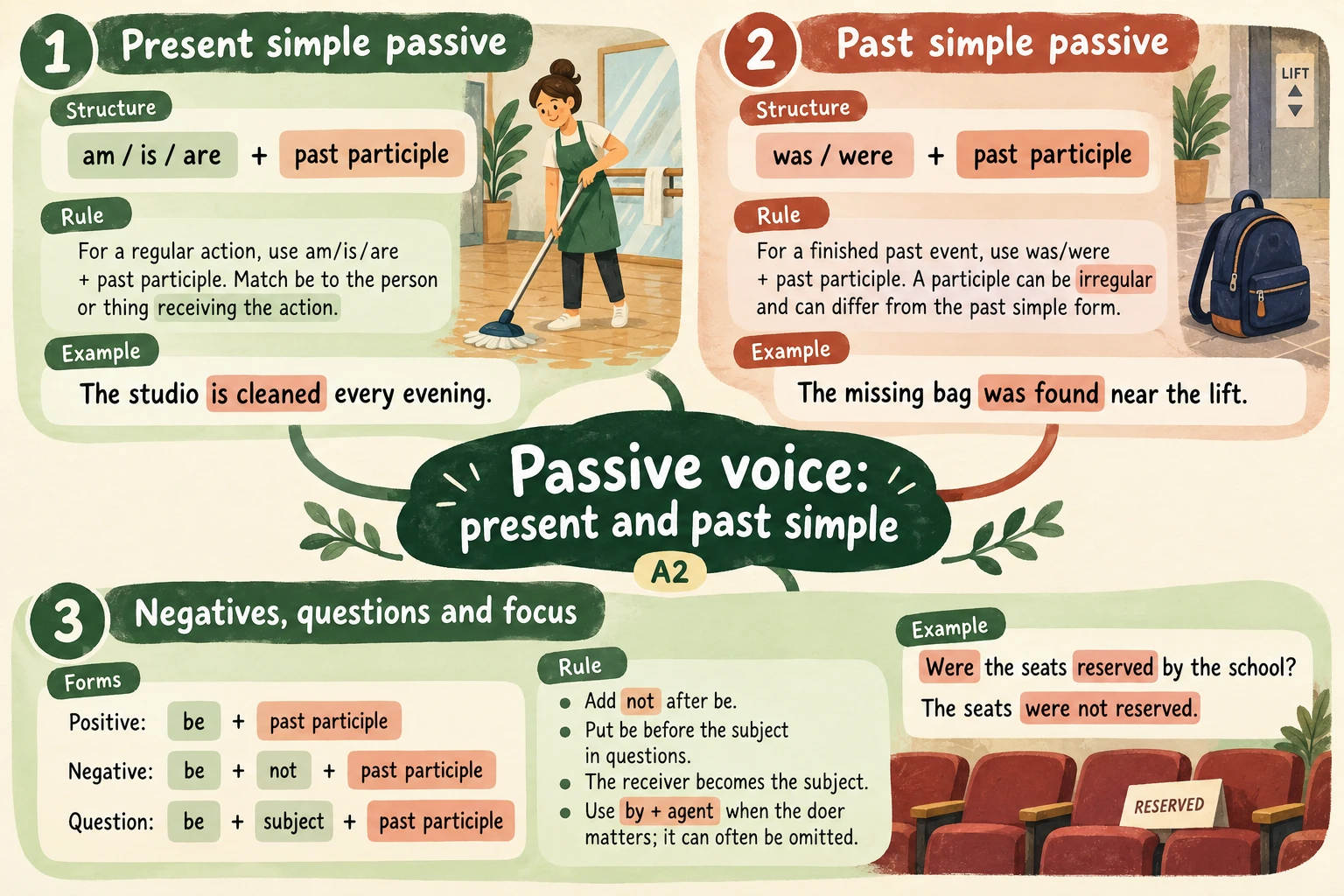
Pour une action habituelle, utilisez am/is/are + participe passé. Accordez « be » avec la personne ou la chose qui subit l’action.
am/is/are + past participlePour un événement passé terminé, utilisez was/were + participe passé. Le participe peut être irrégulier et différer du prétérit.
was/were + past participleAjoutez not après be ; dans les questions, placez be avant le sujet. La personne ou chose qui subit l’action devient sujet. Ajoutez by + agent si son identité compte ; on peut souvent l’omettre.
Was the room cleaned? · It wasn’t cleaned.The room is cleaned daily.It was cleaned yesterday.
The room isn’t cleaned daily.It wasn’t cleaned yesterday.
Is the room cleaned daily?Was it cleaned yesterday?
Yes, it is.No, it wasn’t.
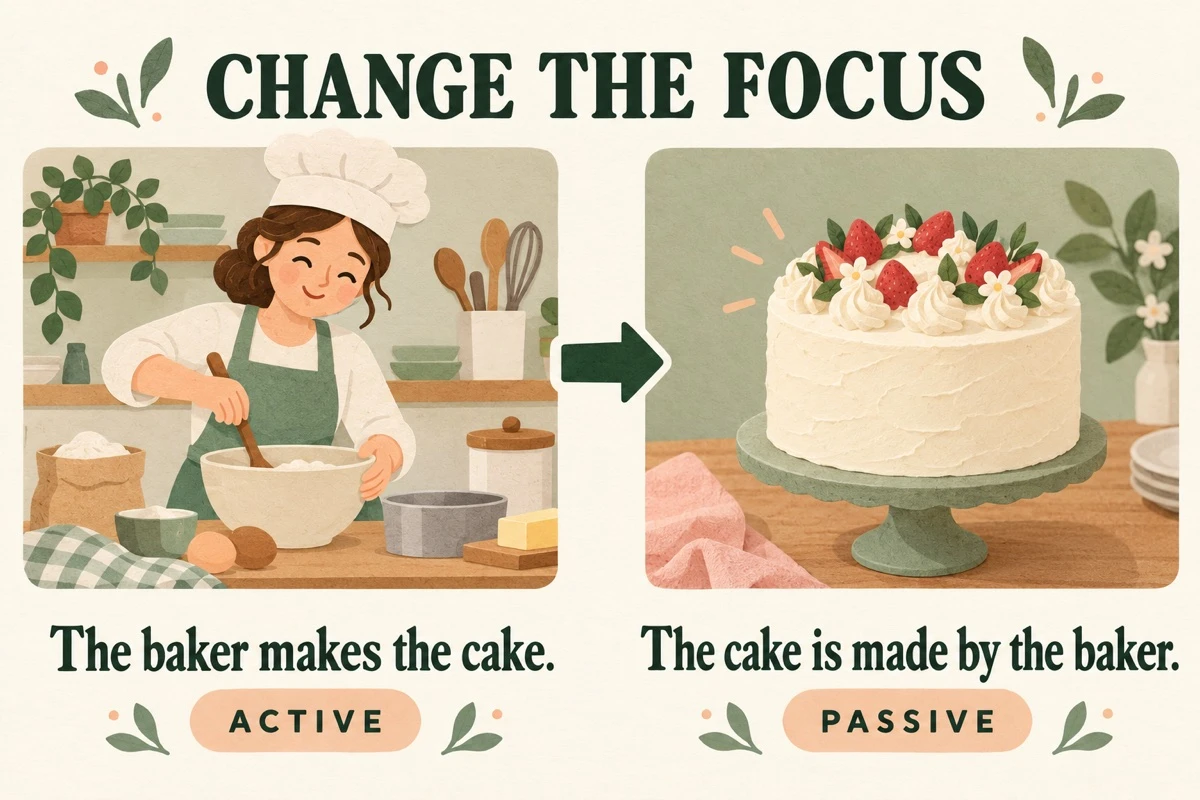
A cleaner cleans one entrance every morning. Focus on the entrance.
Pour une action habituelle, utilisez am/is/are + participe passé. Accordez « be » avec la personne ou la chose qui subit l’action.
The studio is cleaned every evening.Pour un événement passé terminé, utilisez was/were + participe passé. Le participe peut être irrégulier et différer du prétérit.
The missing bag was found near the lift.Ajoutez not après be ; dans les questions, placez be avant le sujet. La personne ou chose qui subit l’action devient sujet. Ajoutez by + agent si son identité compte ; on peut souvent l’omettre.
Were the seats reserved by the school? The seats were not reserved.Gardez la première tentative, comprenez le changement et essayez dans une nouvelle situation.
Pas encore de notes. Essayez un court échauffement.
Pour une action habituelle, utilisez am/is/are + participe passé. Accordez « be » avec la personne ou la chose qui subit l’action.
The studio is cleaned every evening.Pour un événement passé terminé, utilisez was/were + participe passé. Le participe peut être irrégulier et différer du prétérit.
The missing bag was found near the lift.Ajoutez not après be ; dans les questions, placez be avant le sujet. La personne ou chose qui subit l’action devient sujet. Ajoutez by + agent si son identité compte ; on peut souvent l’omettre.
Were the seats reserved by the school? The seats were not reserved.Ouvrir une réponse enregistre une aide pour cette question.
A cleaner cleans one entrance every morning. Focus on the entrance.
Observe « A cleaner cleans one entrance every morning. Focus on the entrance. ». Pour une action habituelle, utilisez am/is/are + participe passé. Accordez « be » avec la personne ou la chose qui subit l’action. Phrase complète : « The entrance is cleaned every morning. ».
The secretary wrote the meeting minutes yesterday. Minutes means the written record of a meeting.
Observe « The secretary wrote the meeting minutes yesterday. Minutes means the written record of a meeting. ». Pour un événement passé terminé, utilisez was/were + participe passé. Le participe peut être irrégulier et différer du prétérit. Phrase complète : « The minutes were written yesterday. ».
The club checks its bikes before each ride. Ask about this routine, focusing on the bikes.
Observe « The club checks its bikes before each ride. Ask about this routine, focusing on the bikes. ». Ajoutez not après be ; dans les questions, placez be avant le sujet. La personne ou chose qui subit l’action devient sujet. Ajoutez by + agent si son identité compte ; on peut souvent l’omettre. Phrase complète : « Are the bikes checked before each ride? ».
The cafe makes these sandwiches here every morning. The sandwiches ___ here every morning.
Les sandwiches subissent cette action habituelle. Le pluriel « sandwiches » demande « are made ».
Last night's storm broke two windows. Focus on the windows.
Observe « Last night's storm broke two windows. Focus on the windows. ». Pour un événement passé terminé, utilisez was/were + participe passé. Le participe peut être irrégulier et différer du prétérit. Phrase complète : « The two windows were broken during last night's storm. ».
The caretaker forgot to lock the doors last night. Nobody else locked them. Focus on the doors.
Observe « The caretaker forgot to lock the doors last night. Nobody else locked them. Focus on the doors. ». Ajoutez not après be ; dans les questions, placez be avant le sujet. La personne ou chose qui subit l’action devient sujet. Ajoutez by + agent si son identité compte ; on peut souvent l’omettre. Phrase complète : « The doors were not locked last night. ».
A local artist painted this mural in 2021.
« This mural » subit l'action. Utilisez « was painted » et gardez l'artiste avec « by ».
Find the agreement error: The invitations is sent every May.
« Invitations » est au pluriel : remplacez « is » par « are ». Gardez « sent » et l'indication de fréquence.
Find the verb-form error: The parcel was took to the office yesterday.
Observe « Find the verb-form error: The parcel was took to the office yesterday. ». Pour un événement passé terminé, utilisez was/were + participe passé. Le participe peut être irrégulier et différer du prétérit. Phrase complète : « The parcel was taken to the office yesterday. ».
Find the error in this question: Did the tickets checked at the gate yesterday?
Observe « Find the error in this question: Did the tickets checked at the gate yesterday? ». Ajoutez not après be ; dans les questions, placez be avant le sujet. La personne ou chose qui subit l’action devient sujet. Ajoutez by + agent si son identité compte ; on peut souvent l’omettre. Phrase complète : « Were the tickets checked at the gate yesterday? ».
Our workshop prints these labels every Friday. Focus on the labels.
Observe « Our workshop prints these labels every Friday. Focus on the labels. ». Pour une action habituelle, utilisez am/is/are + participe passé. Accordez « be » avec la personne ou la chose qui subit l’action. Phrase complète : « These labels are printed in our workshop every Friday. ».
The storm damaged the roof last winter.
Le toit subit des dégâts lors d'un événement passé terminé. Utilisez « was damaged » ; « by the storm » conserve la cause.