01extra information about a named person; whose marks possession and who is a subject
Use who / whose to express extra information about a named person; whose marks possession and who is a subject.
Mara, who manages the archive, is on leave.
Non-defining relative clauses · B1. Use who / whose to express extra information about a named person; whose marks possession and who is a subject.
Complete 12 original tasks. Use the situation to choose the intended meaning, practise the form, then apply it in a fresh context.
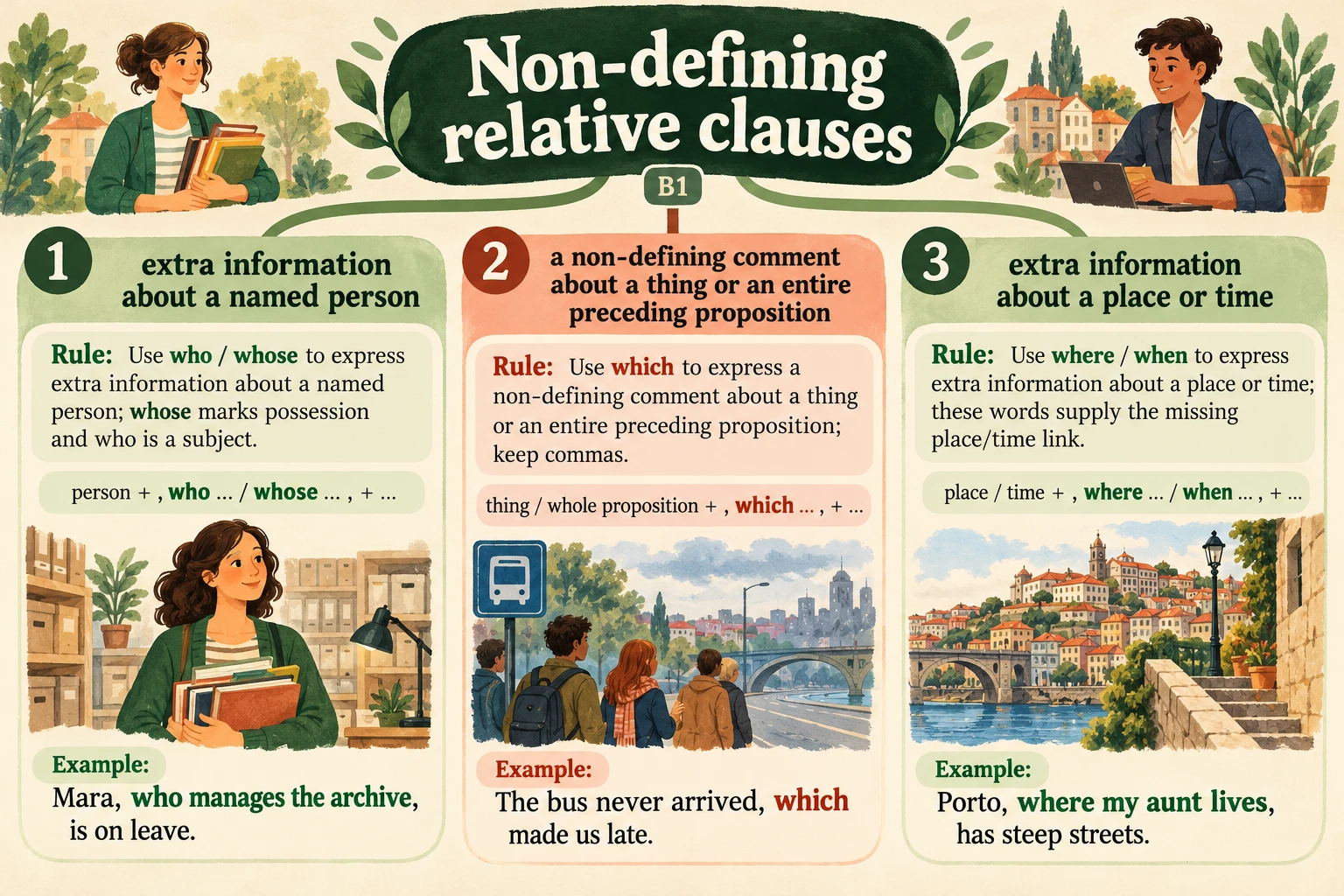
Use who / whose to express extra information about a named person; whose marks possession and who is a subject.
Mara, who manages the archive, is on leave.Use which to express a non-defining comment about a thing or an entire preceding proposition; keep commas.
The bus never arrived, which made us late.Use where / when to express extra information about a place or time; these words supply the missing place/time link.
Porto, where my aunt lives, has steep streets.
Mara is already identified. Add information about her job.
Use who / whose to express extra information about a named person; whose marks possession and who is a subject.
Mara, who manages the archive, is on leave.Use which to express a non-defining comment about a thing or an entire preceding proposition; keep commas.
The bus never arrived, which made us late.Use where / when to express extra information about a place or time; these words supply the missing place/time link.
Porto, where my aunt lives, has steep streets.Keep the first try. Understand the change. Check it in a fresh situation.
No practice notes yet. Try a short warm-up.
Use who / whose to express extra information about a named person; whose marks possession and who is a subject.
Mara, who manages the archive, is on leave.Use which to express a non-defining comment about a thing or an entire preceding proposition; keep commas.
The bus never arrived, which made us late.Use where / when to express extra information about a place or time; these words supply the missing place/time link.
Porto, where my aunt lives, has steep streets.Opening an answer records help for that question.
Mara is already identified. Add information about her job.
Look at “Mara, ___ manages the archive, is on leave.”. Use who / whose to express extra information about a named person; whose marks possession and who is a subject. Complete sentence: “Mara, who manages the archive, is on leave.”.
The comment concerns the whole preceding fact.
Look at “The bus never arrived, ___ made us late.”. Use which to express a non-defining comment about a thing or an entire preceding proposition; keep commas. Complete sentence: “The bus never arrived, which made us late.”.
The missing word links an already identified place to activity there.
Look at “Porto, ___ my aunt lives, has steep streets.”. Use where / when to express extra information about a place or time; these words supply the missing place/time link. Complete sentence: “Porto, where my aunt lives, has steep streets.”.
The colleague is already identified; the gap shows possession of a bike.
Look at “Jon, ___ bike was stolen, has reported it.”. Use who / whose to express extra information about a named person; whose marks possession and who is a subject. Complete sentence: “Jon, whose bike was stolen, has reported it.”.
Add a non-defining comment about the entire preceding event. Supply a relative pronoun.
Complete sentence: “The team cancelled the launch, which surprised investors.” Use which to express a non-defining comment about a thing or an entire preceding proposition; keep commas. The subject, time and meaning in the task determine this form. Only reviewed responses are matched automatically; other wording is not automatically wrong.
A time reference is needed; no place is described.
Look at “In June, ___ the school closes, we will travel.”. Use where / when to express extra information about a place or time; these words supply the missing place/time link. Complete sentence: “In June, when the school closes, we will travel.”.
Supply a relative determiner expressing the named person’s ownership.
Complete sentence: “Aisha, whose studio faces the river, painted the view.” Use who / whose to express extra information about a named person; whose marks possession and who is a subject. The subject, time and meaning in the task determine this form. Only reviewed responses are matched automatically; other wording is not automatically wrong.
A named scientist receives additional subject information.
Look at “Dr Lee, ___ discovered the error, will explain it.”. Use who / whose to express extra information about a named person; whose marks possession and who is a subject. Complete sentence: “Dr Lee, who discovered the error, will explain it.”.
Supply a relative pronoun as the subject referring to the identified machine.
Complete sentence: “The old generator, which still works, powers the shed.” Use which to express a non-defining comment about a thing or an entire preceding proposition; keep commas. The subject, time and meaning in the task determine this form. Only reviewed responses are matched automatically; other wording is not automatically wrong.
The gap represents the place where they first met.
Look at “The old library, ___ we first met, is being restored.”. Use where / when to express extra information about a place or time; these words supply the missing place/time link. Complete sentence: “The old library, where we first met, is being restored.”.
A named building receives additional subject information.
Look at “The lighthouse, ___ was built in 1890, is open today.”. Use which to express a non-defining comment about a thing or an entire preceding proposition; keep commas. Complete sentence: “The lighthouse, which was built in 1890, is open today.”.
Supply a relative time word for additional information about the specified year.
Complete sentence: “In 2014, when the bridge opened, traffic patterns changed.” Use where / when to express extra information about a place or time; these words supply the missing place/time link. The subject, time and meaning in the task determine this form. Only reviewed responses are matched automatically; other wording is not automatically wrong.