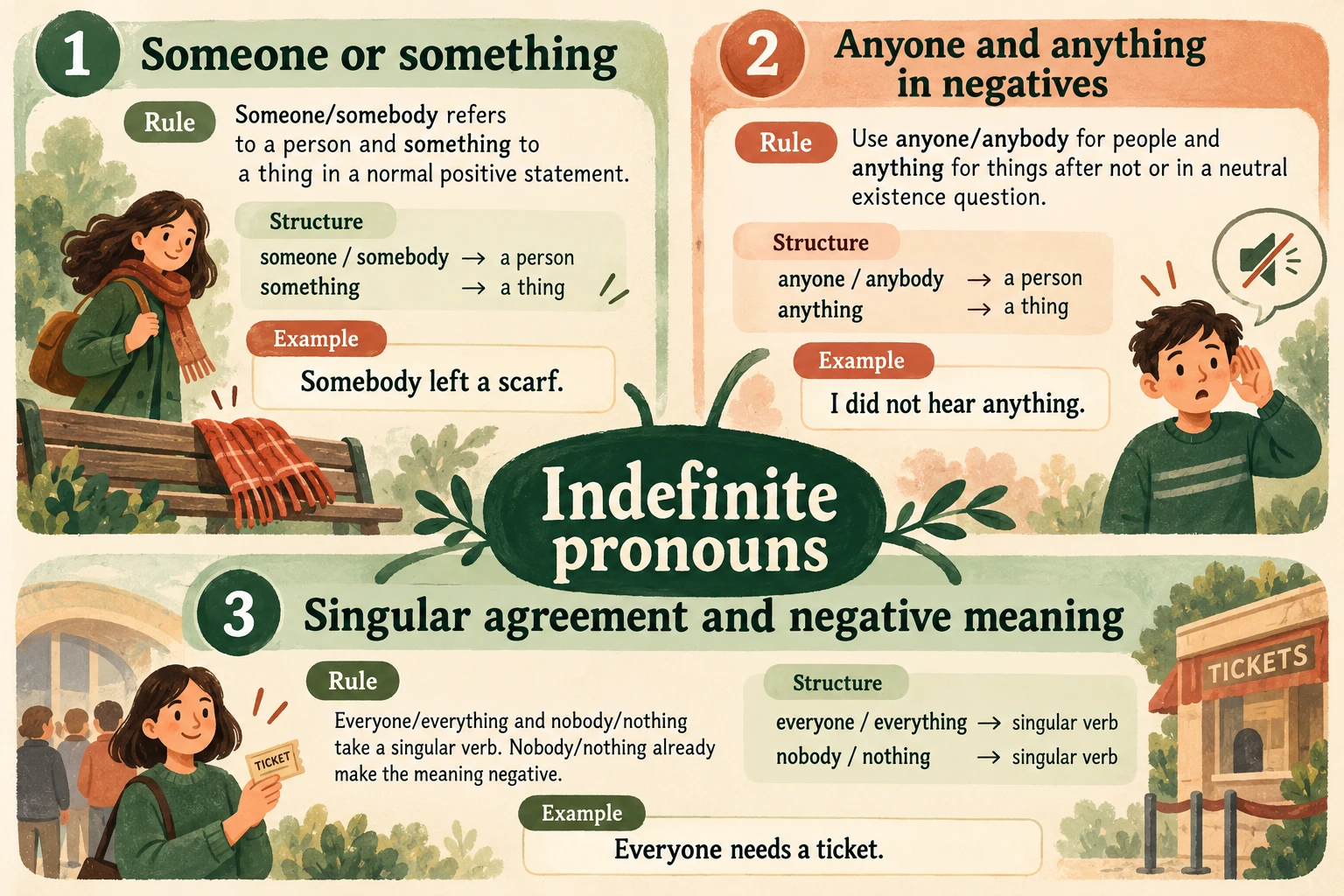
01Someone or something
Someone/somebody refers to a person and something to a thing in a normal positive statement.
Somebody left a scarf.
Indefinite pronouns · A2. Someone/somebody refers to a person and something to a thing in a normal positive statement.
Practise Indefinite pronouns in short situations. Read the clue, choose or write a form, then check the reason. The level is an editorial guide.
Someone/somebody refers to a person and something to a thing in a normal positive statement.
Somebody left a scarf.Use anyone/anybody for people and anything for things after not or in a neutral existence question.
I did not hear anything.Everyone/everything and nobody/nothing take a singular verb. Nobody/nothing already make the meaning negative.
Everyone needs a ticket.
A person is knocking, but I do not know who. ___ is at the door.
Someone/somebody refers to a person and something to a thing in a normal positive statement.
Somebody left a scarf.Use anyone/anybody for people and anything for things after not or in a neutral existence question.
I did not hear anything.Everyone/everything and nobody/nothing take a singular verb. Nobody/nothing already make the meaning negative.
Everyone needs a ticket.Keep the first try. Understand the change. Check it in a fresh situation.
No practice notes yet. Try a short warm-up.
Someone/somebody refers to a person and something to a thing in a normal positive statement.
Somebody left a scarf.Use anyone/anybody for people and anything for things after not or in a neutral existence question.
I did not hear anything.Everyone/everything and nobody/nothing take a singular verb. Nobody/nothing already make the meaning negative.
Everyone needs a ticket.Opening an answer records help for that question.
A person is knocking, but I do not know who. ___ is at the door.
Look at “A person is knocking, but I do not know who. ___ is at the door.”. Someone/somebody refers to a person and something to a thing in a normal positive statement. Complete sentence: “A person is knocking, but I do not know who. Someone is at the door.”.
I opened the empty drawer to look for an object and did not find ___ inside.
Look at “I opened the empty drawer to look for an object and did not find ___ inside.”. Use anyone/anybody for people and anything for things after not or in a neutral existence question. Complete sentence: “I opened the empty drawer and did not find anything inside.”.
All the guests are ready. Everyone ___ ready.
Look at “All the guests are ready. Everyone ___ ready.”. Everyone/everything and nobody/nothing take a singular verb. Nobody/nothing already make the meaning negative. Complete sentence: “All the guests are ready. Everyone is ready.”.
I can hear a strange noise. ___ is moving in the cupboard.
A noise alone does not tell us whether a thing or a person is moving. Something, someone and somebody all fit this evidence and take is. Also accepted in this task: Someone / Somebody. These are reviewed alternatives, not an exhaustive list of all possible English.
I do not know a single person here. I do not know ___.
Look at “I do not know a single person here. I do not know ___.”. Use anyone/anybody for people and anything for things after not or in a neutral existence question. Complete sentence: “I do not know a single person here. I do not know anyone.”.
The room is completely empty. Nobody ___ inside.
Look at “The room is completely empty. Nobody ___ inside.”. Everyone/everything and nobody/nothing take a singular verb. Nobody/nothing already make the meaning negative. Complete sentence: “The room is completely empty. Nobody is inside.”.
I found a useful object in the drawer. I found ___ suitable for opening this lid. (use a some- word for a thing)
Reference completion: “I found a useful object in the drawer. I found something suitable for opening this lid. (use a some- word for a thing)”. Someone/somebody refers to a person and something to a thing in a normal positive statement.
A stranger helped me. ___ helped, but I did not get their name.
Look at “A stranger helped me. ___ helped, but I did not get their name.”. Someone/somebody refers to a person and something to a thing in a normal positive statement. Complete sentence: “A stranger helped me. Someone helped, but I did not get their name.”.
Have you heard any news? I have not heard ___ today.
Look at “Have you heard any news? I have not heard ___ today.”. Use anyone/anybody for people and anything for things after not or in a neutral existence question. Complete sentence: “Have you heard any news? I have not heard anything today.”.
Every single item is packed. Everything ___ in the suitcase.
Reference completion: “Every single item is packed. Everything is in the suitcase.”. Everyone/everything and nobody/nothing take a singular verb. Nobody/nothing already make the meaning negative.
I could not see a single person on the platform. I could not see ___.
Look at “I could not see a single person on the platform. I could not see ___.”. Use anyone/anybody for people and anything for things after not or in a neutral existence question. Complete sentence: “I could not see a single person on the platform. I could not see anyone.”.
No part of this machine works. Nothing ___ properly. (work)
Reference completion: “No part of this machine works. Nothing works properly. (work)”. Everyone/everything and nobody/nothing take a singular verb. Nobody/nothing already make the meaning negative.