01Someone oder something
Someone/somebody bezeichnet eine Person, something eine Sache in einer normalen bejahten Aussage.
Somebody left a scarf.
Indefinitpronomen · A2. Someone/somebody bezeichnet eine Person, something eine Sache in einer normalen bejahten Aussage.
Übe Indefinitpronomen in kurzen Situationen. Lies den Hinweis, wähle oder schreibe eine Form und prüfe die Begründung. Die Stufe dient der redaktionellen Orientierung.
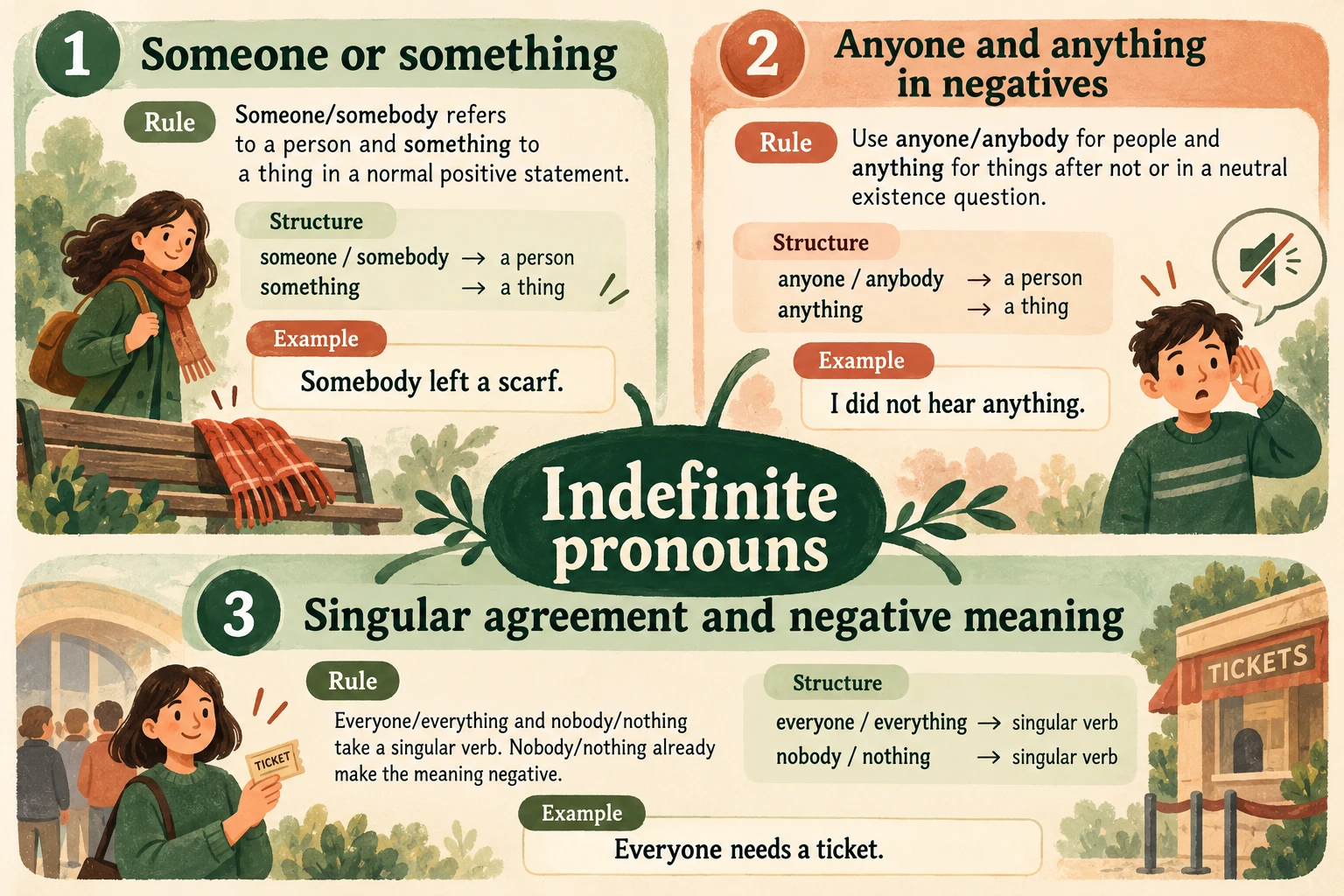
Someone/somebody bezeichnet eine Person, something eine Sache in einer normalen bejahten Aussage.
Somebody left a scarf.Nach not und in neutralen Existenzfragen steht anyone/anybody für Personen, anything für Sachen.
I did not hear anything.Everyone/everything und nobody/nothing verlangen ein Singularverb. Nobody/nothing sind bereits negativ.
Everyone needs a ticket.
A person is knocking, but I do not know who. ___ is at the door.
Someone/somebody bezeichnet eine Person, something eine Sache in einer normalen bejahten Aussage.
Somebody left a scarf.Nach not und in neutralen Existenzfragen steht anyone/anybody für Personen, anything für Sachen.
I did not hear anything.Everyone/everything und nobody/nothing verlangen ein Singularverb. Nobody/nothing sind bereits negativ.
Everyone needs a ticket.Bewahre den ersten Versuch. Verstehe die Änderung. Prüfe sie in einer neuen Situation.
Noch keine Lernnotizen. Starte mit einem kurzen Einstieg.
Someone/somebody bezeichnet eine Person, something eine Sache in einer normalen bejahten Aussage.
Somebody left a scarf.Nach not und in neutralen Existenzfragen steht anyone/anybody für Personen, anything für Sachen.
I did not hear anything.Everyone/everything und nobody/nothing verlangen ein Singularverb. Nobody/nothing sind bereits negativ.
Everyone needs a ticket.Das Öffnen einer Antwort wird für diese Aufgabe als Hilfe erfasst.
A person is knocking, but I do not know who. ___ is at the door.
Achte auf „A person is knocking, but I do not know who. ___ is at the door.“. Someone/somebody bezeichnet eine Person, something eine Sache in einer normalen bejahten Aussage. Vollständiger Satz: „A person is knocking, but I do not know who. Someone is at the door.“.
I opened the empty drawer to look for an object and did not find ___ inside.
Achte auf „I opened the empty drawer to look for an object and did not find ___ inside.“. Nach not und in neutralen Existenzfragen steht anyone/anybody für Personen, anything für Sachen. Vollständiger Satz: „I opened the empty drawer and did not find anything inside.“.
All the guests are ready. Everyone ___ ready.
Achte auf „All the guests are ready. Everyone ___ ready.“. Everyone/everything und nobody/nothing verlangen ein Singularverb. Nobody/nothing sind bereits negativ. Vollständiger Satz: „All the guests are ready. Everyone is ready.“.
I can hear a strange noise. ___ is moving in the cupboard.
Ein Geräusch allein zeigt nicht, ob sich eine Sache oder eine Person bewegt. Something, someone und somebody passen zu dieser Information und stehen mit is. In dieser Aufgabe sind auch diese Formen geprüft: Someone / Somebody. Die Liste ist nicht vollständig.
I do not know a single person here. I do not know ___.
Achte auf „I do not know a single person here. I do not know ___.“. Nach not und in neutralen Existenzfragen steht anyone/anybody für Personen, anything für Sachen. Vollständiger Satz: „I do not know a single person here. I do not know anyone.“.
The room is completely empty. Nobody ___ inside.
Achte auf „The room is completely empty. Nobody ___ inside.“. Everyone/everything und nobody/nothing verlangen ein Singularverb. Nobody/nothing sind bereits negativ. Vollständiger Satz: „The room is completely empty. Nobody is inside.“.
I found a useful object in the drawer. I found ___ suitable for opening this lid. (use a some- word for a thing)
Vollständiger Beispielsatz: „I found a useful object in the drawer. I found something suitable for opening this lid. (use a some- word for a thing)“. Someone/somebody bezeichnet eine Person, something eine Sache in einer normalen bejahten Aussage.
A stranger helped me. ___ helped, but I did not get their name.
Achte auf „A stranger helped me. ___ helped, but I did not get their name.“. Someone/somebody bezeichnet eine Person, something eine Sache in einer normalen bejahten Aussage. Vollständiger Satz: „A stranger helped me. Someone helped, but I did not get their name.“.
Have you heard any news? I have not heard ___ today.
Achte auf „Have you heard any news? I have not heard ___ today.“. Nach not und in neutralen Existenzfragen steht anyone/anybody für Personen, anything für Sachen. Vollständiger Satz: „Have you heard any news? I have not heard anything today.“.
Every single item is packed. Everything ___ in the suitcase.
Vollständiger Beispielsatz: „Every single item is packed. Everything is in the suitcase.“. Everyone/everything und nobody/nothing verlangen ein Singularverb. Nobody/nothing sind bereits negativ.
I could not see a single person on the platform. I could not see ___.
Achte auf „I could not see a single person on the platform. I could not see ___.“. Nach not und in neutralen Existenzfragen steht anyone/anybody für Personen, anything für Sachen. Vollständiger Satz: „I could not see a single person on the platform. I could not see anyone.“.
No part of this machine works. Nothing ___ properly. (work)
Vollständiger Beispielsatz: „No part of this machine works. Nothing works properly. (work)“. Everyone/everything und nobody/nothing verlangen ein Singularverb. Nobody/nothing sind bereits negativ.