01Someone ou something
Someone/somebody désigne une personne et something une chose dans une affirmation ordinaire.
Somebody left a scarf.
Pronoms indéfinis · A2. Someone/somebody désigne une personne et something une chose dans une affirmation ordinaire.
Travaille Pronoms indéfinis dans de courtes situations. Lis l’indice, choisis ou écris une forme, puis vérifie l’explication. Le niveau est une indication éditoriale.
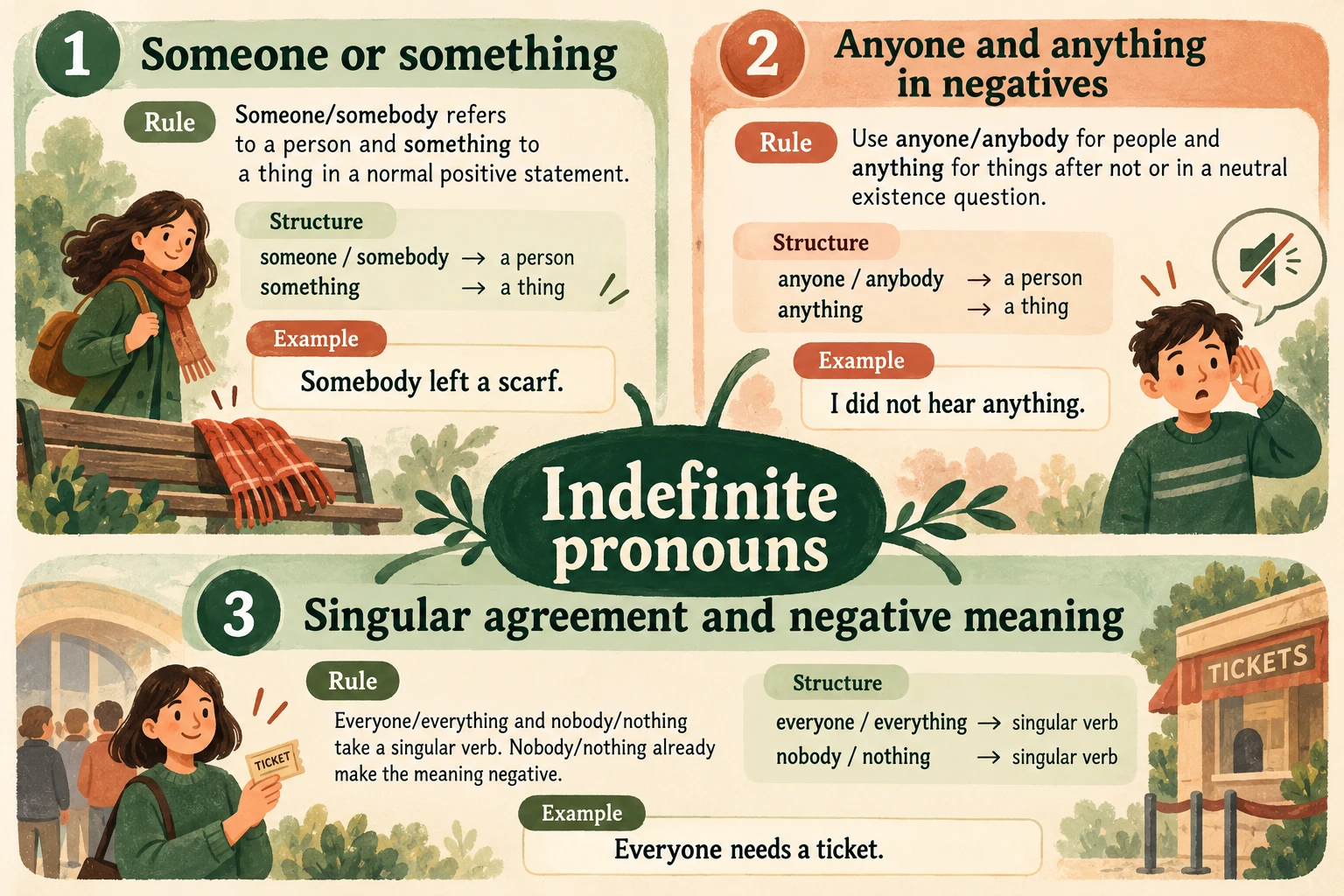
Someone/somebody désigne une personne et something une chose dans une affirmation ordinaire.
Somebody left a scarf.Après not ou dans une question neutre d’existence, utilise anyone/anybody pour les personnes et anything pour les choses.
I did not hear anything.Everyone/everything et nobody/nothing prennent un verbe singulier. Nobody/nothing expriment déjà la négation.
Everyone needs a ticket.
A person is knocking, but I do not know who. ___ is at the door.
Someone/somebody désigne une personne et something une chose dans une affirmation ordinaire.
Somebody left a scarf.Après not ou dans une question neutre d’existence, utilise anyone/anybody pour les personnes et anything pour les choses.
I did not hear anything.Everyone/everything et nobody/nothing prennent un verbe singulier. Nobody/nothing expriment déjà la négation.
Everyone needs a ticket.Gardez la première tentative, comprenez le changement et essayez dans une nouvelle situation.
Pas encore de notes. Essayez un court échauffement.
Someone/somebody désigne une personne et something une chose dans une affirmation ordinaire.
Somebody left a scarf.Après not ou dans une question neutre d’existence, utilise anyone/anybody pour les personnes et anything pour les choses.
I did not hear anything.Everyone/everything et nobody/nothing prennent un verbe singulier. Nobody/nothing expriment déjà la négation.
Everyone needs a ticket.Ouvrir une réponse enregistre une aide pour cette question.
A person is knocking, but I do not know who. ___ is at the door.
Observe « A person is knocking, but I do not know who. ___ is at the door. ». Someone/somebody désigne une personne et something une chose dans une affirmation ordinaire. Phrase complète : « A person is knocking, but I do not know who. Someone is at the door. ».
I opened the empty drawer to look for an object and did not find ___ inside.
Observe « I opened the empty drawer to look for an object and did not find ___ inside. ». Après not ou dans une question neutre d’existence, utilise anyone/anybody pour les personnes et anything pour les choses. Phrase complète : « I opened the empty drawer and did not find anything inside. ».
All the guests are ready. Everyone ___ ready.
Observe « All the guests are ready. Everyone ___ ready. ». Everyone/everything et nobody/nothing prennent un verbe singulier. Nobody/nothing expriment déjà la négation. Phrase complète : « All the guests are ready. Everyone is ready. ».
I can hear a strange noise. ___ is moving in the cupboard.
Un bruit seul ne permet pas de savoir si une chose ou une personne bouge. Something, someone et somebody conviennent à ces indices et prennent is. Autres variantes vérifiées pour cette tâche : Someone / Somebody. La liste ne couvre pas toutes les formulations possibles.
I do not know a single person here. I do not know ___.
Observe « I do not know a single person here. I do not know ___. ». Après not ou dans une question neutre d’existence, utilise anyone/anybody pour les personnes et anything pour les choses. Phrase complète : « I do not know a single person here. I do not know anyone. ».
The room is completely empty. Nobody ___ inside.
Observe « The room is completely empty. Nobody ___ inside. ». Everyone/everything et nobody/nothing prennent un verbe singulier. Nobody/nothing expriment déjà la négation. Phrase complète : « The room is completely empty. Nobody is inside. ».
I found a useful object in the drawer. I found ___ suitable for opening this lid. (use a some- word for a thing)
Phrase de référence : « I found a useful object in the drawer. I found something suitable for opening this lid. (use a some- word for a thing) ». Someone/somebody désigne une personne et something une chose dans une affirmation ordinaire.
A stranger helped me. ___ helped, but I did not get their name.
Observe « A stranger helped me. ___ helped, but I did not get their name. ». Someone/somebody désigne une personne et something une chose dans une affirmation ordinaire. Phrase complète : « A stranger helped me. Someone helped, but I did not get their name. ».
Have you heard any news? I have not heard ___ today.
Observe « Have you heard any news? I have not heard ___ today. ». Après not ou dans une question neutre d’existence, utilise anyone/anybody pour les personnes et anything pour les choses. Phrase complète : « Have you heard any news? I have not heard anything today. ».
Every single item is packed. Everything ___ in the suitcase.
Phrase de référence : « Every single item is packed. Everything is in the suitcase. ». Everyone/everything et nobody/nothing prennent un verbe singulier. Nobody/nothing expriment déjà la négation.
I could not see a single person on the platform. I could not see ___.
Observe « I could not see a single person on the platform. I could not see ___. ». Après not ou dans une question neutre d’existence, utilise anyone/anybody pour les personnes et anything pour les choses. Phrase complète : « I could not see a single person on the platform. I could not see anyone. ».
No part of this machine works. Nothing ___ properly. (work)
Phrase de référence : « No part of this machine works. Nothing works properly. (work) ». Everyone/everything et nobody/nothing prennent un verbe singulier. Nobody/nothing expriment déjà la négation.