01Someone ou something
Someone/somebody se refere a uma pessoa e something a uma coisa em afirmação comum.
Somebody left a scarf.
Pronomes indefinidos · A2. Someone/somebody se refere a uma pessoa e something a uma coisa em afirmação comum.
Pratique Pronomes indefinidos em situações curtas. Leia a pista, escolha ou escreva uma forma e confira a explicação. O nível é uma orientação editorial.
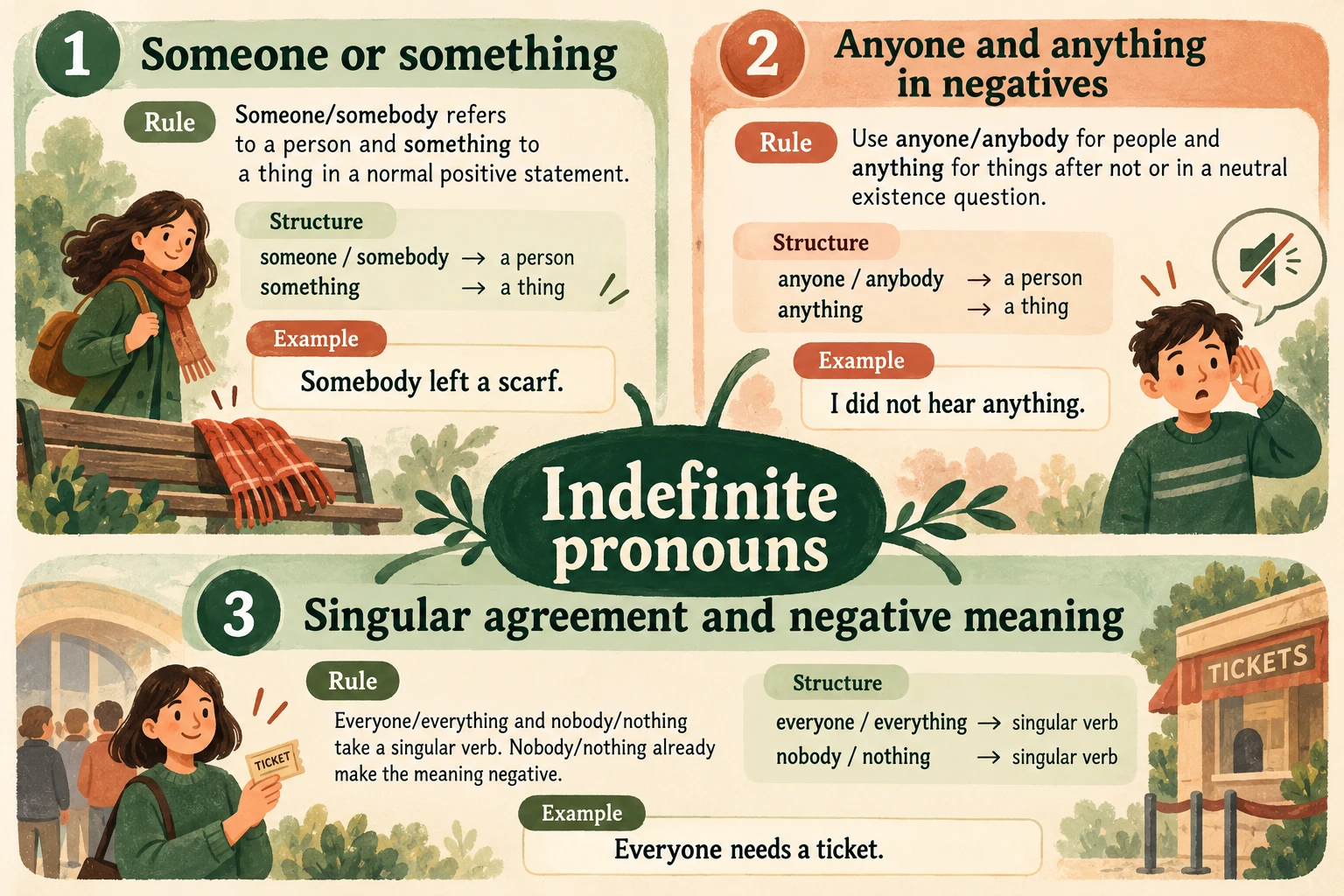
Someone/somebody se refere a uma pessoa e something a uma coisa em afirmação comum.
Somebody left a scarf.Use anyone/anybody para pessoas e anything para coisas depois de not ou em pergunta neutra de existência.
I did not hear anything.Everyone/everything e nobody/nothing pedem verbo singular. Nobody/nothing já dão sentido negativo.
Everyone needs a ticket.
A person is knocking, but I do not know who. ___ is at the door.
Someone/somebody se refere a uma pessoa e something a uma coisa em afirmação comum.
Somebody left a scarf.Use anyone/anybody para pessoas e anything para coisas depois de not ou em pergunta neutra de existência.
I did not hear anything.Everyone/everything e nobody/nothing pedem verbo singular. Nobody/nothing já dão sentido negativo.
Everyone needs a ticket.Guarde a primeira tentativa, entenda a mudança e confira em outra situação.
Ainda não há revisões. Faça um aquecimento curto.
Someone/somebody se refere a uma pessoa e something a uma coisa em afirmação comum.
Somebody left a scarf.Use anyone/anybody para pessoas e anything para coisas depois de not ou em pergunta neutra de existência.
I did not hear anything.Everyone/everything e nobody/nothing pedem verbo singular. Nobody/nothing já dão sentido negativo.
Everyone needs a ticket.Abrir uma resposta registra ajuda para essa questão.
A person is knocking, but I do not know who. ___ is at the door.
Observe “A person is knocking, but I do not know who. ___ is at the door.”. Someone/somebody se refere a uma pessoa e something a uma coisa em afirmação comum. Frase completa: “A person is knocking, but I do not know who. Someone is at the door.”.
I opened the empty drawer to look for an object and did not find ___ inside.
Observe “I opened the empty drawer to look for an object and did not find ___ inside.”. Use anyone/anybody para pessoas e anything para coisas depois de not ou em pergunta neutra de existência. Frase completa: “I opened the empty drawer and did not find anything inside.”.
All the guests are ready. Everyone ___ ready.
Observe “All the guests are ready. Everyone ___ ready.”. Everyone/everything e nobody/nothing pedem verbo singular. Nobody/nothing já dão sentido negativo. Frase completa: “All the guests are ready. Everyone is ready.”.
I can hear a strange noise. ___ is moving in the cupboard.
Um ruído sozinho não revela se algo ou alguém se move. Something, someone e somebody são compatíveis com a informação e usam is. Também são aceitas estas variantes revisadas: Someone / Somebody. A lista não cobre todas as expressões possíveis.
I do not know a single person here. I do not know ___.
Observe “I do not know a single person here. I do not know ___.”. Use anyone/anybody para pessoas e anything para coisas depois de not ou em pergunta neutra de existência. Frase completa: “I do not know a single person here. I do not know anyone.”.
The room is completely empty. Nobody ___ inside.
Observe “The room is completely empty. Nobody ___ inside.”. Everyone/everything e nobody/nothing pedem verbo singular. Nobody/nothing já dão sentido negativo. Frase completa: “The room is completely empty. Nobody is inside.”.
I found a useful object in the drawer. I found ___ suitable for opening this lid. (use a some- word for a thing)
Frase de referência: “I found a useful object in the drawer. I found something suitable for opening this lid. (use a some- word for a thing)”. Someone/somebody se refere a uma pessoa e something a uma coisa em afirmação comum.
A stranger helped me. ___ helped, but I did not get their name.
Observe “A stranger helped me. ___ helped, but I did not get their name.”. Someone/somebody se refere a uma pessoa e something a uma coisa em afirmação comum. Frase completa: “A stranger helped me. Someone helped, but I did not get their name.”.
Have you heard any news? I have not heard ___ today.
Observe “Have you heard any news? I have not heard ___ today.”. Use anyone/anybody para pessoas e anything para coisas depois de not ou em pergunta neutra de existência. Frase completa: “Have you heard any news? I have not heard anything today.”.
Every single item is packed. Everything ___ in the suitcase.
Frase de referência: “Every single item is packed. Everything is in the suitcase.”. Everyone/everything e nobody/nothing pedem verbo singular. Nobody/nothing já dão sentido negativo.
I could not see a single person on the platform. I could not see ___.
Observe “I could not see a single person on the platform. I could not see ___.”. Use anyone/anybody para pessoas e anything para coisas depois de not ou em pergunta neutra de existência. Frase completa: “I could not see a single person on the platform. I could not see anyone.”.
No part of this machine works. Nothing ___ properly. (work)
Frase de referência: “No part of this machine works. Nothing works properly. (work)”. Everyone/everything e nobody/nothing pedem verbo singular. Nobody/nothing já dão sentido negativo.