01Base verbs in instructions
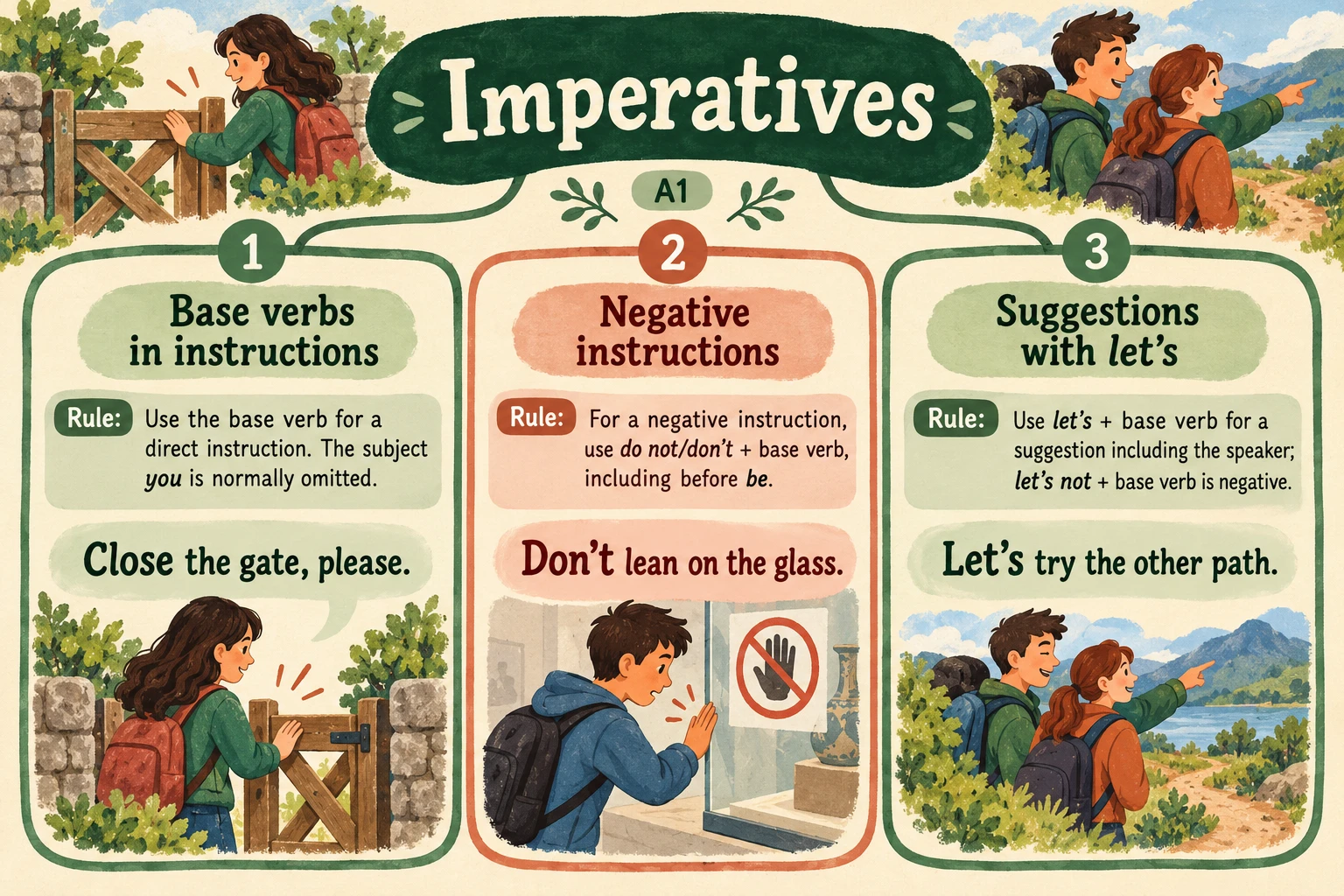
Use the base verb for a direct instruction. The subject you is normally omitted.
Close the gate, please.
Imperatives · A1. Use the base verb for a direct instruction. The subject you is normally omitted.
Practise Imperatives in short situations. Read the clue, choose or write a form, then check the reason. The level is an editorial guide.
Use the base verb for a direct instruction. The subject you is normally omitted.
Close the gate, please.For a negative instruction, use do not/don’t + base verb, including before be.
Don’t lean on the glass.Use let’s + base verb for a suggestion including the speaker; let’s not + base verb is negative.
Let’s try the other path.
The soup is hot. ___ it cool before you eat. (let)
Use the base verb for a direct instruction. The subject you is normally omitted.
Close the gate, please.For a negative instruction, use do not/don’t + base verb, including before be.
Don’t lean on the glass.Use let’s + base verb for a suggestion including the speaker; let’s not + base verb is negative.
Let’s try the other path.Keep the first try. Understand the change. Check it in a fresh situation.
No practice notes yet. Try a short warm-up.
Use the base verb for a direct instruction. The subject you is normally omitted.
Close the gate, please.For a negative instruction, use do not/don’t + base verb, including before be.
Don’t lean on the glass.Use let’s + base verb for a suggestion including the speaker; let’s not + base verb is negative.
Let’s try the other path.Opening an answer records help for that question.
The soup is hot. ___ it cool before you eat. (let)
Look at “The soup is hot. ___ it cool before you eat. (let)”. Use the base verb for a direct instruction. The subject you is normally omitted. Complete sentence: “The soup is hot. Let it cool before you eat. (let)”.
The sign says: ___ touch the paintings.
Look at “The sign says: ___ touch the paintings.”. For a negative instruction, use do not/don’t + base verb, including before be. Complete sentence: “The sign says: Do not touch the paintings.”.
We are both tired. ___ take a short break.
Look at “We are both tired. ___ take a short break.”. Use let’s + base verb for a suggestion including the speaker; let’s not + base verb is negative. Complete sentence: “We are both tired. Let’s take a short break.”.
Please ___ your name at the top. (write)
Reference completion: “Please write your name at the top. (write)”. Use the base verb for a direct instruction. The subject you is normally omitted.
The teacher says: ___ be late tomorrow.
Look at “The teacher says: ___ be late tomorrow.”. For a negative instruction, use do not/don’t + base verb, including before be. Complete sentence: “The teacher says: Do not be late tomorrow.”.
We have time. Let’s ___ rush.
Look at “We have time. Let’s ___ rush.”. Use let’s + base verb for a suggestion including the speaker; let’s not + base verb is negative. Complete sentence: “We have time. Let’s not rush.”.
___ left at the traffic lights. (turn)
Reference completion: “Turn left at the traffic lights. (turn)”. Use the base verb for a direct instruction. The subject you is normally omitted.
For help, ___ this green button. (press)
Look at “For help, ___ this green button. (press)”. Use the base verb for a direct instruction. The subject you is normally omitted. Complete sentence: “For help, press this green button. (press)”.
The floor is wet. ___ run in here.
Look at “The floor is wet. ___ run in here.”. For a negative instruction, use do not/don’t + base verb, including before be. Complete sentence: “The floor is wet. Do not run in here.”.
The bus is slow. Let’s ___ instead. (walk)
Reference completion: “The bus is slow. Let’s walk instead. (walk)”. Use let’s + base verb for a suggestion including the speaker; let’s not + base verb is negative.
The music is too loud. Please ___ make so much noise.
Look at “The music is too loud. Please ___ make so much noise.”. For a negative instruction, use do not/don’t + base verb, including before be. Complete sentence: “The music is too loud. Please do not make so much noise.”.
We can cook at home. Let’s ___ order pizza tonight.
The usual neutral written form here is “Let’s not order pizza tonight”: let’s not + base verb. Let’s don’t is also found in American conversational usage, so it is not marked as bad English; this exercise asks for the usual written pattern.