01Grundform in Anweisungen
Eine direkte Anweisung beginnt mit der Grundform; you wird normalerweise weggelassen.
Close the gate, please.
Imperativ · A1. Eine direkte Anweisung beginnt mit der Grundform; you wird normalerweise weggelassen.
Übe Imperativ in kurzen Situationen. Lies den Hinweis, wähle oder schreibe eine Form und prüfe die Begründung. Die Stufe dient der redaktionellen Orientierung.
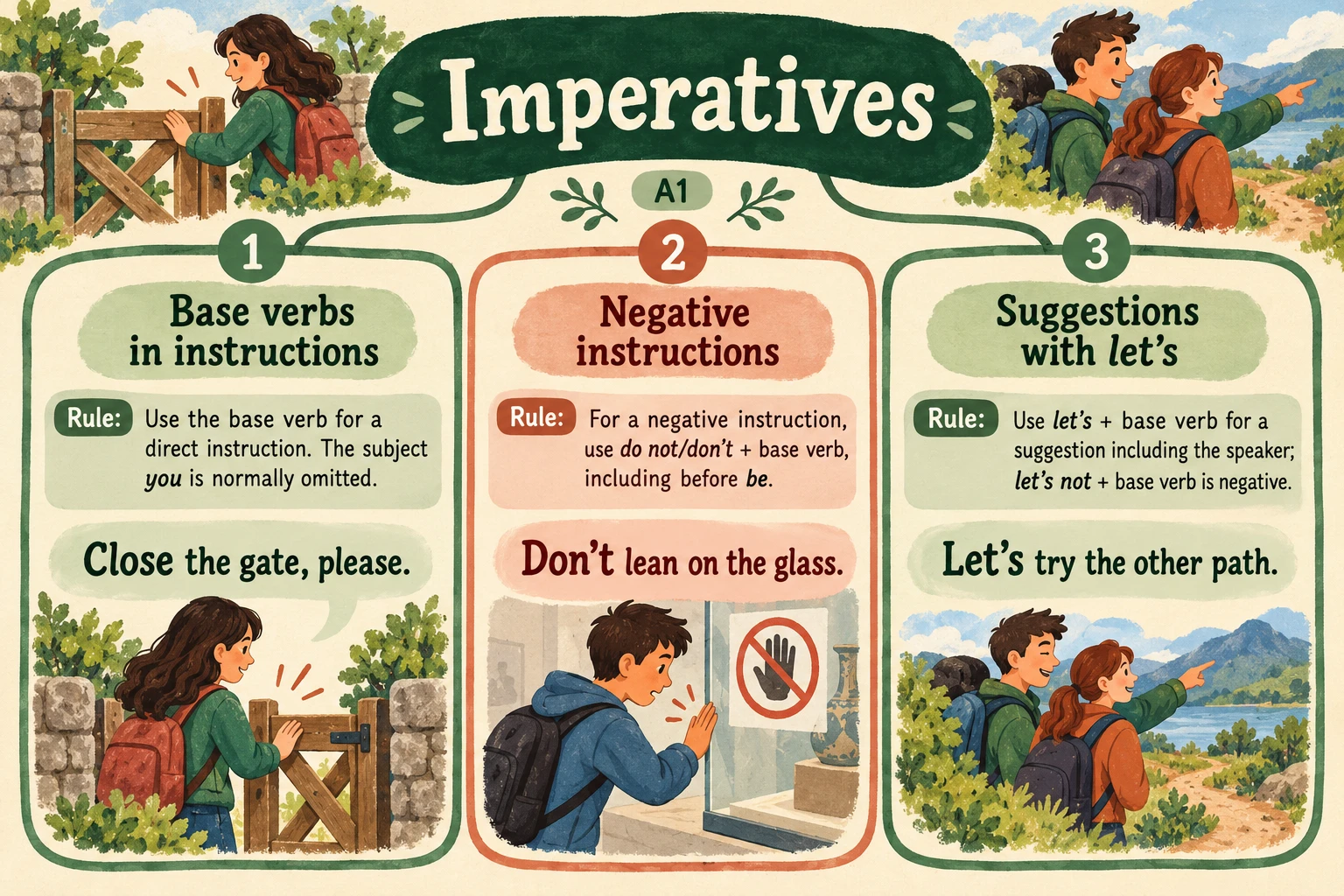
Eine direkte Anweisung beginnt mit der Grundform; you wird normalerweise weggelassen.
Close the gate, please.Verneinte Anweisungen verwenden do not/don’t + Grundform, auch vor be.
Don’t lean on the glass.Let’s + Grundform ist ein Vorschlag mit dem Sprecher; die Verneinung lautet let’s not + Grundform.
Let’s try the other path.
The soup is hot. ___ it cool before you eat. (let)
Eine direkte Anweisung beginnt mit der Grundform; you wird normalerweise weggelassen.
Close the gate, please.Verneinte Anweisungen verwenden do not/don’t + Grundform, auch vor be.
Don’t lean on the glass.Let’s + Grundform ist ein Vorschlag mit dem Sprecher; die Verneinung lautet let’s not + Grundform.
Let’s try the other path.Bewahre den ersten Versuch. Verstehe die Änderung. Prüfe sie in einer neuen Situation.
Noch keine Lernnotizen. Starte mit einem kurzen Einstieg.
Eine direkte Anweisung beginnt mit der Grundform; you wird normalerweise weggelassen.
Close the gate, please.Verneinte Anweisungen verwenden do not/don’t + Grundform, auch vor be.
Don’t lean on the glass.Let’s + Grundform ist ein Vorschlag mit dem Sprecher; die Verneinung lautet let’s not + Grundform.
Let’s try the other path.Das Öffnen einer Antwort wird für diese Aufgabe als Hilfe erfasst.
The soup is hot. ___ it cool before you eat. (let)
Achte auf „The soup is hot. ___ it cool before you eat. (let)“. Eine direkte Anweisung beginnt mit der Grundform; you wird normalerweise weggelassen. Vollständiger Satz: „The soup is hot. Let it cool before you eat. (let)“.
The sign says: ___ touch the paintings.
Achte auf „The sign says: ___ touch the paintings.“. Verneinte Anweisungen verwenden do not/don’t + Grundform, auch vor be. Vollständiger Satz: „The sign says: Do not touch the paintings.“.
We are both tired. ___ take a short break.
Achte auf „We are both tired. ___ take a short break.“. Let’s + Grundform ist ein Vorschlag mit dem Sprecher; die Verneinung lautet let’s not + Grundform. Vollständiger Satz: „We are both tired. Let’s take a short break.“.
Please ___ your name at the top. (write)
Vollständiger Beispielsatz: „Please write your name at the top. (write)“. Eine direkte Anweisung beginnt mit der Grundform; you wird normalerweise weggelassen.
The teacher says: ___ be late tomorrow.
Achte auf „The teacher says: ___ be late tomorrow.“. Verneinte Anweisungen verwenden do not/don’t + Grundform, auch vor be. Vollständiger Satz: „The teacher says: Do not be late tomorrow.“.
We have time. Let’s ___ rush.
Achte auf „We have time. Let’s ___ rush.“. Let’s + Grundform ist ein Vorschlag mit dem Sprecher; die Verneinung lautet let’s not + Grundform. Vollständiger Satz: „We have time. Let’s not rush.“.
___ left at the traffic lights. (turn)
Vollständiger Beispielsatz: „Turn left at the traffic lights. (turn)“. Eine direkte Anweisung beginnt mit der Grundform; you wird normalerweise weggelassen.
For help, ___ this green button. (press)
Achte auf „For help, ___ this green button. (press)“. Eine direkte Anweisung beginnt mit der Grundform; you wird normalerweise weggelassen. Vollständiger Satz: „For help, press this green button. (press)“.
The floor is wet. ___ run in here.
Achte auf „The floor is wet. ___ run in here.“. Verneinte Anweisungen verwenden do not/don’t + Grundform, auch vor be. Vollständiger Satz: „The floor is wet. Do not run in here.“.
The bus is slow. Let’s ___ instead. (walk)
Vollständiger Beispielsatz: „The bus is slow. Let’s walk instead. (walk)“. Let’s + Grundform ist ein Vorschlag mit dem Sprecher; die Verneinung lautet let’s not + Grundform.
The music is too loud. Please ___ make so much noise.
Achte auf „The music is too loud. Please ___ make so much noise.“. Verneinte Anweisungen verwenden do not/don’t + Grundform, auch vor be. Vollständiger Satz: „The music is too loud. Please do not make so much noise.“.
We can cook at home. Let’s ___ order pizza tonight.
Hier lautet die übliche neutrale schriftliche Form „Let’s not order pizza tonight“: let’s not + Grundform. Let’s don’t kommt auch in amerikanischer Umgangssprache vor und wird deshalb nicht als falsches Englisch bewertet; hier ist die übliche schriftliche Form gefragt.