01Verbo base en instrucciones
Usa el verbo base para instrucciones directas; normalmente se omite you.
Close the gate, please.
Imperativos · A1. Usa el verbo base para instrucciones directas; normalmente se omite you.
Practica Imperativos en situaciones breves. Lee la pista, elige o escribe una forma y revisa la explicación. El nivel es una orientación editorial.
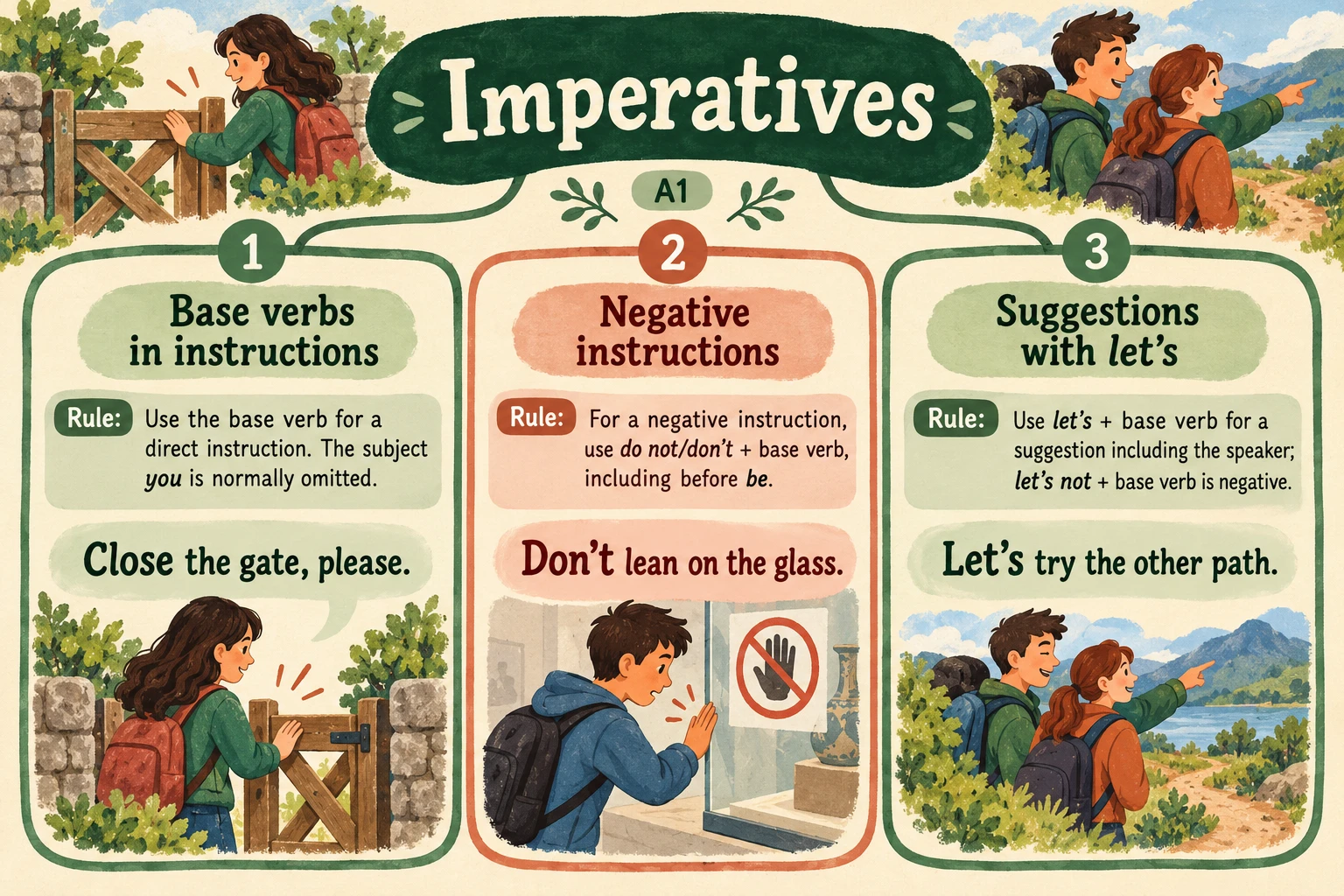
Usa el verbo base para instrucciones directas; normalmente se omite you.
Close the gate, please.Para instrucciones negativas usa do not/don’t + verbo base, también con be.
Don’t lean on the glass.Let’s + verbo base propone algo que incluye al hablante; la negativa es let’s not + verbo base.
Let’s try the other path.
The soup is hot. ___ it cool before you eat. (let)
Usa el verbo base para instrucciones directas; normalmente se omite you.
Close the gate, please.Para instrucciones negativas usa do not/don’t + verbo base, también con be.
Don’t lean on the glass.Let’s + verbo base propone algo que incluye al hablante; la negativa es let’s not + verbo base.
Let’s try the other path.Conserva el primer intento, entiende el cambio y compruébalo en otra situación.
Aún no hay repasos. Prueba un calentamiento corto.
Usa el verbo base para instrucciones directas; normalmente se omite you.
Close the gate, please.Para instrucciones negativas usa do not/don’t + verbo base, también con be.
Don’t lean on the glass.Let’s + verbo base propone algo que incluye al hablante; la negativa es let’s not + verbo base.
Let’s try the other path.Abrir una respuesta registra ayuda para esa pregunta.
The soup is hot. ___ it cool before you eat. (let)
Mira «The soup is hot. ___ it cool before you eat. (let)». Usa el verbo base para instrucciones directas; normalmente se omite you. Oración completa: «The soup is hot. Let it cool before you eat. (let)».
The sign says: ___ touch the paintings.
Mira «The sign says: ___ touch the paintings.». Para instrucciones negativas usa do not/don’t + verbo base, también con be. Oración completa: «The sign says: Do not touch the paintings.».
We are both tired. ___ take a short break.
Mira «We are both tired. ___ take a short break.». Let’s + verbo base propone algo que incluye al hablante; la negativa es let’s not + verbo base. Oración completa: «We are both tired. Let’s take a short break.».
Please ___ your name at the top. (write)
Oración de referencia: «Please write your name at the top. (write)». Usa el verbo base para instrucciones directas; normalmente se omite you.
The teacher says: ___ be late tomorrow.
Mira «The teacher says: ___ be late tomorrow.». Para instrucciones negativas usa do not/don’t + verbo base, también con be. Oración completa: «The teacher says: Do not be late tomorrow.».
We have time. Let’s ___ rush.
Mira «We have time. Let’s ___ rush.». Let’s + verbo base propone algo que incluye al hablante; la negativa es let’s not + verbo base. Oración completa: «We have time. Let’s not rush.».
___ left at the traffic lights. (turn)
Oración de referencia: «Turn left at the traffic lights. (turn)». Usa el verbo base para instrucciones directas; normalmente se omite you.
For help, ___ this green button. (press)
Mira «For help, ___ this green button. (press)». Usa el verbo base para instrucciones directas; normalmente se omite you. Oración completa: «For help, press this green button. (press)».
The floor is wet. ___ run in here.
Mira «The floor is wet. ___ run in here.». Para instrucciones negativas usa do not/don’t + verbo base, también con be. Oración completa: «The floor is wet. Do not run in here.».
The bus is slow. Let’s ___ instead. (walk)
Oración de referencia: «The bus is slow. Let’s walk instead. (walk)». Let’s + verbo base propone algo que incluye al hablante; la negativa es let’s not + verbo base.
The music is too loud. Please ___ make so much noise.
Mira «The music is too loud. Please ___ make so much noise.». Para instrucciones negativas usa do not/don’t + verbo base, también con be. Oración completa: «The music is too loud. Please do not make so much noise.».
We can cook at home. Let’s ___ order pizza tonight.
La forma escrita neutra habitual es «Let’s not order pizza tonight»: let’s not + verbo base. Let’s don’t también se usa en conversación estadounidense, por lo que no se marca como mal inglés; esta actividad pide el patrón escrito habitual.