01Verbo base em instruções
Use o verbo na forma base para instruções diretas; normalmente omita you.
Close the gate, please.
Imperativo · A1. Use o verbo na forma base para instruções diretas; normalmente omita you.
Pratique Imperativo em situações curtas. Leia a pista, escolha ou escreva uma forma e confira a explicação. O nível é uma orientação editorial.
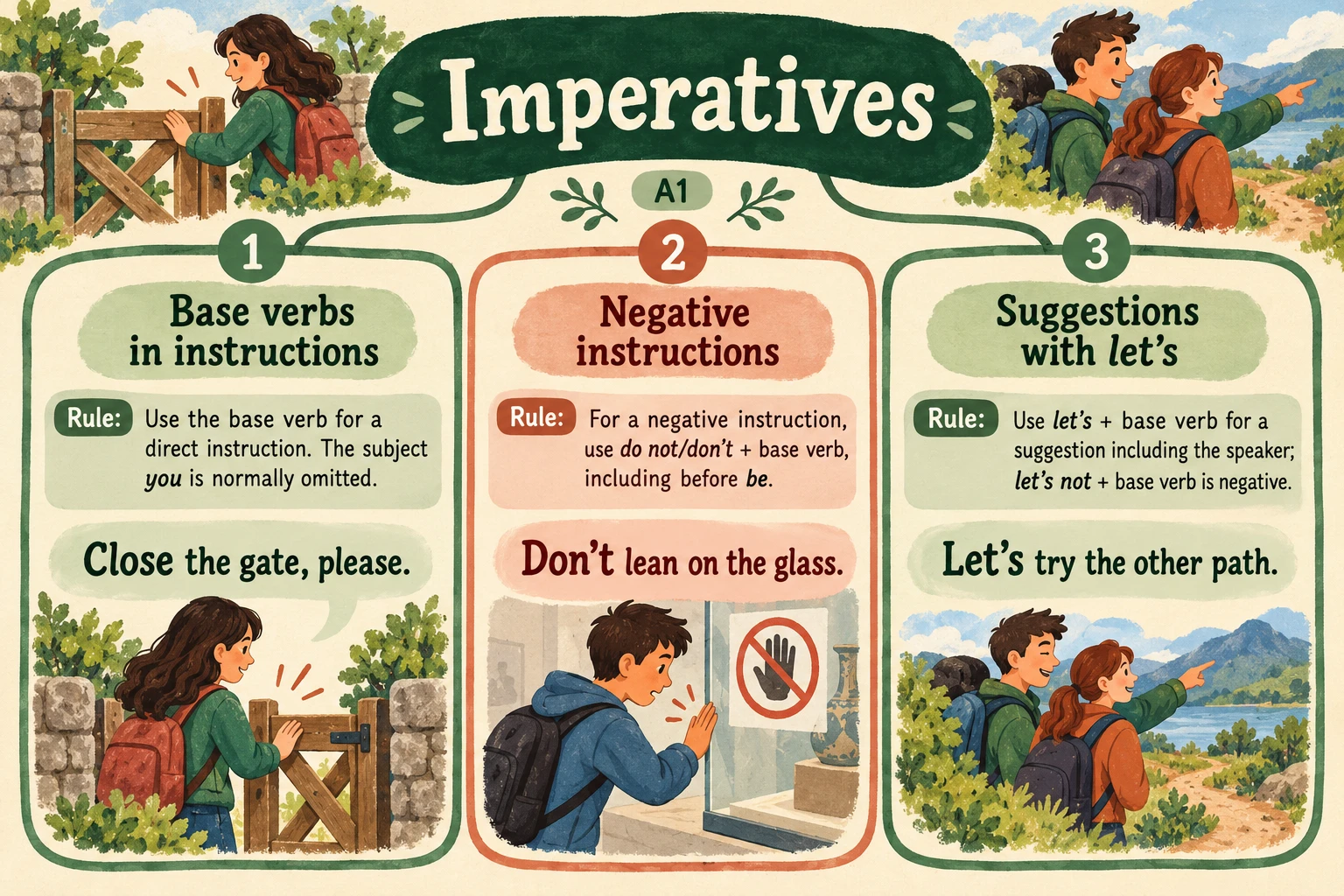
Use o verbo na forma base para instruções diretas; normalmente omita you.
Close the gate, please.Para instruções negativas, use do not/don’t + verbo base, inclusive com be.
Don’t lean on the glass.Let’s + verbo base sugere algo que inclui quem fala; a negativa é let’s not + verbo base.
Let’s try the other path.
The soup is hot. ___ it cool before you eat. (let)
Use o verbo na forma base para instruções diretas; normalmente omita you.
Close the gate, please.Para instruções negativas, use do not/don’t + verbo base, inclusive com be.
Don’t lean on the glass.Let’s + verbo base sugere algo que inclui quem fala; a negativa é let’s not + verbo base.
Let’s try the other path.Guarde a primeira tentativa, entenda a mudança e confira em outra situação.
Ainda não há revisões. Faça um aquecimento curto.
Use o verbo na forma base para instruções diretas; normalmente omita you.
Close the gate, please.Para instruções negativas, use do not/don’t + verbo base, inclusive com be.
Don’t lean on the glass.Let’s + verbo base sugere algo que inclui quem fala; a negativa é let’s not + verbo base.
Let’s try the other path.Abrir uma resposta registra ajuda para essa questão.
The soup is hot. ___ it cool before you eat. (let)
Observe “The soup is hot. ___ it cool before you eat. (let)”. Use o verbo na forma base para instruções diretas; normalmente omita you. Frase completa: “The soup is hot. Let it cool before you eat. (let)”.
The sign says: ___ touch the paintings.
Observe “The sign says: ___ touch the paintings.”. Para instruções negativas, use do not/don’t + verbo base, inclusive com be. Frase completa: “The sign says: Do not touch the paintings.”.
We are both tired. ___ take a short break.
Observe “We are both tired. ___ take a short break.”. Let’s + verbo base sugere algo que inclui quem fala; a negativa é let’s not + verbo base. Frase completa: “We are both tired. Let’s take a short break.”.
Please ___ your name at the top. (write)
Frase de referência: “Please write your name at the top. (write)”. Use o verbo na forma base para instruções diretas; normalmente omita you.
The teacher says: ___ be late tomorrow.
Observe “The teacher says: ___ be late tomorrow.”. Para instruções negativas, use do not/don’t + verbo base, inclusive com be. Frase completa: “The teacher says: Do not be late tomorrow.”.
We have time. Let’s ___ rush.
Observe “We have time. Let’s ___ rush.”. Let’s + verbo base sugere algo que inclui quem fala; a negativa é let’s not + verbo base. Frase completa: “We have time. Let’s not rush.”.
___ left at the traffic lights. (turn)
Frase de referência: “Turn left at the traffic lights. (turn)”. Use o verbo na forma base para instruções diretas; normalmente omita you.
For help, ___ this green button. (press)
Observe “For help, ___ this green button. (press)”. Use o verbo na forma base para instruções diretas; normalmente omita you. Frase completa: “For help, press this green button. (press)”.
The floor is wet. ___ run in here.
Observe “The floor is wet. ___ run in here.”. Para instruções negativas, use do not/don’t + verbo base, inclusive com be. Frase completa: “The floor is wet. Do not run in here.”.
The bus is slow. Let’s ___ instead. (walk)
Frase de referência: “The bus is slow. Let’s walk instead. (walk)”. Let’s + verbo base sugere algo que inclui quem fala; a negativa é let’s not + verbo base.
The music is too loud. Please ___ make so much noise.
Observe “The music is too loud. Please ___ make so much noise.”. Para instruções negativas, use do not/don’t + verbo base, inclusive com be. Frase completa: “The music is too loud. Please do not make so much noise.”.
We can cook at home. Let’s ___ order pizza tonight.
A forma escrita neutra usual é “Let’s not order pizza tonight”: let’s not + verbo base. Let’s don’t também ocorre na fala americana e não é tratado como inglês incorreto; este exercício pede o padrão escrito usual.