01Projets prévus avec going to
Pour un projet déjà décidé, utilise am/is/are going to + base verbale ; accorde be au sujet.
I am going to learn chess.
Futur avec going to · A2. Pour un projet déjà décidé, utilise am/is/are going to + base verbale ; accorde be au sujet.
Travaille Futur avec going to dans de courtes situations. Lis l’indice, choisis ou écris une forme, puis vérifie l’explication. Le niveau est une indication éditoriale.
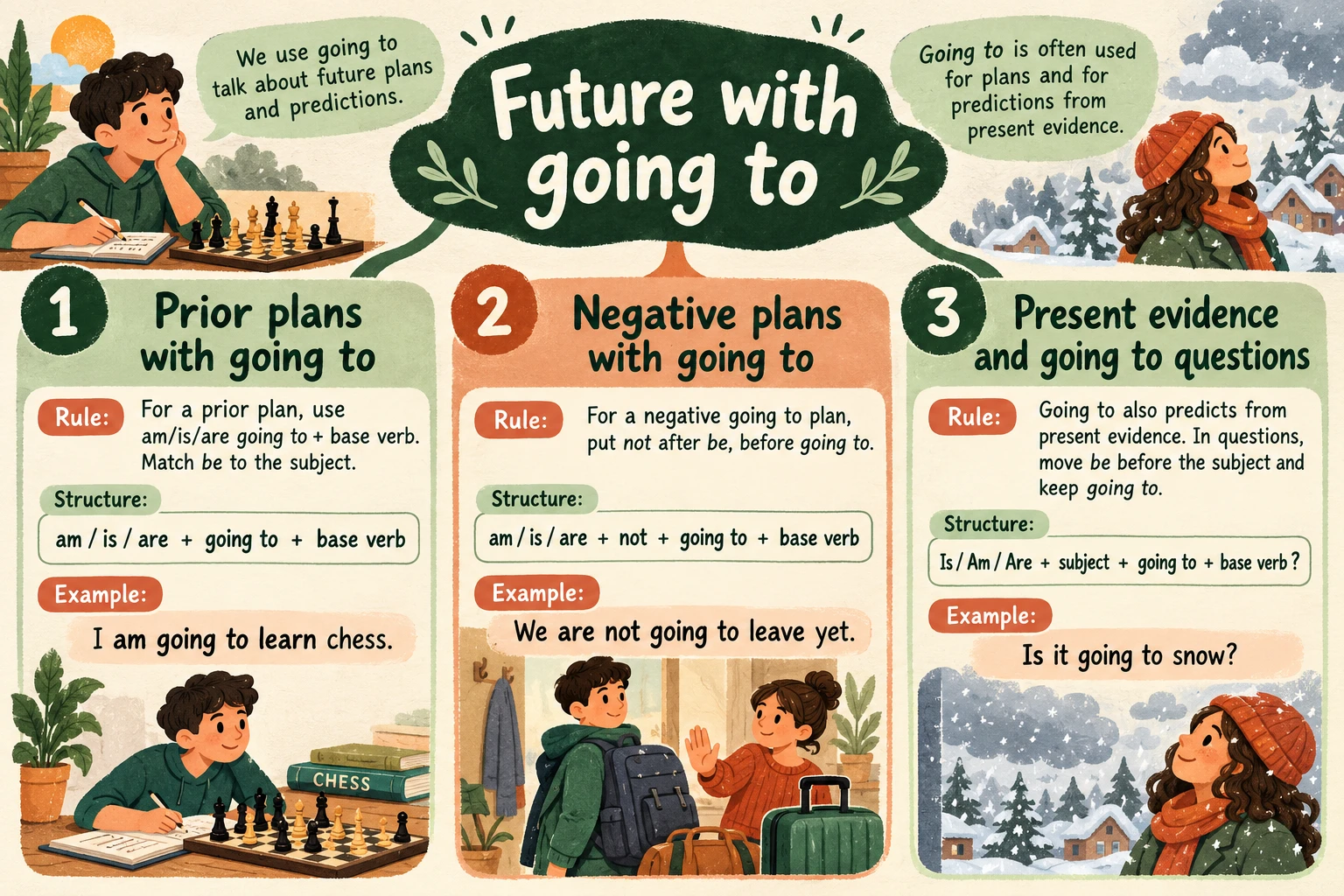
Pour un projet déjà décidé, utilise am/is/are going to + base verbale ; accorde be au sujet.
I am going to learn chess.Pour nier un projet, place not après be et avant going to.
We are not going to leave yet.Going to prédit aussi à partir d’indices présents. Dans une question, place be avant le sujet et garde going to.
Is it going to snow?
We have decided to move. We ___ going to rent a bigger flat.
Pour un projet déjà décidé, utilise am/is/are going to + base verbale ; accorde be au sujet.
I am going to learn chess.Pour nier un projet, place not après be et avant going to.
We are not going to leave yet.Going to prédit aussi à partir d’indices présents. Dans une question, place be avant le sujet et garde going to.
Is it going to snow?Gardez la première tentative, comprenez le changement et essayez dans une nouvelle situation.
Pas encore de notes. Essayez un court échauffement.
Pour un projet déjà décidé, utilise am/is/are going to + base verbale ; accorde be au sujet.
I am going to learn chess.Pour nier un projet, place not après be et avant going to.
We are not going to leave yet.Going to prédit aussi à partir d’indices présents. Dans une question, place be avant le sujet et garde going to.
Is it going to snow?Ouvrir une réponse enregistre une aide pour cette question.
We have decided to move. We ___ going to rent a bigger flat.
Observe « We have decided to move. We ___ going to rent a bigger flat. ». Pour un projet déjà décidé, utilise am/is/are going to + base verbale ; accorde be au sujet. Phrase complète : « We have decided to move. We are going to rent a bigger flat. ».
He has cancelled the trip. He ___ going to travel tomorrow.
Observe « He has cancelled the trip. He ___ going to travel tomorrow. ». Pour nier un projet, place not après be et avant going to. Phrase complète : « He has cancelled the trip. He is not going to travel tomorrow. ».
Look at that loose glass! It is going to ___. (fall)
Observe « Look at that loose glass! It is going to ___. (fall) ». Going to prédit aussi à partir d’indices présents. Dans une question, place be avant le sujet et garde going to. Phrase complète : « Look at that loose glass! It is going to fall. (fall) ».
I have saved for a course. I ___ going to study design.
Phrase de référence : « I have saved for a course. I am going to study design. ». Pour un projet déjà décidé, utilise am/is/are going to + base verbale ; accorde be au sujet. Autres variantes vérifiées pour cette tâche : 'm. La liste ne couvre pas toutes les formulations possibles.
We have other plans. We ___ going to join the tour.
Observe « We have other plans. We ___ going to join the tour. ». Pour nier un projet, place not après be et avant going to. Phrase complète : « We have other plans. We are not going to join the tour. ».
___ Nina going to take the early train?
Observe « ___ Nina going to take the early train? ». Going to prédit aussi à partir d’indices présents. Dans une question, place be avant le sujet et garde going to. Phrase complète : « Is Nina going to take the early train? ».
My brother has chosen a recipe. He ___ going to bake a cake.
Phrase de référence : « My brother has chosen a recipe. He is going to bake a cake. ». Pour un projet déjà décidé, utilise am/is/are going to + base verbale ; accorde be au sujet. Autres variantes vérifiées pour cette tâche : 's. La liste ne couvre pas toutes les formulations possibles.
The neighbours have bought paint. They ___ going to paint the fence.
Observe « The neighbours have bought paint. They ___ going to paint the fence. ». Pour un projet déjà décidé, utilise am/is/are going to + base verbale ; accorde be au sujet. Phrase complète : « The neighbours have bought paint. They are going to paint the fence. ».
I have decided to keep my car. I ___ going to sell it.
Observe « I have decided to keep my car. I ___ going to sell it. ». Pour nier un projet, place not après be et avant going to. Phrase complète : « I have decided to keep my car. I am not going to sell it. ».
___ your friends going to stay at a hotel?
Phrase de référence : « Are your friends going to stay at a hotel? ». Going to prédit aussi à partir d’indices présents. Dans une question, place be avant le sujet et garde going to.
The tickets cost too much. She ___ going to buy them.
Observe « The tickets cost too much. She ___ going to buy them. ». Pour nier un projet, place not après be et avant going to. Phrase complète : « The tickets cost too much. She is not going to buy them. ».
Watch out! Those boxes are going to ___. (fall)
Phrase de référence : « Watch out! Those boxes are going to fall. (fall) ». Going to prédit aussi à partir d’indices présents. Dans une question, place be avant le sujet et garde going to.