01Planes previos con going to
Para un plan previo usa am/is/are going to + verbo base, concordando be con el sujeto.
I am going to learn chess.
Futuro con going to · A2. Para un plan previo usa am/is/are going to + verbo base, concordando be con el sujeto.
Practica Futuro con going to en situaciones breves. Lee la pista, elige o escribe una forma y revisa la explicación. El nivel es una orientación editorial.
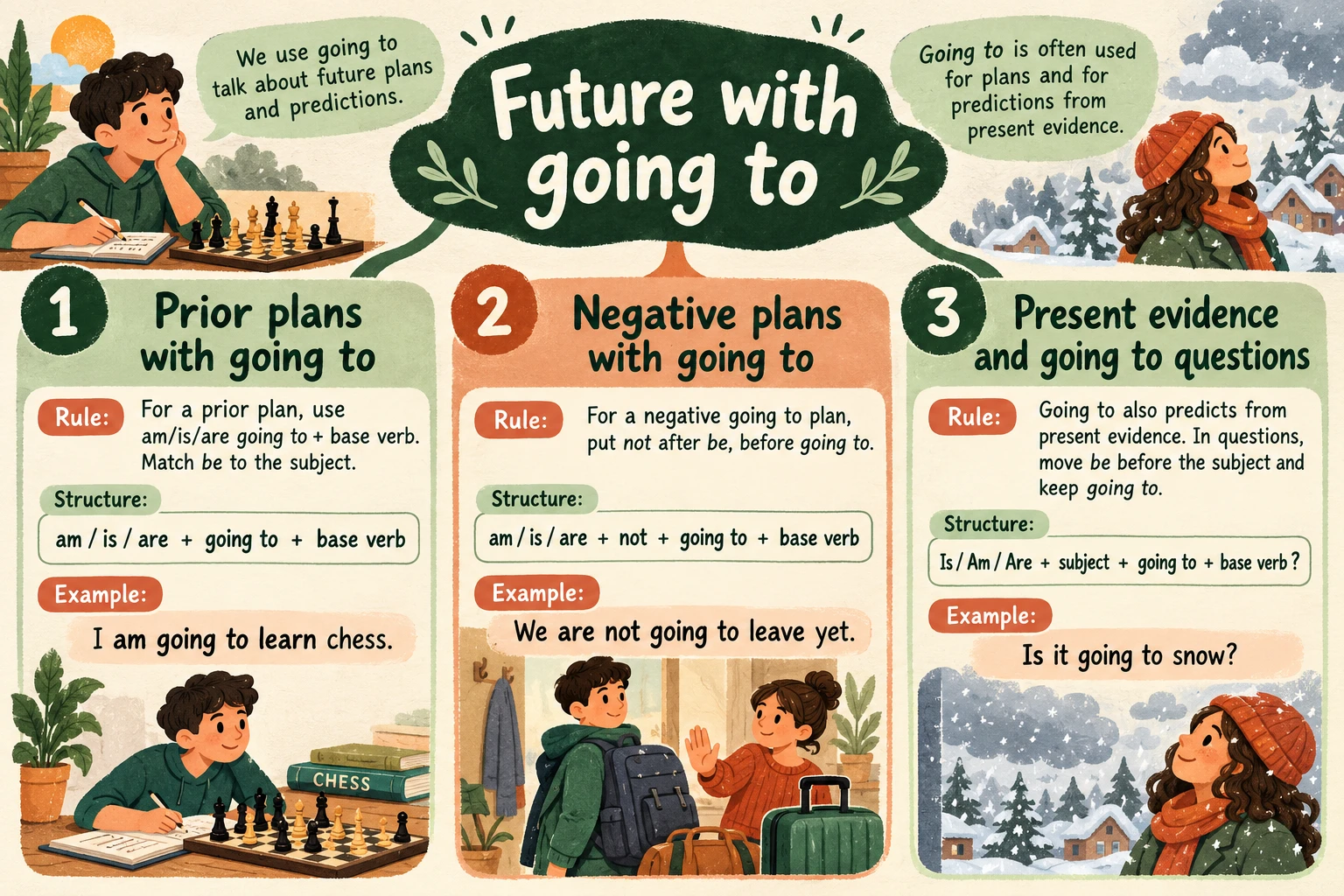
Para un plan previo usa am/is/are going to + verbo base, concordando be con el sujeto.
I am going to learn chess.Para un plan negativo, coloca not después de be y antes de going to.
We are not going to leave yet.Going to también predice con indicios actuales. En preguntas mueve be antes del sujeto y conserva going to.
Is it going to snow?
We have decided to move. We ___ going to rent a bigger flat.
Para un plan previo usa am/is/are going to + verbo base, concordando be con el sujeto.
I am going to learn chess.Para un plan negativo, coloca not después de be y antes de going to.
We are not going to leave yet.Going to también predice con indicios actuales. En preguntas mueve be antes del sujeto y conserva going to.
Is it going to snow?Conserva el primer intento, entiende el cambio y compruébalo en otra situación.
Aún no hay repasos. Prueba un calentamiento corto.
Para un plan previo usa am/is/are going to + verbo base, concordando be con el sujeto.
I am going to learn chess.Para un plan negativo, coloca not después de be y antes de going to.
We are not going to leave yet.Going to también predice con indicios actuales. En preguntas mueve be antes del sujeto y conserva going to.
Is it going to snow?Abrir una respuesta registra ayuda para esa pregunta.
We have decided to move. We ___ going to rent a bigger flat.
Mira «We have decided to move. We ___ going to rent a bigger flat.». Para un plan previo usa am/is/are going to + verbo base, concordando be con el sujeto. Oración completa: «We have decided to move. We are going to rent a bigger flat.».
He has cancelled the trip. He ___ going to travel tomorrow.
Mira «He has cancelled the trip. He ___ going to travel tomorrow.». Para un plan negativo, coloca not después de be y antes de going to. Oración completa: «He has cancelled the trip. He is not going to travel tomorrow.».
Look at that loose glass! It is going to ___. (fall)
Mira «Look at that loose glass! It is going to ___. (fall)». Going to también predice con indicios actuales. En preguntas mueve be antes del sujeto y conserva going to. Oración completa: «Look at that loose glass! It is going to fall. (fall)».
I have saved for a course. I ___ going to study design.
Oración de referencia: «I have saved for a course. I am going to study design.». Para un plan previo usa am/is/are going to + verbo base, concordando be con el sujeto. También se admiten estas variantes revisadas: 'm. No es una lista de todas las expresiones posibles.
We have other plans. We ___ going to join the tour.
Mira «We have other plans. We ___ going to join the tour.». Para un plan negativo, coloca not después de be y antes de going to. Oración completa: «We have other plans. We are not going to join the tour.».
___ Nina going to take the early train?
Mira «___ Nina going to take the early train?». Going to también predice con indicios actuales. En preguntas mueve be antes del sujeto y conserva going to. Oración completa: «Is Nina going to take the early train?».
My brother has chosen a recipe. He ___ going to bake a cake.
Oración de referencia: «My brother has chosen a recipe. He is going to bake a cake.». Para un plan previo usa am/is/are going to + verbo base, concordando be con el sujeto. También se admiten estas variantes revisadas: 's. No es una lista de todas las expresiones posibles.
The neighbours have bought paint. They ___ going to paint the fence.
Mira «The neighbours have bought paint. They ___ going to paint the fence.». Para un plan previo usa am/is/are going to + verbo base, concordando be con el sujeto. Oración completa: «The neighbours have bought paint. They are going to paint the fence.».
I have decided to keep my car. I ___ going to sell it.
Mira «I have decided to keep my car. I ___ going to sell it.». Para un plan negativo, coloca not después de be y antes de going to. Oración completa: «I have decided to keep my car. I am not going to sell it.».
___ your friends going to stay at a hotel?
Oración de referencia: «Are your friends going to stay at a hotel?». Going to también predice con indicios actuales. En preguntas mueve be antes del sujeto y conserva going to.
The tickets cost too much. She ___ going to buy them.
Mira «The tickets cost too much. She ___ going to buy them.». Para un plan negativo, coloca not después de be y antes de going to. Oración completa: «The tickets cost too much. She is not going to buy them.».
Watch out! Those boxes are going to ___. (fall)
Oración de referencia: «Watch out! Those boxes are going to fall. (fall)». Going to también predice con indicios actuales. En preguntas mueve be antes del sujeto y conserva going to.