01Short adjective comparisons
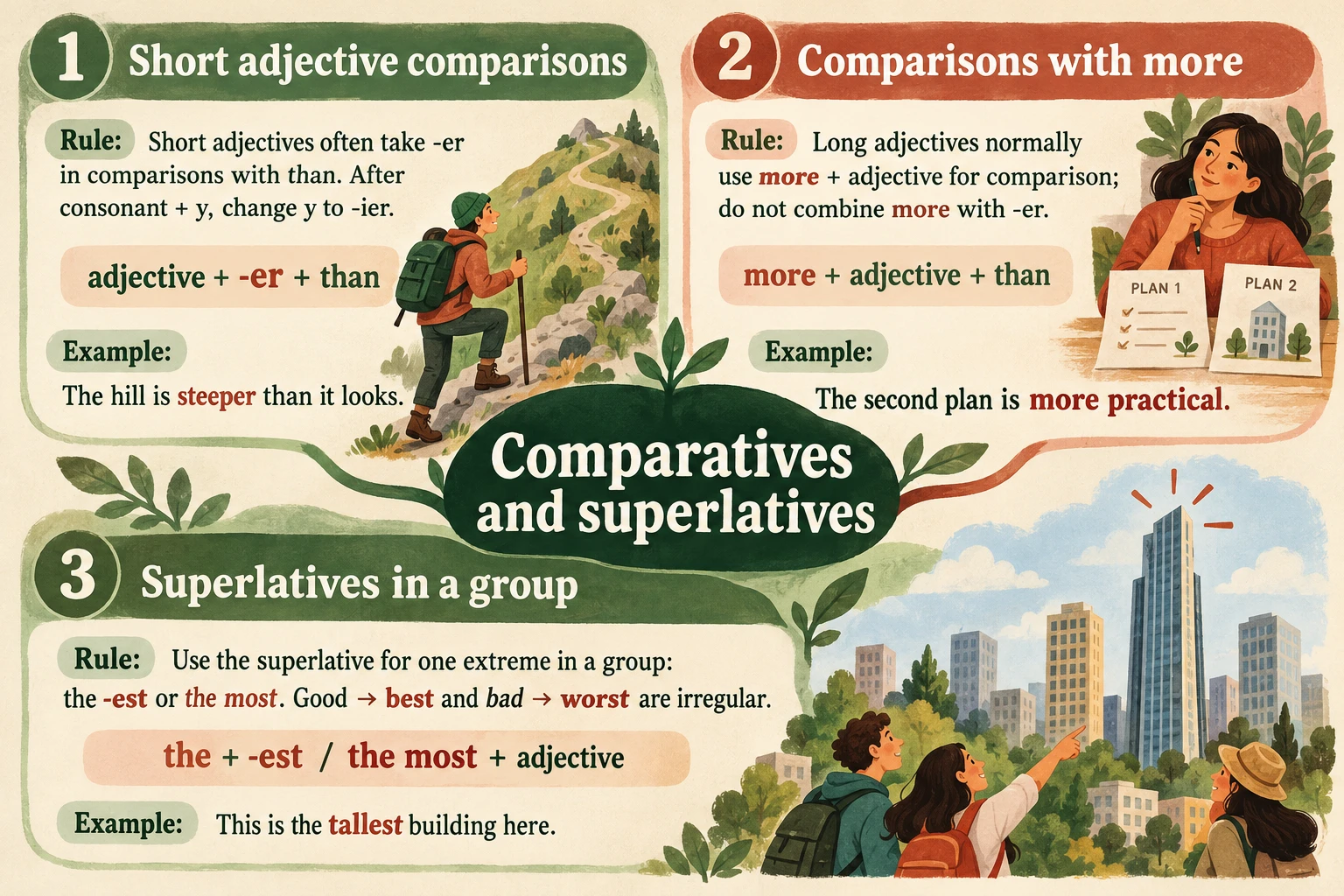
Short adjectives often take -er in comparisons with than. After consonant + y, change y to -ier.
The hill is steeper than it looks.
Comparatives and superlatives · A2. Short adjectives often take -er in comparisons with than. After consonant + y, change y to -ier.
Practise Comparatives and superlatives in short situations. Read the clue, choose or write a form, then check the reason. The level is an editorial guide.
Short adjectives often take -er in comparisons with than. After consonant + y, change y to -ier.
The hill is steeper than it looks.Long adjectives normally use more + adjective for comparison; do not combine more with -er.
The second plan is more practical.Use the superlative for one extreme in a group: the -est or the most. Good→best and bad→worst are irregular.
This is the tallest building here.
This road is ___ than the old one. (wide)
Short adjectives often take -er in comparisons with than. After consonant + y, change y to -ier.
The hill is steeper than it looks.Long adjectives normally use more + adjective for comparison; do not combine more with -er.
The second plan is more practical.Use the superlative for one extreme in a group: the -est or the most. Good→best and bad→worst are irregular.
This is the tallest building here.Keep the first try. Understand the change. Check it in a fresh situation.
No practice notes yet. Try a short warm-up.
Short adjectives often take -er in comparisons with than. After consonant + y, change y to -ier.
The hill is steeper than it looks.Long adjectives normally use more + adjective for comparison; do not combine more with -er.
The second plan is more practical.Use the superlative for one extreme in a group: the -est or the most. Good→best and bad→worst are irregular.
This is the tallest building here.Opening an answer records help for that question.
This road is ___ than the old one. (wide)
Look at “This road is ___ than the old one. (wide)”. Short adjectives often take -er in comparisons with than. After consonant + y, change y to -ier. Complete sentence: “This road is wider than the old one. (wide)”.
The train is ___ than the bus. (expensive)
Look at “The train is ___ than the bus. (expensive)”. Long adjectives normally use more + adjective for comparison; do not combine more with -er. Complete sentence: “The train is more expensive than the bus. (expensive)”.
Of all five runners, Lia is the ___. (fast)
Look at “Of all five runners, Lia is the ___. (fast)”. Use the superlative for one extreme in a group: the -est or the most. Good→best and bad→worst are irregular. Complete sentence: “Of all five runners, Lia is the fastest. (fast)”.
My bag is ___ than yours. (heavy)
Reference completion: “My bag is heavier than yours. (heavy)”. Short adjectives often take -er in comparisons with than. After consonant + y, change y to -ier.
This chair is ___ than that stool. (comfortable)
Look at “This chair is ___ than that stool. (comfortable)”. Long adjectives normally use more + adjective for comparison; do not combine more with -er. Complete sentence: “This chair is more comfortable than that stool. (comfortable)”.
It was the ___ meal of our whole trip. (good)
Look at “It was the ___ meal of our whole trip. (good)”. Use the superlative for one extreme in a group: the -est or the most. Good→best and bad→worst are irregular. Complete sentence: “It was the best meal of our whole trip. (good)”.
Today is ___ than yesterday. (hot)
Reference completion: “Today is hotter than yesterday. (hot)”. Short adjectives often take -er in comparisons with than. After consonant + y, change y to -ier.
The river is ___ here than near the bridge. (deep)
Look at “The river is ___ here than near the bridge. (deep)”. Short adjectives often take -er in comparisons with than. After consonant + y, change y to -ier. Complete sentence: “The river is deeper here than near the bridge. (deep)”.
The book is ___ than the leaflet. (interesting)
Look at “The book is ___ than the leaflet. (interesting)”. Long adjectives normally use more + adjective for comparison; do not combine more with -er. Complete sentence: “The book is more interesting than the leaflet. (interesting)”.
Of these six rooms, this is the ___. (small)
Reference completion: “Of these six rooms, this is the smallest. (small)”. Use the superlative for one extreme in a group: the -est or the most. Good→best and bad→worst are irregular.
This puzzle is ___ than the first one. (difficult)
Look at “This puzzle is ___ than the first one. (difficult)”. Long adjectives normally use more + adjective for comparison; do not combine more with -er. Complete sentence: “This puzzle is more difficult than the first one. (difficult)”.
That was the ___ storm in the town’s history. (bad)
Reference completion: “That was the worst storm in the town’s history. (bad)”. Use the superlative for one extreme in a group: the -est or the most. Good→best and bad→worst are irregular.