01Vergleich kurzer Adjektive
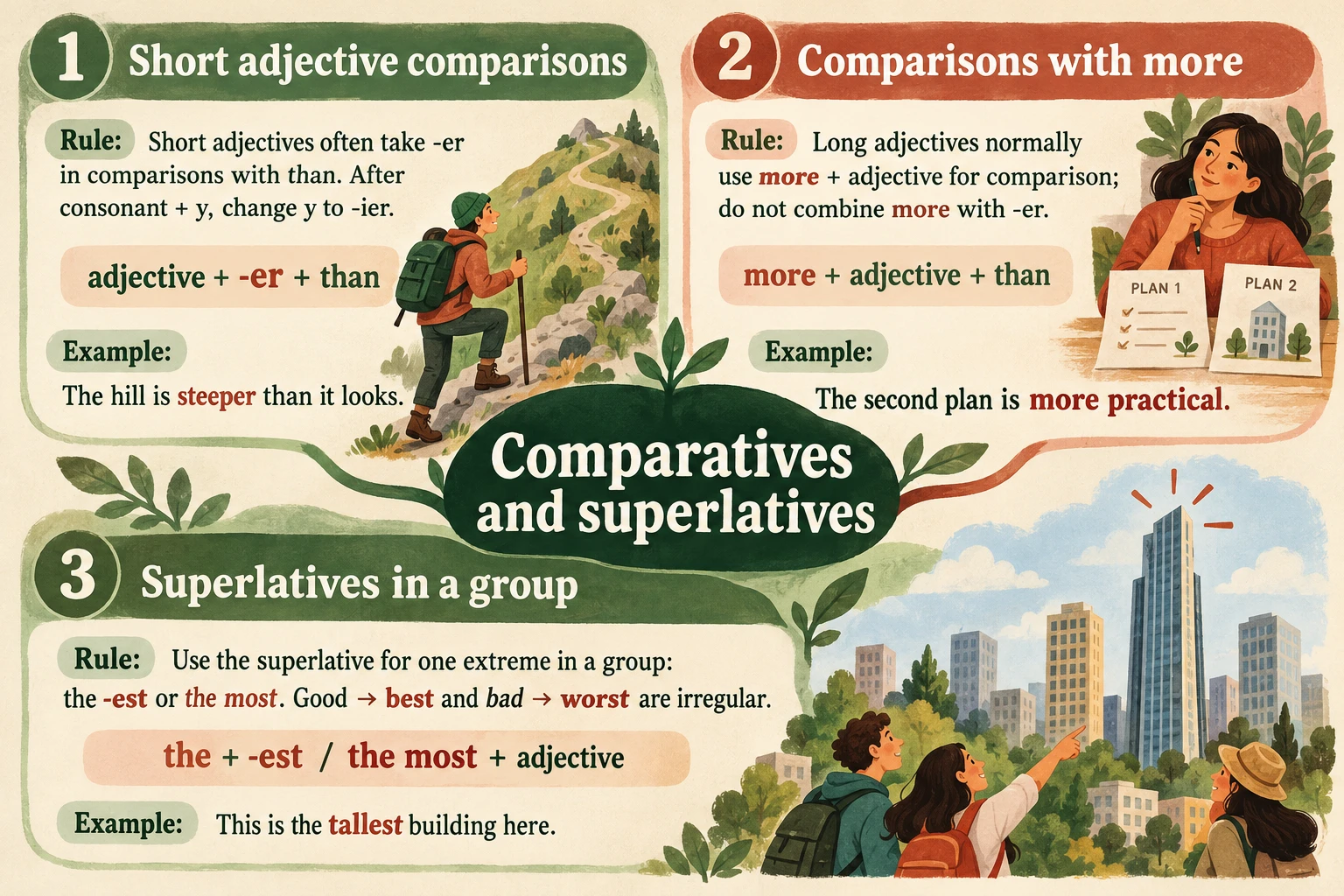
Kurze Adjektive erhalten oft -er mit than; Konsonant + y wird zu -ier.
The hill is steeper than it looks.
Komparativ und Superlativ · A2. Kurze Adjektive erhalten oft -er mit than; Konsonant + y wird zu -ier.
Übe Komparativ und Superlativ in kurzen Situationen. Lies den Hinweis, wähle oder schreibe eine Form und prüfe die Begründung. Die Stufe dient der redaktionellen Orientierung.
Kurze Adjektive erhalten oft -er mit than; Konsonant + y wird zu -ier.
The hill is steeper than it looks.Lange Adjektive bilden den Komparativ meist mit more; more und -er werden nicht kombiniert.
The second plan is more practical.Für das Extrem einer Gruppe steht the -est oder the most; good→best und bad→worst sind unregelmäßig.
This is the tallest building here.
This road is ___ than the old one. (wide)
Kurze Adjektive erhalten oft -er mit than; Konsonant + y wird zu -ier.
The hill is steeper than it looks.Lange Adjektive bilden den Komparativ meist mit more; more und -er werden nicht kombiniert.
The second plan is more practical.Für das Extrem einer Gruppe steht the -est oder the most; good→best und bad→worst sind unregelmäßig.
This is the tallest building here.Bewahre den ersten Versuch. Verstehe die Änderung. Prüfe sie in einer neuen Situation.
Noch keine Lernnotizen. Starte mit einem kurzen Einstieg.
Kurze Adjektive erhalten oft -er mit than; Konsonant + y wird zu -ier.
The hill is steeper than it looks.Lange Adjektive bilden den Komparativ meist mit more; more und -er werden nicht kombiniert.
The second plan is more practical.Für das Extrem einer Gruppe steht the -est oder the most; good→best und bad→worst sind unregelmäßig.
This is the tallest building here.Das Öffnen einer Antwort wird für diese Aufgabe als Hilfe erfasst.
This road is ___ than the old one. (wide)
Achte auf „This road is ___ than the old one. (wide)“. Kurze Adjektive erhalten oft -er mit than; Konsonant + y wird zu -ier. Vollständiger Satz: „This road is wider than the old one. (wide)“.
The train is ___ than the bus. (expensive)
Achte auf „The train is ___ than the bus. (expensive)“. Lange Adjektive bilden den Komparativ meist mit more; more und -er werden nicht kombiniert. Vollständiger Satz: „The train is more expensive than the bus. (expensive)“.
Of all five runners, Lia is the ___. (fast)
Achte auf „Of all five runners, Lia is the ___. (fast)“. Für das Extrem einer Gruppe steht the -est oder the most; good→best und bad→worst sind unregelmäßig. Vollständiger Satz: „Of all five runners, Lia is the fastest. (fast)“.
My bag is ___ than yours. (heavy)
Vollständiger Beispielsatz: „My bag is heavier than yours. (heavy)“. Kurze Adjektive erhalten oft -er mit than; Konsonant + y wird zu -ier.
This chair is ___ than that stool. (comfortable)
Achte auf „This chair is ___ than that stool. (comfortable)“. Lange Adjektive bilden den Komparativ meist mit more; more und -er werden nicht kombiniert. Vollständiger Satz: „This chair is more comfortable than that stool. (comfortable)“.
It was the ___ meal of our whole trip. (good)
Achte auf „It was the ___ meal of our whole trip. (good)“. Für das Extrem einer Gruppe steht the -est oder the most; good→best und bad→worst sind unregelmäßig. Vollständiger Satz: „It was the best meal of our whole trip. (good)“.
Today is ___ than yesterday. (hot)
Vollständiger Beispielsatz: „Today is hotter than yesterday. (hot)“. Kurze Adjektive erhalten oft -er mit than; Konsonant + y wird zu -ier.
The river is ___ here than near the bridge. (deep)
Achte auf „The river is ___ here than near the bridge. (deep)“. Kurze Adjektive erhalten oft -er mit than; Konsonant + y wird zu -ier. Vollständiger Satz: „The river is deeper here than near the bridge. (deep)“.
The book is ___ than the leaflet. (interesting)
Achte auf „The book is ___ than the leaflet. (interesting)“. Lange Adjektive bilden den Komparativ meist mit more; more und -er werden nicht kombiniert. Vollständiger Satz: „The book is more interesting than the leaflet. (interesting)“.
Of these six rooms, this is the ___. (small)
Vollständiger Beispielsatz: „Of these six rooms, this is the smallest. (small)“. Für das Extrem einer Gruppe steht the -est oder the most; good→best und bad→worst sind unregelmäßig.
This puzzle is ___ than the first one. (difficult)
Achte auf „This puzzle is ___ than the first one. (difficult)“. Lange Adjektive bilden den Komparativ meist mit more; more und -er werden nicht kombiniert. Vollständiger Satz: „This puzzle is more difficult than the first one. (difficult)“.
That was the ___ storm in the town’s history. (bad)
Vollständiger Beispielsatz: „That was the worst storm in the town’s history. (bad)“. Für das Extrem einer Gruppe steht the -est oder the most; good→best und bad→worst sind unregelmäßig.