01Comparação com adjetivos curtos
Adjetivos curtos geralmente recebem -er com than; consoante + y vira -ier.
The hill is steeper than it looks.
Comparativos e superlativos · A2. Adjetivos curtos geralmente recebem -er com than; consoante + y vira -ier.
Pratique Comparativos e superlativos em situações curtas. Leia a pista, escolha ou escreva uma forma e confira a explicação. O nível é uma orientação editorial.
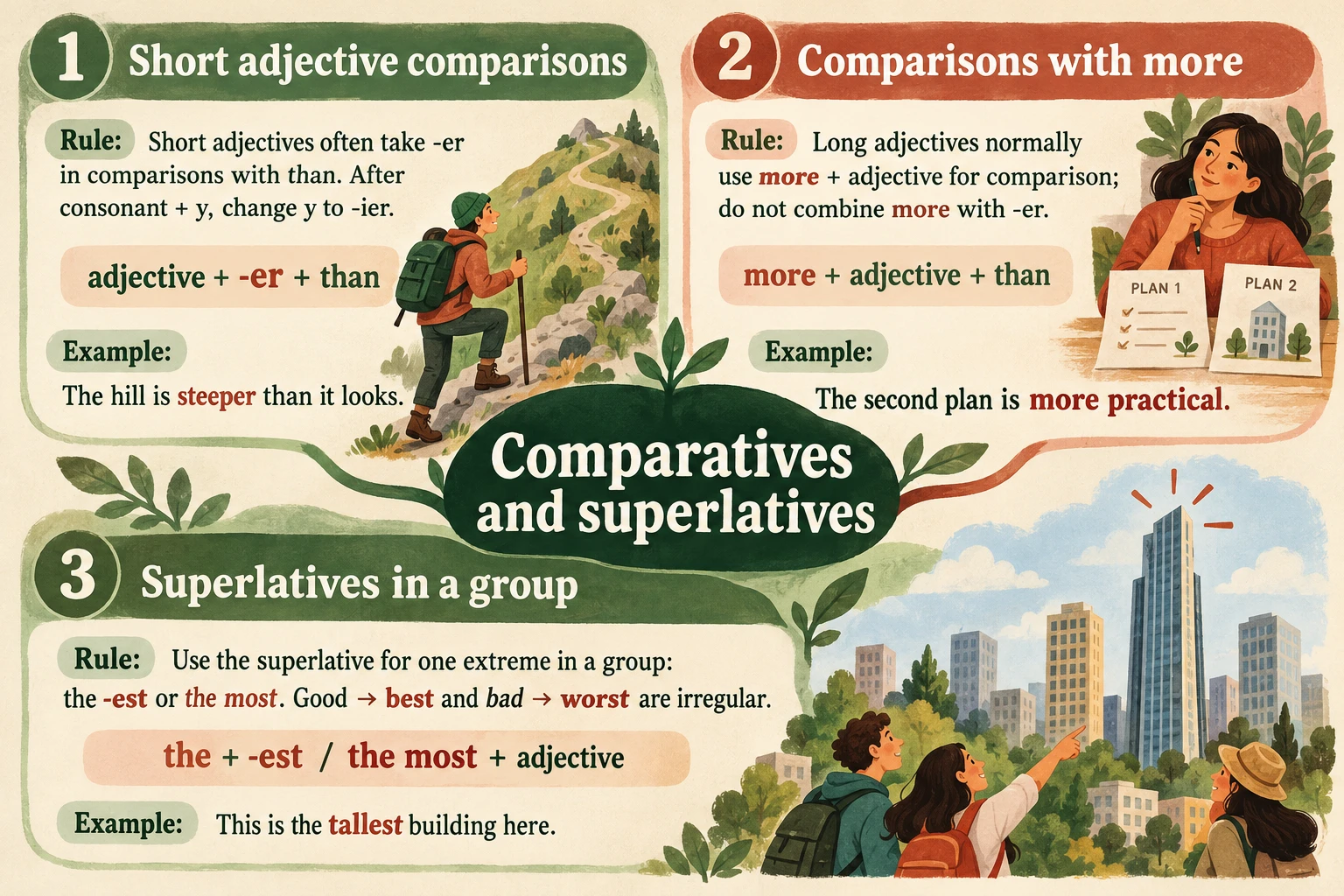
Adjetivos curtos geralmente recebem -er com than; consoante + y vira -ier.
The hill is steeper than it looks.Adjetivos longos normalmente usam more + adjetivo; não combine more e -er.
The second plan is more practical.Para um extremo em um grupo, use the -est ou the most; good→best e bad→worst são irregulares.
This is the tallest building here.
This road is ___ than the old one. (wide)
Adjetivos curtos geralmente recebem -er com than; consoante + y vira -ier.
The hill is steeper than it looks.Adjetivos longos normalmente usam more + adjetivo; não combine more e -er.
The second plan is more practical.Para um extremo em um grupo, use the -est ou the most; good→best e bad→worst são irregulares.
This is the tallest building here.Guarde a primeira tentativa, entenda a mudança e confira em outra situação.
Ainda não há revisões. Faça um aquecimento curto.
Adjetivos curtos geralmente recebem -er com than; consoante + y vira -ier.
The hill is steeper than it looks.Adjetivos longos normalmente usam more + adjetivo; não combine more e -er.
The second plan is more practical.Para um extremo em um grupo, use the -est ou the most; good→best e bad→worst são irregulares.
This is the tallest building here.Abrir uma resposta registra ajuda para essa questão.
This road is ___ than the old one. (wide)
Observe “This road is ___ than the old one. (wide)”. Adjetivos curtos geralmente recebem -er com than; consoante + y vira -ier. Frase completa: “This road is wider than the old one. (wide)”.
The train is ___ than the bus. (expensive)
Observe “The train is ___ than the bus. (expensive)”. Adjetivos longos normalmente usam more + adjetivo; não combine more e -er. Frase completa: “The train is more expensive than the bus. (expensive)”.
Of all five runners, Lia is the ___. (fast)
Observe “Of all five runners, Lia is the ___. (fast)”. Para um extremo em um grupo, use the -est ou the most; good→best e bad→worst são irregulares. Frase completa: “Of all five runners, Lia is the fastest. (fast)”.
My bag is ___ than yours. (heavy)
Frase de referência: “My bag is heavier than yours. (heavy)”. Adjetivos curtos geralmente recebem -er com than; consoante + y vira -ier.
This chair is ___ than that stool. (comfortable)
Observe “This chair is ___ than that stool. (comfortable)”. Adjetivos longos normalmente usam more + adjetivo; não combine more e -er. Frase completa: “This chair is more comfortable than that stool. (comfortable)”.
It was the ___ meal of our whole trip. (good)
Observe “It was the ___ meal of our whole trip. (good)”. Para um extremo em um grupo, use the -est ou the most; good→best e bad→worst são irregulares. Frase completa: “It was the best meal of our whole trip. (good)”.
Today is ___ than yesterday. (hot)
Frase de referência: “Today is hotter than yesterday. (hot)”. Adjetivos curtos geralmente recebem -er com than; consoante + y vira -ier.
The river is ___ here than near the bridge. (deep)
Observe “The river is ___ here than near the bridge. (deep)”. Adjetivos curtos geralmente recebem -er com than; consoante + y vira -ier. Frase completa: “The river is deeper here than near the bridge. (deep)”.
The book is ___ than the leaflet. (interesting)
Observe “The book is ___ than the leaflet. (interesting)”. Adjetivos longos normalmente usam more + adjetivo; não combine more e -er. Frase completa: “The book is more interesting than the leaflet. (interesting)”.
Of these six rooms, this is the ___. (small)
Frase de referência: “Of these six rooms, this is the smallest. (small)”. Para um extremo em um grupo, use the -est ou the most; good→best e bad→worst são irregulares.
This puzzle is ___ than the first one. (difficult)
Observe “This puzzle is ___ than the first one. (difficult)”. Adjetivos longos normalmente usam more + adjetivo; não combine more e -er. Frase completa: “This puzzle is more difficult than the first one. (difficult)”.
That was the ___ storm in the town’s history. (bad)
Frase de referência: “That was the worst storm in the town’s history. (bad)”. Para um extremo em um grupo, use the -est ou the most; good→best e bad→worst são irregulares.