01Comparación con adjetivos cortos
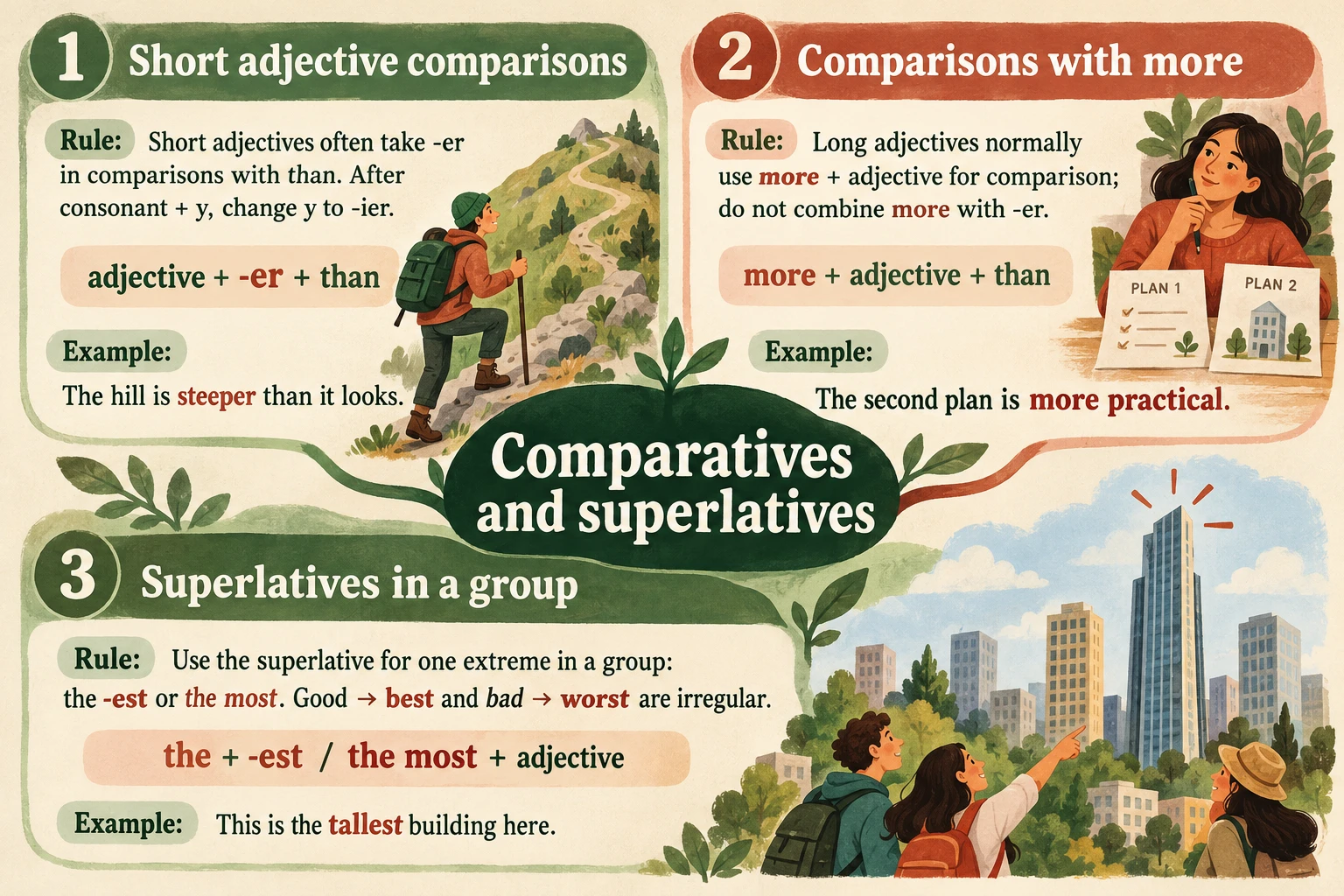
Los adjetivos cortos suelen llevar -er con than; consonante + y pasa a -ier.
The hill is steeper than it looks.
Comparativos y superlativos · A2. Los adjetivos cortos suelen llevar -er con than; consonante + y pasa a -ier.
Practica Comparativos y superlativos en situaciones breves. Lee la pista, elige o escribe una forma y revisa la explicación. El nivel es una orientación editorial.
Los adjetivos cortos suelen llevar -er con than; consonante + y pasa a -ier.
The hill is steeper than it looks.Los adjetivos largos suelen usar more + adjetivo; no combines more con -er.
The second plan is more practical.Para un extremo de un grupo usa the -est o the most; good→best y bad→worst son irregulares.
This is the tallest building here.
This road is ___ than the old one. (wide)
Los adjetivos cortos suelen llevar -er con than; consonante + y pasa a -ier.
The hill is steeper than it looks.Los adjetivos largos suelen usar more + adjetivo; no combines more con -er.
The second plan is more practical.Para un extremo de un grupo usa the -est o the most; good→best y bad→worst son irregulares.
This is the tallest building here.Conserva el primer intento, entiende el cambio y compruébalo en otra situación.
Aún no hay repasos. Prueba un calentamiento corto.
Los adjetivos cortos suelen llevar -er con than; consonante + y pasa a -ier.
The hill is steeper than it looks.Los adjetivos largos suelen usar more + adjetivo; no combines more con -er.
The second plan is more practical.Para un extremo de un grupo usa the -est o the most; good→best y bad→worst son irregulares.
This is the tallest building here.Abrir una respuesta registra ayuda para esa pregunta.
This road is ___ than the old one. (wide)
Mira «This road is ___ than the old one. (wide)». Los adjetivos cortos suelen llevar -er con than; consonante + y pasa a -ier. Oración completa: «This road is wider than the old one. (wide)».
The train is ___ than the bus. (expensive)
Mira «The train is ___ than the bus. (expensive)». Los adjetivos largos suelen usar more + adjetivo; no combines more con -er. Oración completa: «The train is more expensive than the bus. (expensive)».
Of all five runners, Lia is the ___. (fast)
Mira «Of all five runners, Lia is the ___. (fast)». Para un extremo de un grupo usa the -est o the most; good→best y bad→worst son irregulares. Oración completa: «Of all five runners, Lia is the fastest. (fast)».
My bag is ___ than yours. (heavy)
Oración de referencia: «My bag is heavier than yours. (heavy)». Los adjetivos cortos suelen llevar -er con than; consonante + y pasa a -ier.
This chair is ___ than that stool. (comfortable)
Mira «This chair is ___ than that stool. (comfortable)». Los adjetivos largos suelen usar more + adjetivo; no combines more con -er. Oración completa: «This chair is more comfortable than that stool. (comfortable)».
It was the ___ meal of our whole trip. (good)
Mira «It was the ___ meal of our whole trip. (good)». Para un extremo de un grupo usa the -est o the most; good→best y bad→worst son irregulares. Oración completa: «It was the best meal of our whole trip. (good)».
Today is ___ than yesterday. (hot)
Oración de referencia: «Today is hotter than yesterday. (hot)». Los adjetivos cortos suelen llevar -er con than; consonante + y pasa a -ier.
The river is ___ here than near the bridge. (deep)
Mira «The river is ___ here than near the bridge. (deep)». Los adjetivos cortos suelen llevar -er con than; consonante + y pasa a -ier. Oración completa: «The river is deeper here than near the bridge. (deep)».
The book is ___ than the leaflet. (interesting)
Mira «The book is ___ than the leaflet. (interesting)». Los adjetivos largos suelen usar more + adjetivo; no combines more con -er. Oración completa: «The book is more interesting than the leaflet. (interesting)».
Of these six rooms, this is the ___. (small)
Oración de referencia: «Of these six rooms, this is the smallest. (small)». Para un extremo de un grupo usa the -est o the most; good→best y bad→worst son irregulares.
This puzzle is ___ than the first one. (difficult)
Mira «This puzzle is ___ than the first one. (difficult)». Los adjetivos largos suelen usar more + adjetivo; no combines more con -er. Oración completa: «This puzzle is more difficult than the first one. (difficult)».
That was the ___ storm in the town’s history. (bad)
Oración de referencia: «That was the worst storm in the town’s history. (bad)». Para un extremo de un grupo usa the -est o the most; good→best y bad→worst son irregulares.