01Position before the main verb
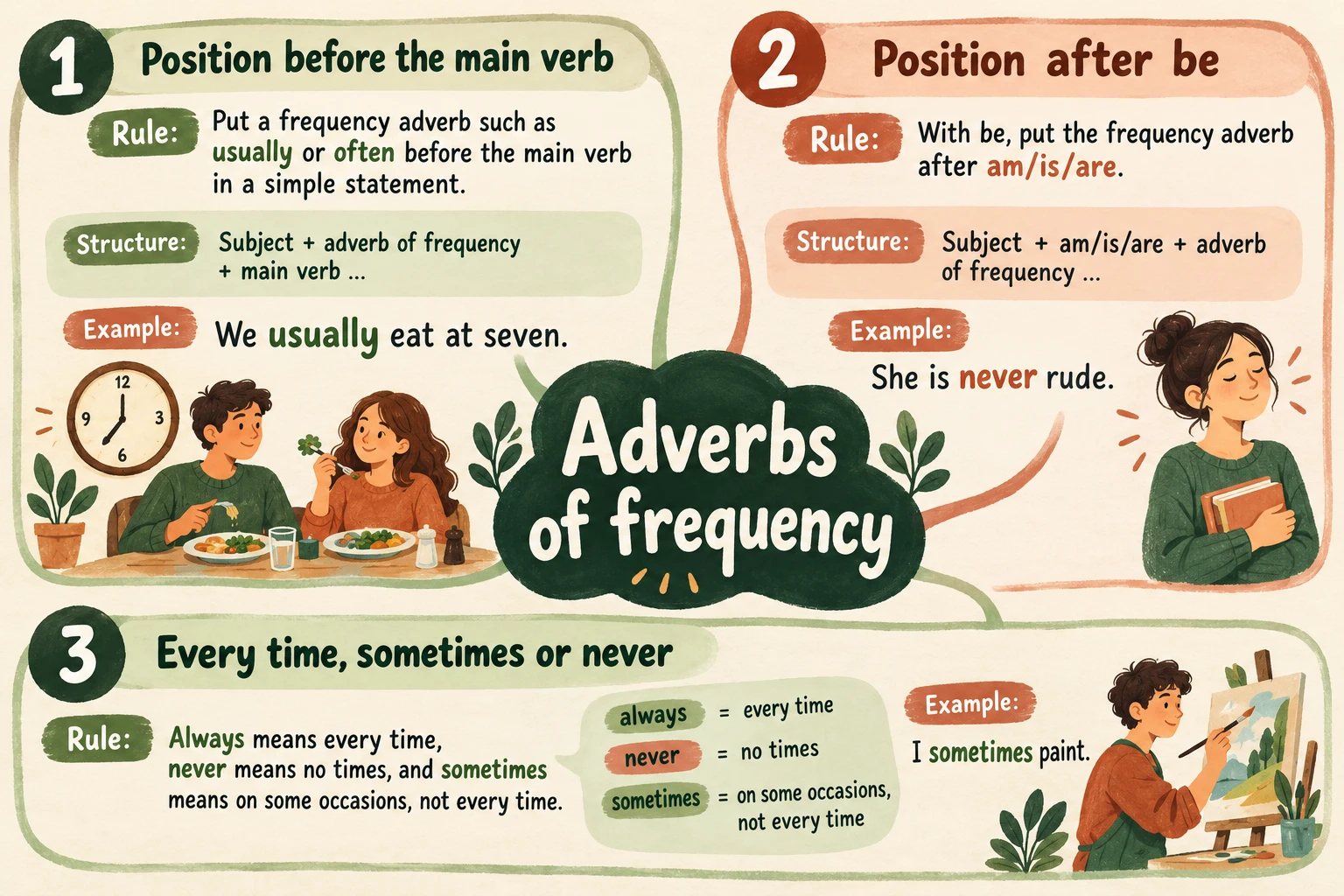
Put a frequency adverb such as usually or often before the main verb in a simple statement.
We usually eat at seven.
Adverbs of frequency · A1. Put a frequency adverb such as usually or often before the main verb in a simple statement.
Practise Adverbs of frequency in short situations. Read the clue, choose or write a form, then check the reason. The level is an editorial guide.
Put a frequency adverb such as usually or often before the main verb in a simple statement.
We usually eat at seven.With be, put the frequency adverb after am/is/are.
She is never rude.Always means every time, never means no times, and sometimes means on some occasions, not every time.
I sometimes paint.
Choose the normal word order: I ___ before breakfast.
Put a frequency adverb such as usually or often before the main verb in a simple statement.
We usually eat at seven.With be, put the frequency adverb after am/is/are.
She is never rude.Always means every time, never means no times, and sometimes means on some occasions, not every time.
I sometimes paint.Keep the first try. Understand the change. Check it in a fresh situation.
No practice notes yet. Try a short warm-up.
Put a frequency adverb such as usually or often before the main verb in a simple statement.
We usually eat at seven.With be, put the frequency adverb after am/is/are.
She is never rude.Always means every time, never means no times, and sometimes means on some occasions, not every time.
I sometimes paint.Opening an answer records help for that question.
Choose the normal word order: I ___ before breakfast.
Look at “Choose the normal word order: I ___ before breakfast.”. Put a frequency adverb such as usually or often before the main verb in a simple statement. Complete sentence: “Choose the normal word order: I usually shower before breakfast.”.
Complete the sentence: Sam ___ often early for class.
Look at “Complete the sentence: Sam ___ often early for class.”. With be, put the frequency adverb after am/is/are. Complete sentence: “Complete the sentence: Sam is often early for class.”.
Ted takes the bus every single day. He ___ takes the bus.
Look at “Ted takes the bus every single day. He ___ takes the bus.”. Always means every time, never means no times, and sometimes means on some occasions, not every time. Complete sentence: “Ted takes the bus every single day. He always takes the bus.”.
Complete the normal order: We ___ cook together on Fridays. (usually)
Reference completion: “Complete the normal order: We usually cook together on Fridays. (usually)”. Put a frequency adverb such as usually or often before the main verb in a simple statement.
Complete the normal order: My keys are ___ in this drawer. (usually)
Look at “Complete the normal order: My keys are ___ in this drawer. (usually)”. With be, put the frequency adverb after am/is/are. Complete sentence: “Complete the normal order: My keys are usually in this drawer. (usually)”.
I have not eaten meat at any time in my life. I ___ eat meat.
Look at “I have not eaten meat at any time in my life. I ___ eat meat.”. Always means every time, never means no times, and sometimes means on some occasions, not every time. Complete sentence: “I have not eaten meat at any time in my life. I never eat meat.”.
Complete the normal order: Ana ___ walks to school. (often)
Reference completion: “Complete the normal order: Ana often walks to school. (often)”. Put a frequency adverb such as usually or often before the main verb in a simple statement.
Choose the normal word order: Our neighbours ___ after lunch.
Look at “Choose the normal word order: Our neighbours ___ after lunch.”. Put a frequency adverb such as usually or often before the main verb in a simple statement. Complete sentence: “Choose the normal word order: Our neighbours often walk after lunch.”.
Choose the normal word order: The train ___ on Mondays.
Look at “Choose the normal word order: The train ___ on Mondays.”. With be, put the frequency adverb after am/is/are. Complete sentence: “Choose the normal word order: The train is usually crowded on Mondays.”.
Only on some evenings, not every evening, we watch a film. We ___ watch films.
Reference completion: “Only on some evenings, not every evening, we watch a film. We sometimes watch films.”. Always means every time, never means no times, and sometimes means on some occasions, not every time.
Complete the normal order: I am ___ tired after swimming. (often)
Look at “Complete the normal order: I am ___ tired after swimming. (often)”. With be, put the frequency adverb after am/is/are. Complete sentence: “Complete the normal order: I am often tired after swimming. (often)”.
Our team has won every match this season. So far, it has ___ won.
Reference completion: “Our team has won every match this season. So far, it has always won.”. Always means every time, never means no times, and sometimes means on some occasions, not every time. Also accepted in this task: consistently / invariably. These are reviewed alternatives, not an exhaustive list of all possible English.