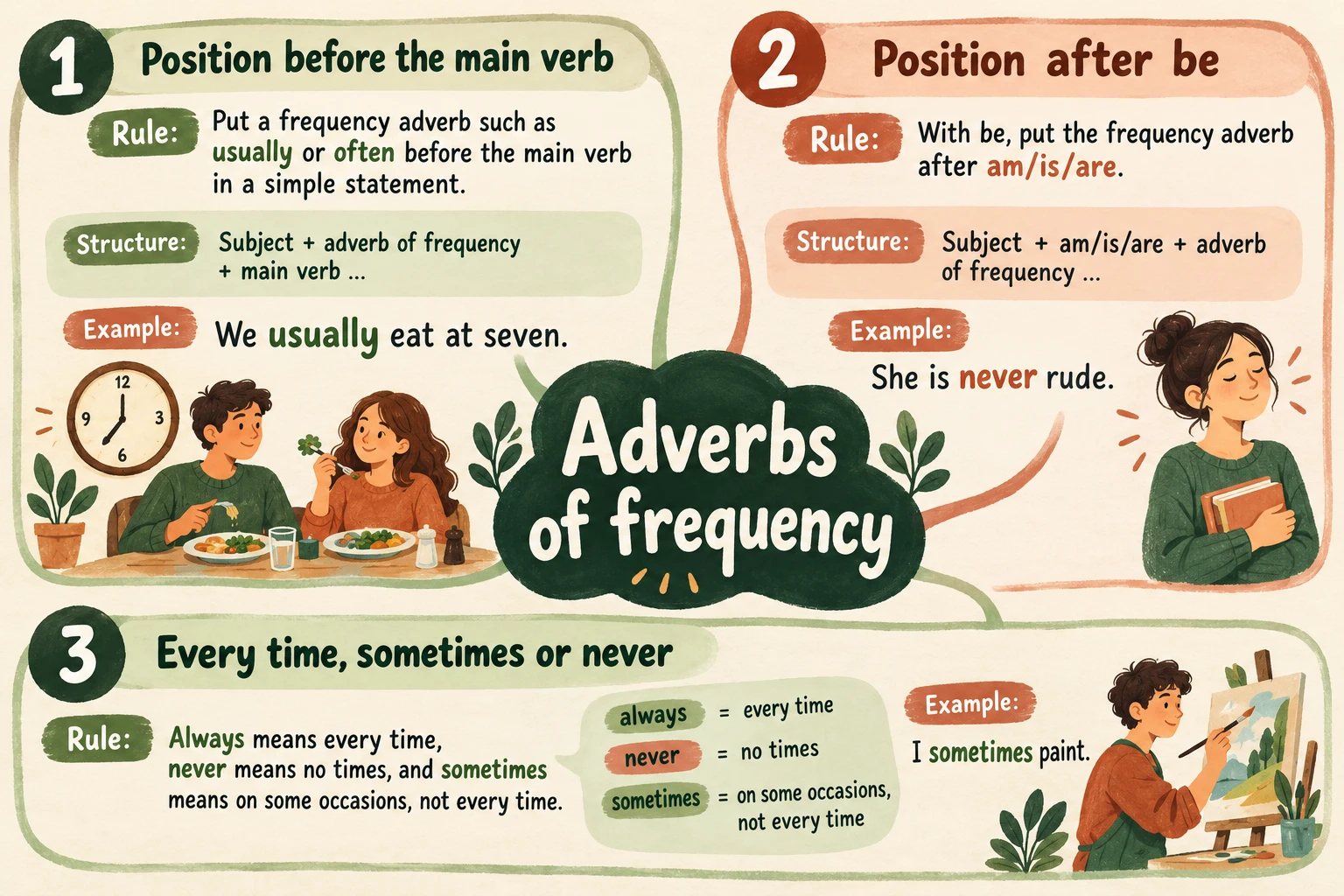
01Place avant le verbe principal
Dans une affirmation, place usually ou often avant le verbe principal.
We usually eat at seven.
Adverbes de fréquence · A1. Dans une affirmation, place usually ou often avant le verbe principal.
Travaille Adverbes de fréquence dans de courtes situations. Lis l’indice, choisis ou écris une forme, puis vérifie l’explication. Le niveau est une indication éditoriale.
Dans une affirmation, place usually ou often avant le verbe principal.
We usually eat at seven.Avec be, place l’adverbe de fréquence après am/is/are.
She is never rude.Always signifie à chaque fois, never aucune fois et sometimes à certaines occasions.
I sometimes paint.
Choose the normal word order: I ___ before breakfast.
Dans une affirmation, place usually ou often avant le verbe principal.
We usually eat at seven.Avec be, place l’adverbe de fréquence après am/is/are.
She is never rude.Always signifie à chaque fois, never aucune fois et sometimes à certaines occasions.
I sometimes paint.Gardez la première tentative, comprenez le changement et essayez dans une nouvelle situation.
Pas encore de notes. Essayez un court échauffement.
Dans une affirmation, place usually ou often avant le verbe principal.
We usually eat at seven.Avec be, place l’adverbe de fréquence après am/is/are.
She is never rude.Always signifie à chaque fois, never aucune fois et sometimes à certaines occasions.
I sometimes paint.Ouvrir une réponse enregistre une aide pour cette question.
Choose the normal word order: I ___ before breakfast.
Observe « Choose the normal word order: I ___ before breakfast. ». Dans une affirmation, place usually ou often avant le verbe principal. Phrase complète : « Choose the normal word order: I usually shower before breakfast. ».
Complete the sentence: Sam ___ often early for class.
Observe « Complete the sentence: Sam ___ often early for class. ». Avec be, place l’adverbe de fréquence après am/is/are. Phrase complète : « Complete the sentence: Sam is often early for class. ».
Ted takes the bus every single day. He ___ takes the bus.
Observe « Ted takes the bus every single day. He ___ takes the bus. ». Always signifie à chaque fois, never aucune fois et sometimes à certaines occasions. Phrase complète : « Ted takes the bus every single day. He always takes the bus. ».
Complete the normal order: We ___ cook together on Fridays. (usually)
Phrase de référence : « Complete the normal order: We usually cook together on Fridays. (usually) ». Dans une affirmation, place usually ou often avant le verbe principal.
Complete the normal order: My keys are ___ in this drawer. (usually)
Observe « Complete the normal order: My keys are ___ in this drawer. (usually) ». Avec be, place l’adverbe de fréquence après am/is/are. Phrase complète : « Complete the normal order: My keys are usually in this drawer. (usually) ».
I have not eaten meat at any time in my life. I ___ eat meat.
Observe « I have not eaten meat at any time in my life. I ___ eat meat. ». Always signifie à chaque fois, never aucune fois et sometimes à certaines occasions. Phrase complète : « I have not eaten meat at any time in my life. I never eat meat. ».
Complete the normal order: Ana ___ walks to school. (often)
Phrase de référence : « Complete the normal order: Ana often walks to school. (often) ». Dans une affirmation, place usually ou often avant le verbe principal.
Choose the normal word order: Our neighbours ___ after lunch.
Observe « Choose the normal word order: Our neighbours ___ after lunch. ». Dans une affirmation, place usually ou often avant le verbe principal. Phrase complète : « Choose the normal word order: Our neighbours often walk after lunch. ».
Choose the normal word order: The train ___ on Mondays.
Observe « Choose the normal word order: The train ___ on Mondays. ». Avec be, place l’adverbe de fréquence après am/is/are. Phrase complète : « Choose the normal word order: The train is usually crowded on Mondays. ».
Only on some evenings, not every evening, we watch a film. We ___ watch films.
Phrase de référence : « Only on some evenings, not every evening, we watch a film. We sometimes watch films. ». Always signifie à chaque fois, never aucune fois et sometimes à certaines occasions.
Complete the normal order: I am ___ tired after swimming. (often)
Observe « Complete the normal order: I am ___ tired after swimming. (often) ». Avec be, place l’adverbe de fréquence après am/is/are. Phrase complète : « Complete the normal order: I am often tired after swimming. (often) ».
Our team has won every match this season. So far, it has ___ won.
Phrase de référence : « Our team has won every match this season. So far, it has always won. ». Always signifie à chaque fois, never aucune fois et sometimes à certaines occasions. Autres variantes vérifiées pour cette tâche : consistently / invariably. La liste ne couvre pas toutes les formulations possibles.