01Posição antes do verbo principal
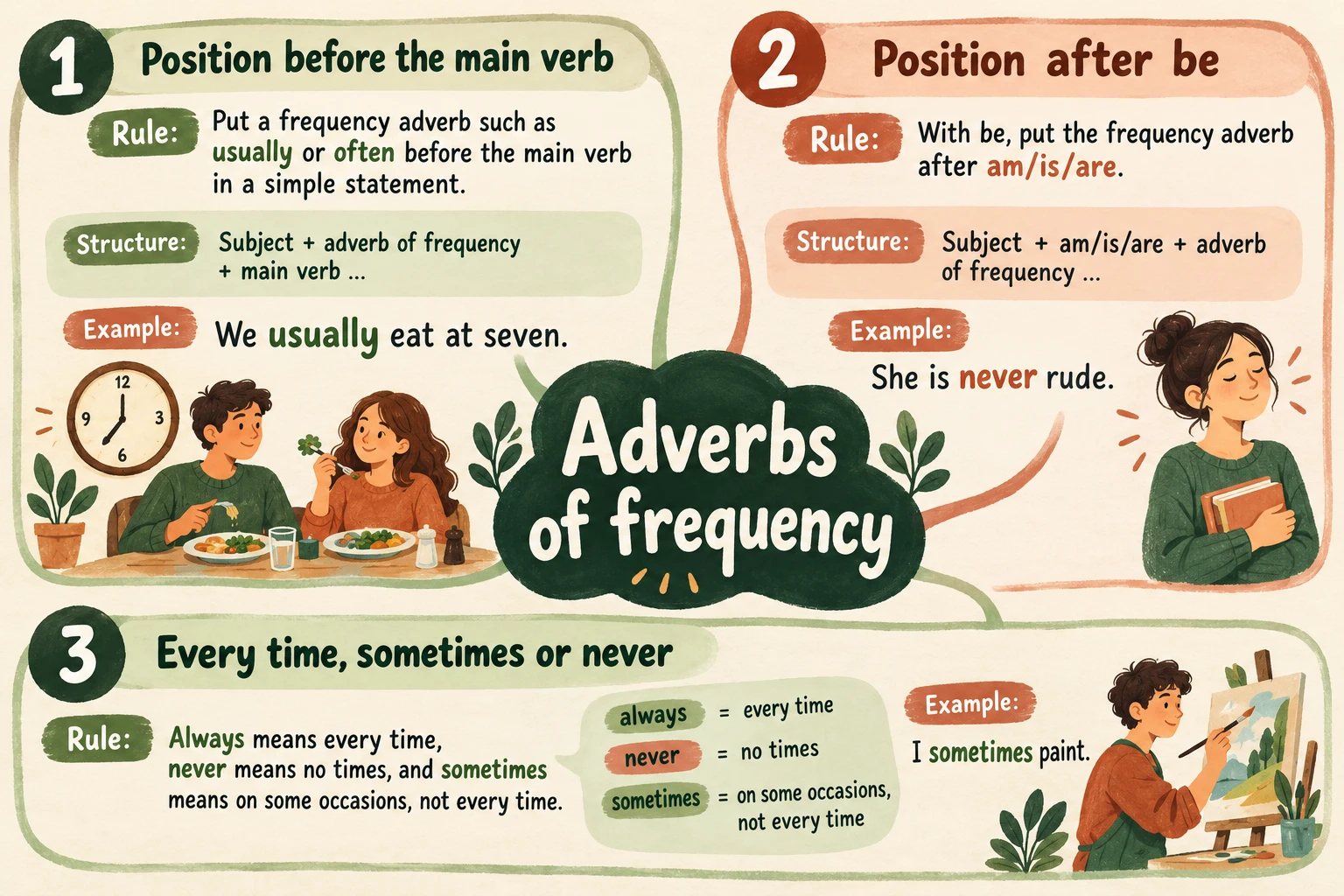
Em afirmações, ponha usually ou often antes do verbo principal.
We usually eat at seven.
Advérbios de frequência · A1. Em afirmações, ponha usually ou often antes do verbo principal.
Pratique Advérbios de frequência em situações curtas. Leia a pista, escolha ou escreva uma forma e confira a explicação. O nível é uma orientação editorial.
Em afirmações, ponha usually ou often antes do verbo principal.
We usually eat at seven.Com be, ponha o advérbio de frequência depois de am/is/are.
She is never rude.Always significa todas as vezes; never, nenhuma vez; sometimes, em algumas ocasiões.
I sometimes paint.
Choose the normal word order: I ___ before breakfast.
Em afirmações, ponha usually ou often antes do verbo principal.
We usually eat at seven.Com be, ponha o advérbio de frequência depois de am/is/are.
She is never rude.Always significa todas as vezes; never, nenhuma vez; sometimes, em algumas ocasiões.
I sometimes paint.Guarde a primeira tentativa, entenda a mudança e confira em outra situação.
Ainda não há revisões. Faça um aquecimento curto.
Em afirmações, ponha usually ou often antes do verbo principal.
We usually eat at seven.Com be, ponha o advérbio de frequência depois de am/is/are.
She is never rude.Always significa todas as vezes; never, nenhuma vez; sometimes, em algumas ocasiões.
I sometimes paint.Abrir uma resposta registra ajuda para essa questão.
Choose the normal word order: I ___ before breakfast.
Observe “Choose the normal word order: I ___ before breakfast.”. Em afirmações, ponha usually ou often antes do verbo principal. Frase completa: “Choose the normal word order: I usually shower before breakfast.”.
Complete the sentence: Sam ___ often early for class.
Observe “Complete the sentence: Sam ___ often early for class.”. Com be, ponha o advérbio de frequência depois de am/is/are. Frase completa: “Complete the sentence: Sam is often early for class.”.
Ted takes the bus every single day. He ___ takes the bus.
Observe “Ted takes the bus every single day. He ___ takes the bus.”. Always significa todas as vezes; never, nenhuma vez; sometimes, em algumas ocasiões. Frase completa: “Ted takes the bus every single day. He always takes the bus.”.
Complete the normal order: We ___ cook together on Fridays. (usually)
Frase de referência: “Complete the normal order: We usually cook together on Fridays. (usually)”. Em afirmações, ponha usually ou often antes do verbo principal.
Complete the normal order: My keys are ___ in this drawer. (usually)
Observe “Complete the normal order: My keys are ___ in this drawer. (usually)”. Com be, ponha o advérbio de frequência depois de am/is/are. Frase completa: “Complete the normal order: My keys are usually in this drawer. (usually)”.
I have not eaten meat at any time in my life. I ___ eat meat.
Observe “I have not eaten meat at any time in my life. I ___ eat meat.”. Always significa todas as vezes; never, nenhuma vez; sometimes, em algumas ocasiões. Frase completa: “I have not eaten meat at any time in my life. I never eat meat.”.
Complete the normal order: Ana ___ walks to school. (often)
Frase de referência: “Complete the normal order: Ana often walks to school. (often)”. Em afirmações, ponha usually ou often antes do verbo principal.
Choose the normal word order: Our neighbours ___ after lunch.
Observe “Choose the normal word order: Our neighbours ___ after lunch.”. Em afirmações, ponha usually ou often antes do verbo principal. Frase completa: “Choose the normal word order: Our neighbours often walk after lunch.”.
Choose the normal word order: The train ___ on Mondays.
Observe “Choose the normal word order: The train ___ on Mondays.”. Com be, ponha o advérbio de frequência depois de am/is/are. Frase completa: “Choose the normal word order: The train is usually crowded on Mondays.”.
Only on some evenings, not every evening, we watch a film. We ___ watch films.
Frase de referência: “Only on some evenings, not every evening, we watch a film. We sometimes watch films.”. Always significa todas as vezes; never, nenhuma vez; sometimes, em algumas ocasiões.
Complete the normal order: I am ___ tired after swimming. (often)
Observe “Complete the normal order: I am ___ tired after swimming. (often)”. Com be, ponha o advérbio de frequência depois de am/is/are. Frase completa: “Complete the normal order: I am often tired after swimming. (often)”.
Our team has won every match this season. So far, it has ___ won.
Frase de referência: “Our team has won every match this season. So far, it has always won.”. Always significa todas as vezes; never, nenhuma vez; sometimes, em algumas ocasiões. Também são aceitas estas variantes revisadas: consistently / invariably. A lista não cobre todas as expressões possíveis.